

Tennessee White Bunker Sand: Spec, Looks and Maintenance
Quick answer: Tennessee White Bunker Sand from Jackson Sand is a bright white bunker sand that tests 99.6% sand with just 0.2% silt and 0.1% clay, and 73.5% of its particles fall in the recommended 0.25 to 1.0 mm range. It gives courses in West Tennessee and the Mid-South strong visual definition and a firm, clean, fast-draining surface, provided surrounds and contamination are managed well.
Why Courses Choose Bright White Bunker Sand
Walk onto almost any course that hosts televised events and the first thing you notice about the bunkers is the color. Bright white sand frames the green against dark turf, makes hazards easy to read from the tee and gives a property a polished, high-end look. That is the main reason clubs ask about white sand, and it is a perfectly good reason. Golf is a visual game, and members and daily-fee players notice presentation.
Color alone, though, is a bad way to buy bunker sand. A white sand with the wrong particle sizes will crust, plug balls and hold water just like any other poorly graded sand, and it will look dirty within a season. The courses that are happiest with white bunkers are the ones that bought a white sand with a sound lab report and then managed it properly.
Jackson Sand’s Tennessee White Bunker Sand is a bright white bunker sand offered from its yard in Jackson, Tennessee for golf courses across West Tennessee and the Mid-South. It sits beside the company’s Regular Bunker Sand as the premium-look option. This guide covers why courses choose it, what its lab numbers say about how it will play, how aesthetics and playability trade off, and what maintenance a white bunker really demands.
The people who will get the most from this article are superintendents and green committees weighing a bunker renovation, architects writing a sand spec, and owners of private practice facilities who want a clean, bright short-game area. If you want to see every Jackson Sand report in one place, the sand specs page lists them.
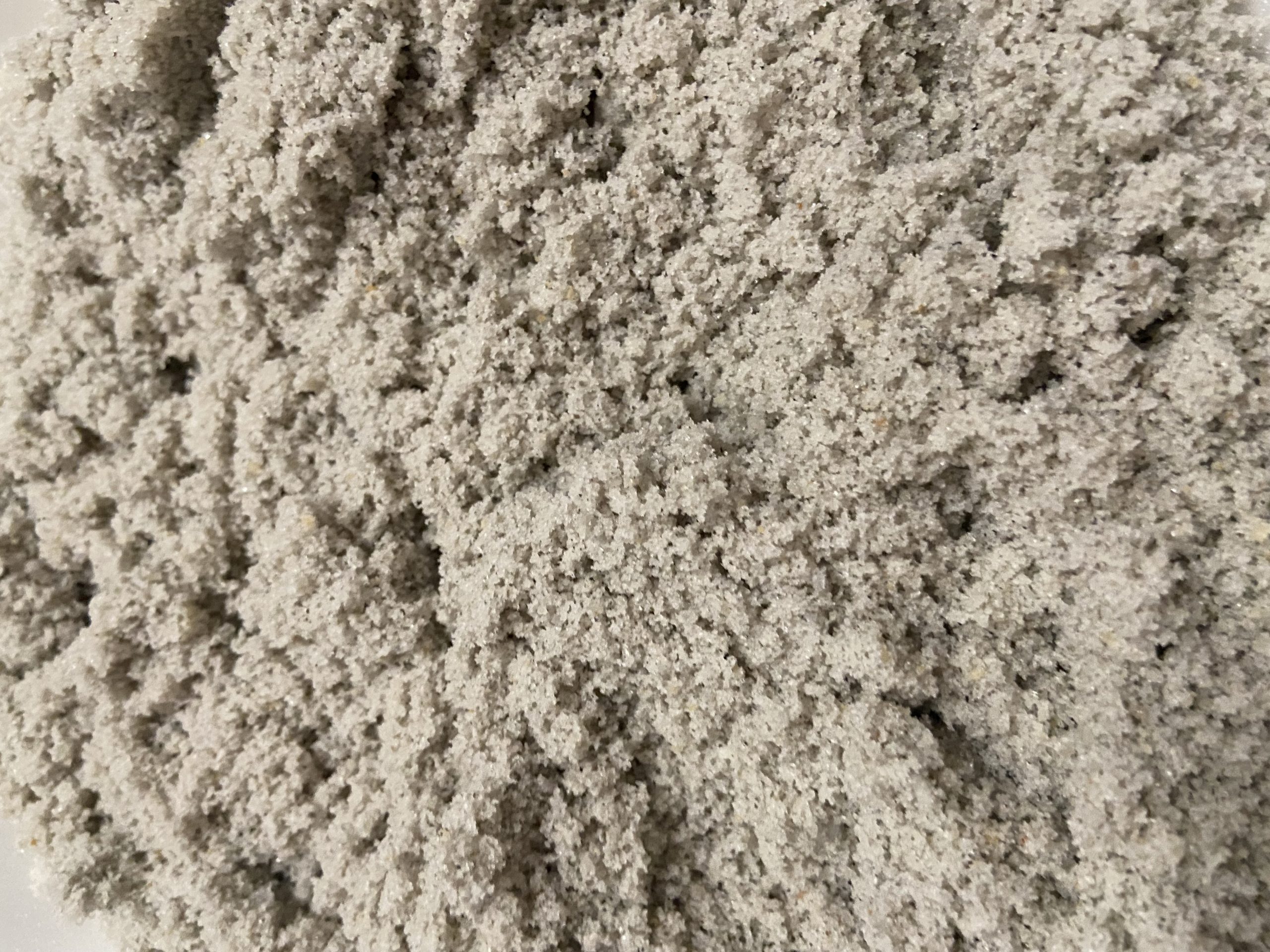
The Tennessee White Bunker Sand Lab Report

Here is the particle size analysis for Tennessee White Bunker Sand. Each percentage is the share of the sample by weight in that size class.
| Size class | Particle diameter | Tennessee White | Practical meaning |
|---|---|---|---|
| Gravel | over 2.0 mm | 0.1% | Essentially no stones to chip clubs or reach greens |
| Very coarse sand | 1.0 to 2.0 mm | 2.1% | Small, controlled top end |
| Coarse sand | 0.5 to 1.0 mm | 22.8% | Strong structural fraction; firmness and wind resistance |
| Medium sand | 0.25 to 0.5 mm | 50.7% | Core playing and drainage fraction |
| Fine sand | 0.15 to 0.25 mm | 22.3% | Fills voids and firms the surface |
| Very fine sand | 0.05 to 0.15 mm | 1.7% | Low; limited sealing potential |
| Silt | 0.002 to 0.05 mm | 0.2% | Very low crusting potential |
| Clay | under 0.002 mm | 0.1% | Very low staining and binding potential |
Total sand content is 99.6%. The combined coarse and medium fraction, the range from 0.25 to 1.0 mm that bunker sand guidance focuses on, is 73.5%, comfortably above the 65% minimum commonly used as a benchmark.
Two things jump out. First, the silt and clay numbers are tiny: three tenths of a percent combined. Second, the grading is broader than a medium-dominant sand. Instead of piling up in one size class, Tennessee White spreads across coarse, medium and fine sand in a roughly 23 / 51 / 22 pattern. Both of those facts shape how it plays and how it ages, and the next sections take them one at a time.
Very Low Fines: 0.2% Silt and 0.1% Clay
Silt and clay are the particles that turn a bunker from a sand hazard into a mud hazard. They wash down between grains, bind them together and dry into a crust. They also stain. On a white sand, staining is the problem everyone sees first: a little clay turns a bright bunker beige, then tan, and the whole point of buying white sand is lost.
Tennessee White Bunker Sand reports 0.2% silt and 0.1% clay. That is about as clean as bunker sand gets, and it pays off in several ways:
- Color holds longer. With almost no clay in the product, the sand starts bright and stays bright until outside contamination arrives.
- Minimal crusting. There is very little fine material to form a surface skin after rain, so the bunker plays the same the morning after a storm as it did the day before.
- Fast infiltration. Water moves down through the profile instead of hanging at the surface, which keeps bunker faces from washing and floors from puddling.
- Cleaner balls and shoes. Golfers notice when sand smears on a ball or sticks to their shoes. Low fines avoid both.
The other half of keeping fines low is delivery. A white sand dropped from a truck that hauled topsoil yesterday will show every speck of that soil. Jackson Sand runs its own fleet of roughly 14 trucks and keeps them clean specifically to prevent cross-contamination, which is a bigger deal for white sand than for any other product the company sells.
A Broader Grading: 73.5% Coarse and Medium
Compared with a medium-dominant bunker sand, Tennessee White has a noticeably broader distribution. About half the sample is medium sand, with roughly equal shares of coarse and fine sand on either side.
What the coarse fraction contributes
At 22.8% coarse sand, Tennessee White has a strong structural component. Coarse grains resist displacement when a ball lands, help the ball sit up and resist wind erosion on exposed bunker faces. They also keep the pore network open for drainage even as fine grains fill some of the gaps.
What the fine fraction contributes
The 22.3% fine sand fills spaces between the larger grains. That increases grain-to-grain contact and firms the surface. A firmer surface reduces buried lies and fried-egg lies, which is one of the most common complaints about bunkers that look great but play soft.
Why the combination works
A spread of sizes packs more tightly than a uniform sand. Some packing is good: it creates a stable surface that holds a ball up. Too much packing is bad: it slows drainage and can turn the floor hard. Tennessee White keeps very fine sand at 1.7% and silt plus clay at 0.3%, so the material doing the packing is mostly true fine sand, not the dust-sized particles that seal pores. The result is a sand that should be firmer than a uniform medium sand while still draining freely.
The top end is also controlled. With 2.1% very coarse and 0.1% gravel, there is little material large enough to feel stony, scratch clubs or scatter onto greens.
The lab report quoted here does not list D85 or a uniformity coefficient for Tennessee White. If your architect’s spec calls for either value, ask Jackson Sand for the complete current report so the numbers come straight from the lab.

Aesthetics vs. Playability: Getting Both

The pitch for white sand is visual. The questions to ask are practical. Here is how the two sides balance out.
What white sand does well visually
- Definition. Bright bunkers outline greens and fairways, which helps golfers read the hole and judge distance.
- Contrast with Tennessee turf. Against deep green bermudagrass or bentgrass, white sand gives the property a crisp, premium appearance in photos and in person.
- Perceived quality. For clubs competing for members, events or weddings, presentation affects how the whole course is judged.
Where white sand asks more of you
- Glare. On bright summer afternoons, very white sand reflects a lot of light. Most golfers adjust quickly, but it is worth seeing a white bunker in full sun before committing.
- Visible imperfections. Footprints, rake lines, clippings, leaves and washouts all show more clearly against white.
- Contamination shows immediately. Soil from a washed-out face or a careless cart path repair stands out on white sand in a way it never would on a natural-toned sand.
- Color matching. Once some bunkers are white, mixing white and natural sands across the course looks unfinished. Plan for a whole-course or hole-by-hole program.
Playability is not sacrificed
Nothing about color makes a sand play better or worse. Particle size, shape, fines and depth decide playability. Tennessee White’s lab numbers describe a clean, well-graded sand with a strong coarse and medium core, so the visual upgrade does not come at the cost of drainage or lie quality. The trade-off is maintenance effort, not playing quality.
How Tennessee White Plays: Lies, Firmness and Fried Eggs
Golfers judge bunkers on three things: whether the ball plugs, whether the sand feels consistent, and whether they can get out with a normal swing.
Buried and fried-egg lies
A fried-egg lie happens when a ball lands in soft sand and settles into its own crater. The firmer the surface, the less often it happens. The industry measures firmness with a penetrometer, which records how much force it takes to push a probe into the sand. Lower readings mean softer sand and more plugged balls; higher readings mean a firmer surface that holds the ball up. A sand’s penetrometer value depends heavily on particle shape and grading.
Tennessee White’s broader grading, with substantial coarse and fine fractions around a medium core, is the kind of distribution that tends to produce a firmer surface than a narrowly graded sand. The actual value should come from a lab test, so ask for the penetrometer and particle shape ratings if they are part of your spec.
Consistency
Very low fines mean little crusting, so the surface feel does not change much from wet days to dry days. That consistency matters more than any single number. Golfers adapt to firm or soft bunkers; they get frustrated when the same bunker plays differently from one day to the next.
Depth drives the feel
Even an ideal sand plays poorly at the wrong depth. Too deep and the ball buries; too shallow and the club bounces off the subgrade or liner. Keep at least 4 inches on floors, probe often, and move sand back up the faces after storms so the floors do not get overloaded.
Jackson Sand’s golf course sand page gives an overview of how bunker sand fits into the rest of a course’s sand program.
Maintenance: Keeping White Sand White
White sand does not get dirtier faster than natural sand; it just shows dirt sooner. A maintenance plan built around that fact keeps the investment looking new.
- Control the surrounds. Most contamination comes from outside the bunker. Keep turf edges tight, prevent soil from washing in off steep surrounds, and fix drainage on slopes that shed water into the bunker. Jackson Sand’s guide to surface water drainage and slope covers the grading side; turf slopes should generally have at least 2% fall to move water.
- Repair washouts quickly. After heavy rain, push sand back up faces before golfers walk through and mix the washed-down sand with the subsoil.
- Clean up edging debris. Edging is when turf clippings and soil most often end up in the sand. Rake them out the same day.
- Watch the leaves. Hardwoods around many West Tennessee courses drop a lot of leaves in fall. Blow bunkers out frequently so leaves do not break down and stain the sand.
- Use clean equipment. Mechanical rakes and utility vehicles that have been in the dirt carry it into the bunker.
- Test the sand periodically. Bunker sand acts as a filter. In one documented case, infiltration dropped from 24 to 12 inches per hour in three years as organic matter climbed from 0.3% to about 1%. Periodic testing tells you when contamination is changing how the bunker drains.
When it is time to top up, use the same Tennessee White product. Adding a different sand changes color and grading, and the mismatch will be obvious.
Installing Tennessee White Bunker Sand

White sand rewards a careful installation more than any other bunker sand, because every mistake is visible.
Prepare the bunker first
Finish shaping, drainage and any liner work before the sand arrives. Drain lines should sit in clean gravel at the bunker’s low points and connect to an outlet that actually flows. If the old sand is coming out, remove it completely. Even a thin layer of old, contaminated sand under new white sand can wick up fines and color the new material.
Calculate the quantity
Length times width times depth in feet, divided by 27, gives cubic yards. A 2,500 square foot bunker at 4 inches deep needs about 31 cubic yards before allowing for faces and irregular shapes. Use Jackson Sand’s yardage calculator to check your numbers.
Keep it clean on the way in
Stage deliveries on a clean surface or straight into the bunker, not on bare soil. Keep loader buckets clean, and avoid tracking through mud between the stockpile and the bunker. This is where clean, dedicated trucks matter: the sand should arrive exactly as it left the yard.
Place, settle and probe
Spread from the floor up with low-pressure equipment, keep wheels off liners and drain lines, and let the sand settle with irrigation or a good rain. Then probe for a minimum of 4 inches on floors and fix any thin spots before opening the bunker.
Is Tennessee White Right for Your Course?
Tennessee White Bunker Sand is a strong fit when several of these are true:
- Presentation is a priority, whether for members, events, tournaments or photography.
- The maintenance staff has the time to edge, blow out and repair washouts promptly.
- Bunker surrounds drain away from the sand, or the renovation will fix them.
- You want a firm, well-graded surface with very low fines.
- You can convert all bunkers, or a clearly defined set of holes, so color stays consistent.
Regular Bunker Sand may be the better choice when:
- Labor is tight and you would rather not have every footprint and leaf on display.
- Surrounds are steep and wash frequently, and fixing them is not in the budget yet.
- You are topping up existing natural-toned bunkers and do not want a color mismatch.
- You prefer a more uniform, medium-dominant sand.
Neither choice is wrong. Both sands test clean and both have the bulk of their particles in the range that bunker guidance recommends. The decision usually comes down to the look you want and the maintenance budget you have. Compare both reports on the bunker sand page, and ask Jackson Sand for current pricing on each so you can weigh the full cost.
Order Tennessee White Bunker Sand from Jackson Sand
Jackson Sand mixes its products on its own premises at 139 United Dr. in Jackson, Tennessee and delivers in its own trucks, which keeps the sand clean from the yard to your bunker. For a white sand, that is the difference between a bunker that looks right on day one and one that shows somebody else’s topsoil.
When you call, it helps to have:
- Bunker count and approximate square footage, or your cubic yard total.
- Whether you are converting all bunkers or a phase of holes.
- Your architect’s spec, including any D85, uniformity or penetrometer requirements, so the team can send the matching lab data.
- Delivery access details and any staging limits on the property.
Jackson Sand has made golf-course-grade sand since the late 1990s and hauls it as far as Huntsville, Alabama, Jackson, Mississippi, Little Rock, Owensboro, Kentucky and Tullahoma, Tennessee. Whether you run a course in Jackson, elsewhere in West Tennessee or across the Mid-South, call 731-668-0440 or use the contact page to request the current Tennessee White lab report and a quote.
Inside the Jackson Sand Plant
Take a 90-second look at where our sand comes from: the washing plant, screens and conveyors, and the Jackson Sand truck fleet that delivers every load. President Carlton Pope tells the story of how the company grew from one truck in 1996.
Sources and Further Reading
- sand color doesn't influence bunker playing quality (USGA)
- why bunker sand is never the same (USGA Green Section Record)
- algae in bunkers: why it shows up and how to fix it (USGA Green Section Record)
- USGA guide to selecting the right bunker sand (USGA Green Section Record)
Frequently Asked Questions
What makes Tennessee White Bunker Sand different from regular bunker sand?
The obvious difference is color: it is a bright white sand chosen for visual impact. Its grading is also broader, with 22.8% coarse, 50.7% medium and 22.3% fine sand, versus a more medium-dominant regular sand. It tests very clean at 0.2% silt and 0.1% clay, which helps it stay bright and drain quickly.
Does white bunker sand meet bunker sand guidelines?
Tennessee White's lab report shows 73.5% of particles in the coarse and medium range between 0.25 and 1.0 mm, above the 65% minimum commonly used as a bunker sand benchmark. It is 99.6% sand with very low silt and clay. For a formal spec, ask Jackson Sand for the complete current report.
Will white bunker sand stain or turn brown?
The sand itself contains very little clay, so it starts bright. Discoloration usually comes from outside: soil washing in from surrounds, decomposing leaves and clippings, or contaminated equipment. Prompt washout repair, clean edging and regular blowing out of leaves keep white sand looking white for years.
Is white sand harder to maintain than natural-colored sand?
It is not more work to rake, but it shows imperfections and contamination more clearly, so crews tend to spend more time on edging cleanup, leaf removal and washout repair. Courses with good surround drainage and adequate staff find the extra effort manageable.
Does white sand cause glare for golfers?
Bright white sand reflects more light than natural-toned sand, and on sunny afternoons that can be noticeable. Most golfers adjust quickly, and many courses consider the visual definition worth it. Look at a white bunker in full sun before converting the whole course.
Can I put Tennessee White on top of my old bunker sand?
It is better to remove contaminated old sand first. A layer of old sand underneath can hold fines that migrate upward and dull the new white surface, and two sands with different gradings may drain at different rates. Install at least 4 inches of settled depth on bunker floors.
Ready to order or have a question about the right material? Call Jackson Sand at 731-668-0440 or send us a message and we will help you pick the right product and quantity.
Leave a Reply