
How Often Should Golf Courses Apply Top Dressing Sand? Your 8-Point Guide
Quick answer: Most golf courses should apply top dressing sand to greens at least 6 to 12 times per year, with light applications every 2 to 4 weeks during the active growing season. High-traffic or heavily thatched greens may need more frequent passes. Tees and fairways typically receive 2 to 4 applications annually. The right schedule depends on grass species, thatch depth, soil compaction, play volume, and climate — factors that vary considerably across West Tennessee and the broader Mid-South region. Using the correct particle-size sand and consistent timing is just as important as frequency.
1. What Is Top Dressing Sand and Why Does It Matter?
Before diving into frequency, it helps to understand exactly what top dressing sand does at the soil level. Top dressing is one of the oldest and most effective cultural practices in golf course agronomy, yet it’s also one of the most misunderstood — especially when it comes to how often it should be done and how much sand to apply each time.
The Basic Mechanics of Top Dressing
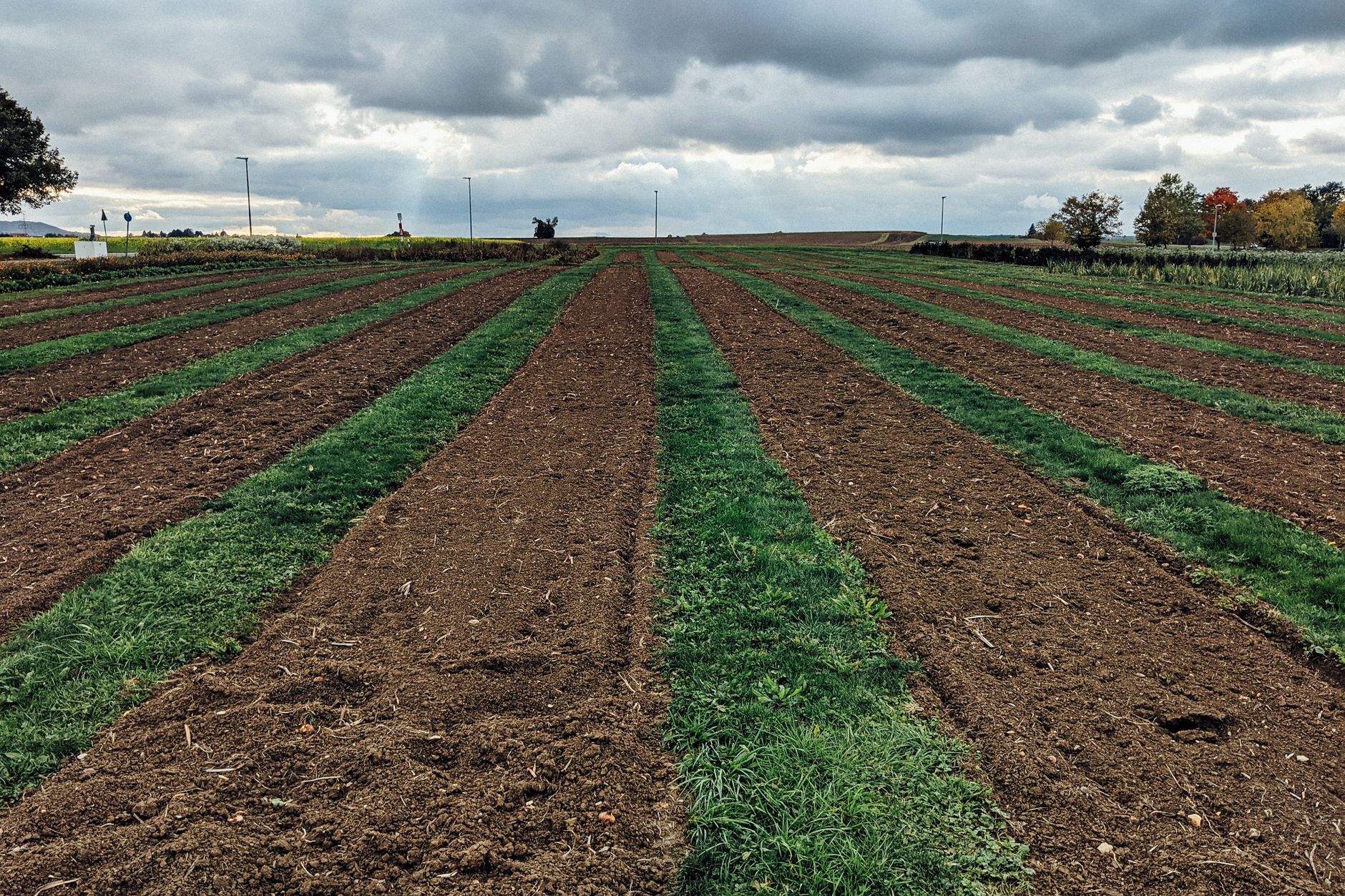
Top dressing is the practice of spreading a thin, uniform layer of sand — typically 1/8 to 1/4 inch — across a turf surface and then working it down into the canopy with a drag mat, brush, or irrigation. The sand filters through the grass blades and settles into the thatch layer and soil profile below.
Done consistently, this process dilutes organic matter, smooths surface irregularities, and creates a firmer, truer putting surface. It also reduces the spongy feel that players complain about after heavy rain — a common issue on Mid-South courses during spring and early summer.
Why Particle Size Is Non-Negotiable
Not all sand is created equal. Using the wrong particle size — one that doesn’t match the existing soil profile — can actually create a layering problem that impedes drainage rather than improving it. The USGA recommends a specific particle-size distribution for greens construction and topdressing, with medium sand (0.25–0.5 mm) making up the bulk of the blend.
Jackson Sand publishes lab-tested spec sheets for every product they supply. Before committing to a top dressing program, superintendents should review the sand specs to confirm the material matches their existing root-zone mix. Mismatched layers are one of the most common — and most expensive — mistakes in turf management.
2. The Standard Frequency Benchmarks for Golf Greens
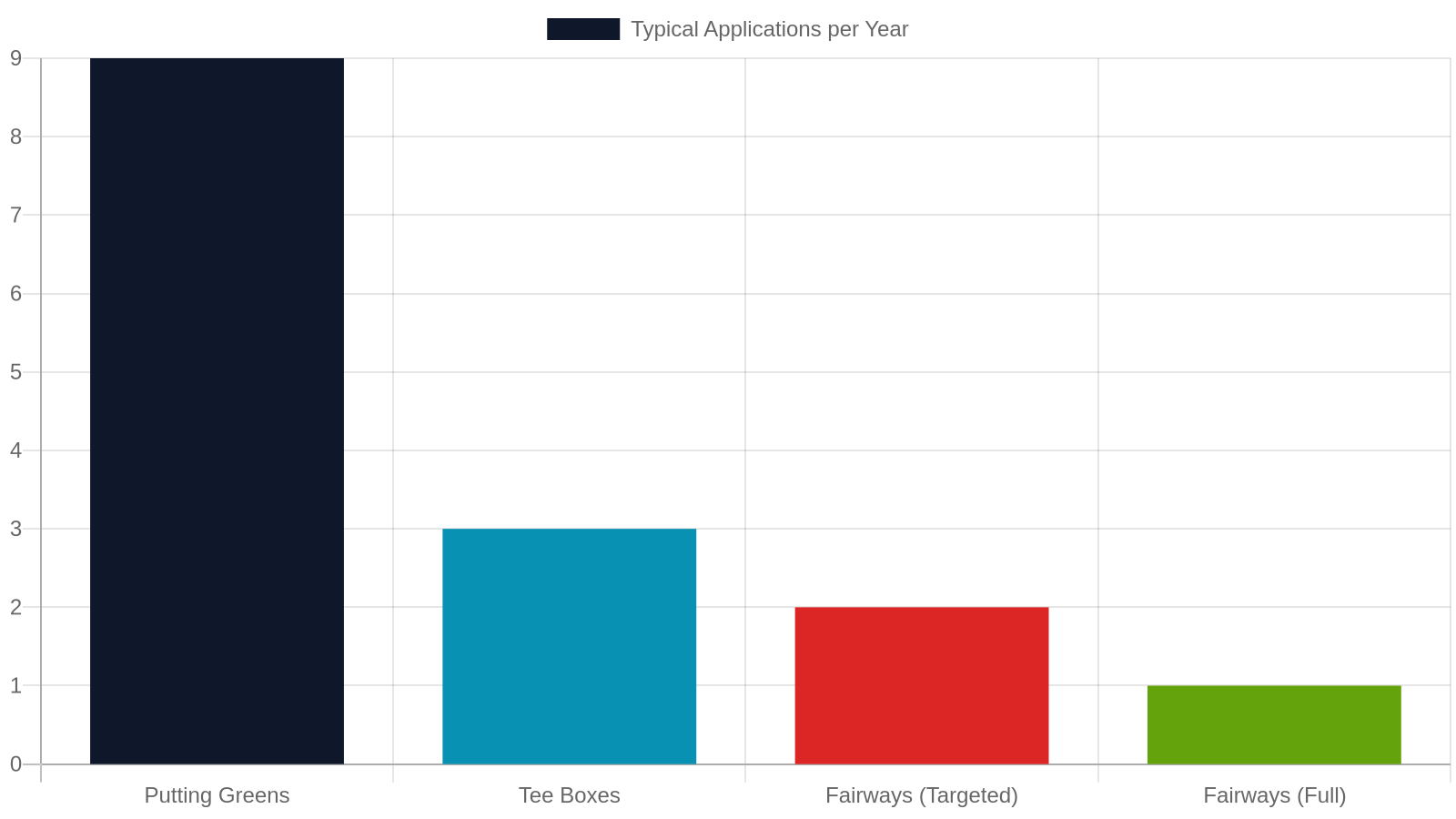
Industry guidelines from the Golf Course Superintendents Association of America (GCSAA) and the USGA Green Section suggest that most 18-hole courses should plan for a minimum of 6 applications per year on greens, with high-performance courses applying sand as often as every 14 days during peak growing periods. The exact number depends on your specific conditions, but these benchmarks give a useful starting point.
Light, Frequent Applications vs. Heavy, Infrequent Ones
Research from turfgrass universities and USGA agronomists consistently supports a light-and-frequent approach over heavy-and-infrequent. Applying 1/8 inch of sand every two to four weeks during the growing season is far less disruptive to play than dumping 1/2 inch twice a year. Light applications are incorporated within a few days; heavy ones can take weeks and anger golfers in the meantime.
A practical rule of thumb: aim for 12 to 18 cubic feet of sand per 1,000 square feet of green surface per year, spread across as many individual applications as your schedule allows.
Seasonal Breakdown for Mid-South Climates
In West Tennessee and the broader Mid-South, the growing season for warm-season grasses (bermudagrass, zoysia) typically runs from late April through October. That gives superintendents roughly 26 active weeks to work with. A typical schedule might look like this:
- April–May: 2 applications as turf breaks dormancy and begins rapid growth
- June–August: 1 application every 2–3 weeks (peak thatch production)
- September–October: 2 applications before dormancy, with the final one timed at least 4 weeks before first frost
That adds up to roughly 8 to 12 applications per year on greens — consistent with national benchmarks for high-quality bermudagrass putting surfaces.
3. Tees and Fairways: A Different Schedule Entirely

Greens get the most attention in any top dressing conversation, but tees and fairways also benefit from periodic sand applications. The frequency and volume differ significantly from greens, however, because the agronomic goals and traffic patterns are different. Understanding those differences helps superintendents allocate their sand budget more effectively.
Top Dressing Tee Boxes
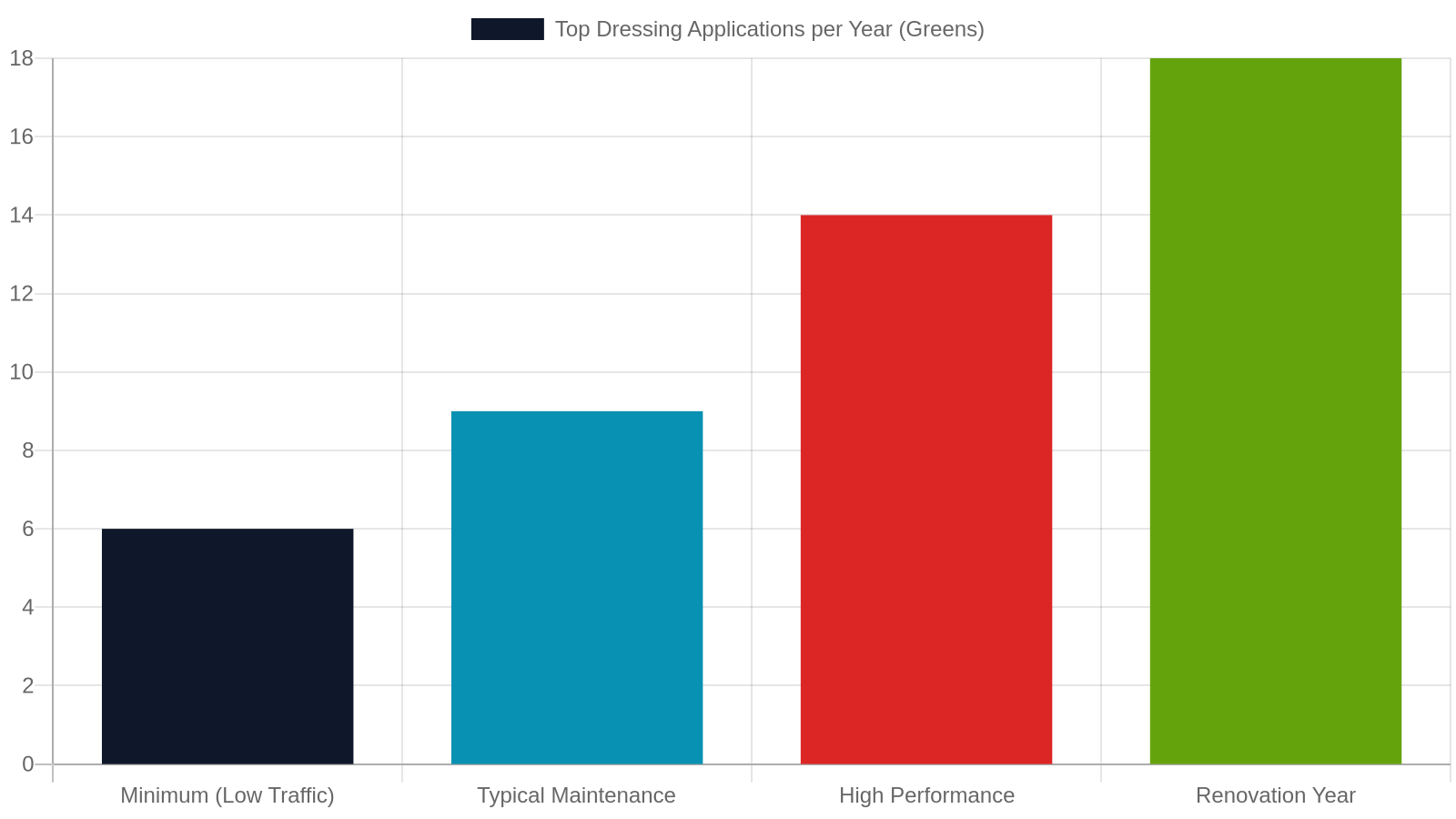
Tee boxes take a beating from divots and foot traffic, but they don’t require the same frequency as greens. Most courses apply top dressing sand to tees 2 to 4 times per year, with applications timed around aerification events. A light sand application immediately after aerification helps fill the holes and smooth the surface faster, getting the tee back in play sooner.
High-use tee boxes — particularly par-3 tees where every player hits from the same general area — may benefit from an additional mid-season application to level out wear patterns.
Fairway Top Dressing: Less Frequent, Higher Volume
Fairway top dressing is a significant logistical undertaking. A typical 18-hole course has 30 to 50 acres of fairway, and covering that area with even 1/8 inch of sand requires a substantial amount of material. As a result, most courses limit fairway top dressing to 1 to 2 times per year, usually in conjunction with core aerification in spring and/or fall.
Some courses skip fairway top dressing entirely and focus their sand budget on greens, where the payoff in surface quality is most visible to players. Others use a targeted approach, top dressing only the highest-traffic areas — landing zones and approaches — rather than entire fairways.
4. Key Factors That Adjust Your Top Dressing Schedule
No single schedule fits every course. The right top dressing frequency for a bermudagrass course in Jackson, TN may be very different from what works at a bentgrass course in a cooler climate. Several site-specific factors should push your schedule earlier, later, or more frequent than the baseline benchmarks.
Thatch Depth
Thatch — the layer of dead and living organic matter between the grass blades and the soil — is the primary driver of top dressing frequency. A thatch layer greater than 1/2 inch on bermudagrass greens is generally considered problematic. It causes soft, spongy surfaces, promotes disease, and holds excess moisture.
If your greens are running above that threshold, you need to increase top dressing frequency until the organic matter percentage in the top inch of the profile drops below 3–4%. Annual testing of thatch depth and organic matter content gives you the data to make those decisions objectively rather than by feel.
Play Volume and Foot Traffic
A course running 50,000 rounds per year needs a more aggressive top dressing program than one running 15,000. Heavy play compacts the surface, disrupts the turf canopy, and accelerates thatch accumulation. If your course is busy — particularly during West Tennessee’s spring and fall peak seasons — plan for applications at the shorter end of the 2-to-4-week range.
Grass Species and Growth Rate
Bermudagrass produces organic matter faster than almost any other warm-season grass, which is why bermuda greens typically require more frequent top dressing than bentgrass greens in cooler climates. Ultradwarf bermuda varieties (TifEagle, MiniVerde, Latitude 36) are particularly aggressive producers of thatch and may need top dressing every 10 to 14 days during peak summer growth.
Zoysia, which is common on some Mid-South fairways and tees, produces thatch more slowly and can tolerate a less aggressive schedule.
5. Timing Top Dressing Around Aerification

Aerification events are the most important anchors in any top dressing calendar. Most courses aerify greens at least twice a year — once in spring (April–May in West Tennessee) and once in fall (September–October). Each aerification event should be immediately followed by a substantial top dressing application. The rest of the annual schedule fills in around those two anchor points.
Why Aerification and Top Dressing Go Together
Core aerification — pulling 1/2- to 3/4-inch plugs from the green — creates open channels that sand can fill directly. Applying top dressing immediately after aerification (within 24 to 48 hours) is one of the most efficient uses of sand because the material drops straight into the holes rather than sitting on the surface waiting to be incorporated.
A typical post-aerification top dressing rate is 2 to 4 times the normal application rate — sometimes as much as 1/2 inch of sand — because the open holes can accept a much larger volume without smothering the turf.
Scheduling Around Player Expectations
The biggest complaint golfers have about top dressing is the disruption to putting quality. Sand sitting on the surface creates grainy, inconsistent ball roll. Timing applications to give the sand 48 to 72 hours to incorporate before a busy weekend is a basic courtesy — and a smart operational decision.
Many West Tennessee courses schedule their heavier top dressing events on Monday or Tuesday mornings, when play volume is lowest, and use irrigation and drag mats to speed incorporation before the weekend rush. Light applications during the growing season are less disruptive and can often be done mid-week without significant player complaints.
6. How Much Sand Per Application? Getting the Volume Right

One of the most common mistakes in top dressing programs is inconsistent application rates — going heavy one time and light the next, or eyeballing the depth rather than measuring it. Consistent, measured applications are what produce the smooth, firm surfaces that players and tournament committees expect. Here’s how to get the numbers right.
Standard Application Rates by Surface Type
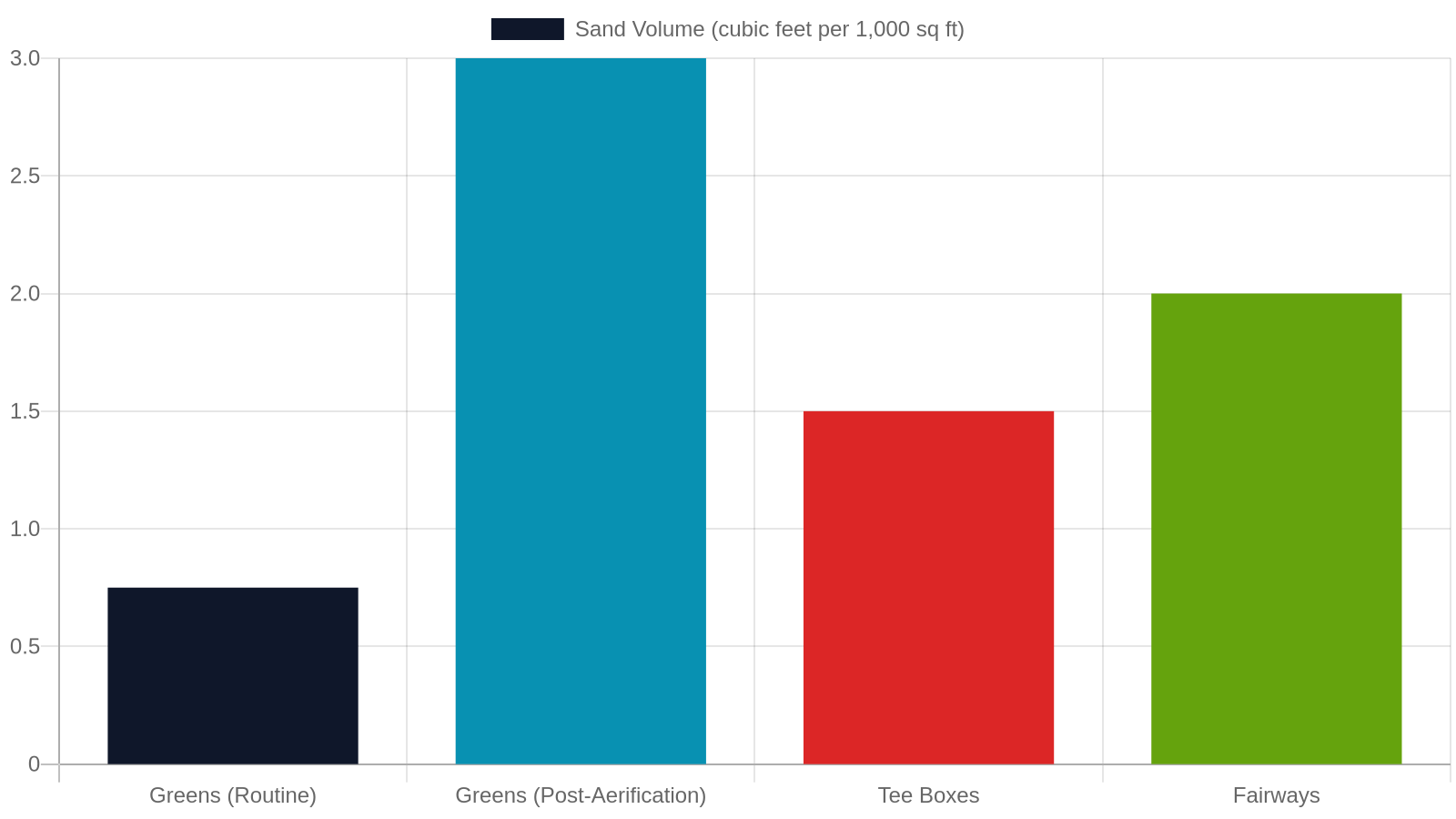
The volume of sand per application matters as much as the frequency. Too little and you’re not making meaningful progress on thatch dilution. Too much and you smother the turf, block sunlight, and create a sandy mess that takes weeks to incorporate. Here are standard application rates by surface:
- Putting greens (routine): 0.5–1.0 cubic foot per 1,000 sq ft (roughly 1/16 to 1/8 inch depth)
- Putting greens (post-aerification): 2–4 cubic feet per 1,000 sq ft
- Tee boxes: 1–2 cubic feet per 1,000 sq ft
- Fairways: 1–3 cubic feet per 1,000 sq ft
Calculating Total Yardage for Your Course
Before ordering sand, you need an accurate square footage for each area you’re treating. A standard 18-hole course has roughly 50,000 to 90,000 square feet of putting green surface, 20,000 to 40,000 square feet of tee boxes, and 30 to 50 acres of fairway. The math adds up quickly.
Jackson Sand offers a free yardage calculator on their website that lets you plug in your square footage and target depth to get an accurate cubic-yard figure before you place an order. Using it takes the guesswork out of ordering and helps you avoid both shortfalls and costly overages.
7. Choosing the Right Sand: Specs, Sourcing, and Consistency
Frequency and volume mean nothing if the sand itself is wrong. Using a sand that doesn’t match your existing profile — or that varies in particle size from load to load — can undermine years of careful top dressing work. This is where supplier selection becomes a strategic decision, not just a price comparison.
Why Consistency Between Batches Matters
If you switch sand suppliers mid-season — or even mid-program — you risk introducing a different particle-size distribution into the profile. Over time, inconsistent sand creates distinct layers in the soil that impede water movement and root development. This is called layering, and it’s one of the hardest problems to correct after the fact.
The safest approach is to source all of your top dressing sand from a single supplier who mixes their product consistently and can provide documentation. Jackson Sand mixes sand on their own premises in Jackson, TN, which means every load comes from the same controlled blend — not a quarry stockpile that varies from week to week.
Lab Testing and USGA Compliance
For greens that were built to USGA specifications, the top dressing sand should match the root-zone mix as closely as possible. That means reviewing a particle-size analysis — sometimes called a sieve analysis — before purchasing. Key parameters include:
- Medium sand fraction (0.25–0.5 mm): should dominate the blend
- Very coarse and coarse fractions: should be minimal
- Fine and very fine fractions: should be below 10% to avoid drainage problems
Jackson Sand’s published sand spec sheets include particle-size data so superintendents can verify compliance before ordering rather than after delivery.
Top Dressing Program Comparison at a Glance
Use this table to compare top dressing approaches by program intensity, frequency, and typical outcomes. Most West Tennessee bermudagrass courses fall in the 'Standard' or 'High Performance' range.
8. Building a Full-Season Top Dressing Calendar

Having a written calendar — not just a mental plan — is what separates reactive maintenance from a proactive turf management program. A documented schedule lets you order sand in advance, coordinate with your crew, and communicate with club management about upcoming disruptions. Here’s how to build one that works for the Mid-South climate.
A Sample 12-Month Schedule for West Tennessee Bermudagrass
Here’s a practical starting-point calendar for a bermudagrass course in the Jackson, TN area. Adjust based on your specific conditions, play volume, and budget:
- March: Pre-season scalp and cleanup; no top dressing until active growth begins
- April: First aerification of the year (greens); heavy top dressing immediately after (3–4 cu ft per 1,000 sq ft)
- May: Light top dressing on greens (1 cu ft per 1,000 sq ft); tee aerification and top dressing
- June: Top dress greens every 3 weeks
- July: Top dress greens every 2 weeks (peak thatch production)
- August: Top dress greens every 2–3 weeks; fairway top dressing if budget allows
- September: Second aerification (greens and tees); heavy top dressing post-aerification
- October: One final light application on greens before dormancy; fairway top dressing
- November–March: Dormant season; no top dressing on bermudagrass
Tracking and Adjusting Over Time
The best top dressing programs are data-driven. Keep a log of every application — date, rate, sand volume, and weather conditions. Pair that with quarterly organic matter tests and annual thatch depth measurements. If organic matter in the top inch is trending down toward 3%, your program is working. If it’s holding steady or rising, you need to increase frequency or volume.
Many superintendents also track stimpmeter readings before and after top dressing events to quantify the impact on green speed. A well-executed light application typically has minimal effect on speed within 48 hours of incorporation — a useful data point when communicating with club management about the program’s value.
9. Common Top Dressing Mistakes (and How to Avoid Them)
Even experienced superintendents fall into predictable traps with top dressing programs. Understanding the most common mistakes — and why they happen — makes it easier to avoid them and keep your program on track through a full season.
Applying Too Much Sand at Once
The most damaging mistake is applying too much sand in a single pass. A layer thicker than 1/4 inch on an established green can block photosynthesis, cause scalping when mowed, and take weeks to fully incorporate. If you’ve fallen behind on your schedule and feel the urge to catch up with a heavy application, resist it. It’s better to do two lighter applications two weeks apart than one heavy one.
Using Inconsistent or Unmatched Sand
As discussed in Section 7, layering from mismatched sand is a long-term problem. Don’t buy sand from a different supplier just because it’s slightly cheaper per ton if you can’t verify that the particle-size distribution matches your existing profile. The cost of correcting a layering problem — often requiring aggressive aerification and profile renovation — far exceeds any short-term savings.
Skipping Applications During Stressful Periods
Superintendents sometimes pause top dressing during heat stress events in July and August to avoid additional disruption. While this is understandable, it’s also when bermudagrass is producing the most organic matter. Skipping two or three applications during peak summer can undo months of progress on thatch dilution. Light applications — even lighter than normal — are almost always preferable to a complete pause.
10. Top Dressing Services vs. DIY: What's Right for Your Course?
Not every course has the equipment, staff, or budget to run an aggressive in-house top dressing program. Understanding your options — and what to look for in a supplier or service provider — helps you build the best program for your resources.
When to Bring in Outside Help
Smaller courses, municipal facilities, and schools with limited maintenance staff sometimes benefit from outsourcing top dressing applications rather than purchasing and maintaining their own equipment. A dedicated top dressing machine costs $15,000 to $40,000 new, and operating it correctly requires trained personnel.
If your course only top dresses 3 to 4 times per year, the math often favors contracting the work rather than owning the equipment. Suppliers and turf management companies in the Mid-South can provide both the sand and the application service as a bundled offering.
What to Look for in a Sand Supplier
Whether you’re applying the sand yourself or having it applied, the supplier relationship matters. Look for a supplier who:
- Mixes their own product on-site for consistency
- Provides lab-tested particle-size data with every product
- Owns their delivery trucks (not third-party haulers) to ensure load accuracy
- Can supply both small test orders and large seasonal volumes
- Has experience serving golf courses and understands the agronomic requirements
Jackson Sand checks every one of those boxes for courses across West Tennessee and the Mid-South. They mix sand on their own premises, deliver in their own trucks, and publish spec sheets for every product they offer.
Ready to Build Your Top Dressing Program? Start Here.
You now have the framework for a top dressing program that can improve surface firmness, reduce thatch, and produce the consistent putting surfaces your players expect. The next step is making sure you have the right sand, in the right quantity, delivered on a schedule that supports your calendar. Jackson Sand has been supplying West Tennessee golf courses and turf professionals with high-quality sand and aggregate for years — and they’re ready to support your program.
Order Sand That's Right for Your Greens
Jackson Sand supplies golf courses, athletic facilities, and contractors across West Tennessee and the Mid-South from their facility at 139 United Dr., Jackson, TN 38305. They mix their own sand on premises, deliver in their own trucks, and include delivery in their pricing — so what you order is what shows up, clean and accurate, every time.
To get started, explore the top dressing sand and services page on their website, or use the free yardage calculator to figure out exactly how much sand you need for your next application before you call.
Get in Touch with the Jackson Sand Team
Whether you’re planning a full-season program for an 18-hole course or just need a few yards of sand for a tee box repair, the team at Jackson Sand is ready to help. Call 731-668-0440 to talk through your project, request a spec sheet, or schedule a delivery. They serve large and small jobs alike, and they understand the agronomic demands that golf course superintendents in West Tennessee face throughout the season.
A consistent, well-timed top dressing program is one of the highest-return investments a golf course can make in surface quality. The sand is the foundation — make sure it’s the right one.
Frequently Asked Questions
How often should golf course greens be top dressed with sand?
Most golf courses should top dress greens 6 to 14 times per year, depending on grass species, thatch depth, and play volume. High-performance bermudagrass courses in warm climates like West Tennessee often apply sand every 2 to 3 weeks during the active growing season from April through October.
How much sand should be applied per top dressing application on a golf green?
A routine light application is typically 0.5 to 1.0 cubic foot of sand per 1,000 square feet of green surface, which equates to roughly 1/16 to 1/8 inch of depth. Post-aerification applications can be 2 to 4 times heavier because the open holes can accept more material without smothering the turf.
What type of sand is best for top dressing golf greens?
Medium-sized sand (0.25–0.5 mm particle diameter) that matches the existing root-zone profile is the standard recommendation. The USGA provides particle-size guidelines, and any sand used for top dressing should come with a lab-tested sieve analysis to confirm it meets those specifications.
Can you top dress a golf course during summer heat stress?
Yes, but keep applications light — no more than 1/16 to 1/8 inch — and time them for early morning to minimize stress on the turf. Skipping top dressing entirely during peak summer is tempting but counterproductive, since bermudagrass produces the most organic matter during July and August.
How do I calculate how much top dressing sand I need for my golf course?
Multiply your green square footage by the target depth in feet to get cubic feet, then divide by 27 to convert to cubic yards. For example, 70,000 sq ft of greens at 1/8 inch depth requires about 32 cubic yards. Jackson Sand's free yardage calculator at jacksonsand.com/yardage-calculator/ does this math for you automatically.
Does top dressing sand need to match the original root-zone mix?
Yes. Using sand with a different particle-size distribution than the existing profile creates a distinct layer in the soil that impedes drainage and root development — a problem called layering. Always verify the particle-size analysis of your top dressing sand against your root-zone profile before ordering.