
What Kind of Sand Do Golf Courses Use for Greens? Your 9-Point Guide
Quick answer: Golf courses use a specific washed, medium-fine silica sand for greens — typically conforming to USGA particle-size guidelines with 60–80% of particles falling between 0.25 mm and 0.5 mm. This sand is used in rootzone construction, top dressing, bunker fills, and aeration backfill. The goal is consistent drainage (ideally 6–12 inches per hour), firm playing surfaces, and a rootzone that resists compaction. In West Tennessee, Jackson Sand supplies lab-tested golf course sand mixed on premises and delivered in their own trucks to courses throughout the region.
1. Why the Type of Sand on a Golf Green Matters So Much
Ask any golf course superintendent what keeps them up at night, and the answer often comes back to greens health. Greens represent less than 2% of a typical course’s total acreage, yet they consume a disproportionate share of maintenance time, budget, and agronomic attention. The reason is simple: the sand underneath a green determines almost everything about how it performs and how long it lasts.
The Green Is the Most Demanding Surface in Turf Management
A putting green endures more foot traffic per square foot than almost any other managed turf surface. Golfers walk the same lines repeatedly, mowers roll over it daily, and tournament play can push traffic into the thousands of rounds per season. All of that compacts the soil beneath — unless the rootzone is engineered to resist it.
Sand is the backbone of that engineered rootzone. Unlike native soil, which compacts easily and drains poorly, a properly specified sand mix maintains pore space even under heavy use. Those pores allow oxygen to reach grass roots and let excess water drain away quickly, preventing the waterlogged conditions that kill bentgrass and bermudagrass greens.
Playability Starts Below the Surface
Superintendents talk about firmness, smoothness, and speed — the three qualities golfers judge a green by. All three trace back to what’s underneath the turf. A green built on the wrong sand can be too soft (slow, spongy, prone to ball marks), too hard (fast but brittle, prone to cracking), or inconsistently drained (patchy color, disease pockets).
- Firmness depends on particle shape and size distribution
- Smoothness depends on consistent top dressing with matching sand
- Speed depends partly on moisture content, which drainage controls
Getting the sand specification right from the start — and maintaining it consistently — is the single most important agronomic decision a golf course superintendent makes.
2. The USGA Greens Method: the Industry Standard Explained
When turf professionals say they want USGA sand, they’re referring to a particle-size distribution — not a brand name or a geographic source. The USGA greens construction method is the most widely adopted standard for high-performance putting surfaces in the world, and it sets precise requirements for every component of the rootzone, starting with the sand.
What the USGA Specification Actually Requires
The United States Golf Association published its greens construction method in 1960 and has refined it through several updates, most recently in 2018. The spec defines a rootzone mix — typically 80–85% sand by volume blended with 15–20% organic matter (usually peat) — built over a 4-inch gravel drainage blanket and a network of perforated drain pipes.
The critical particle-size requirements are:
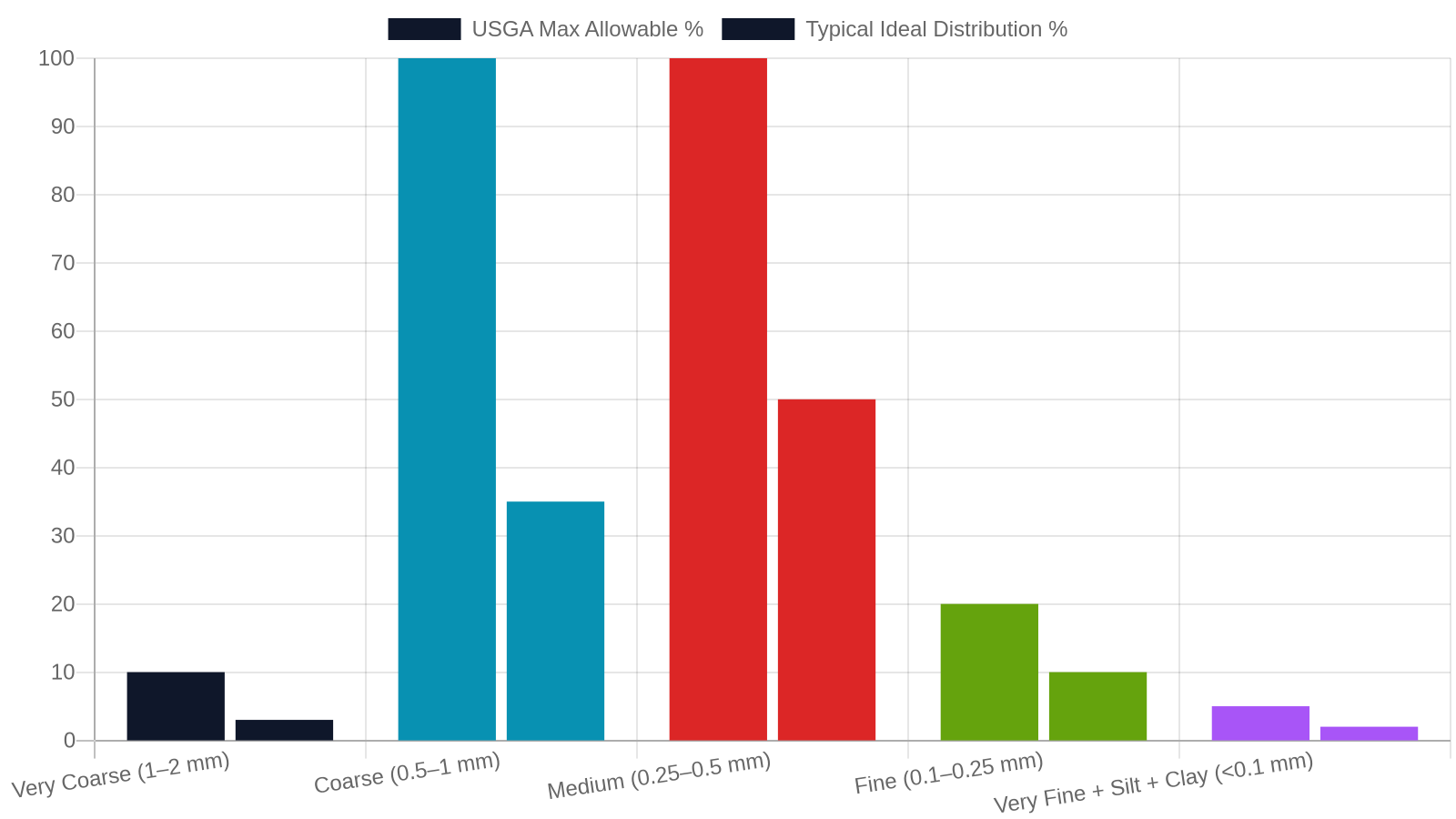
- Particle diameter: predominantly 0.25–1.0 mm (medium to coarse sand)
- Very coarse sand (1–2 mm): no more than 10%
- Fine sand (0.1–0.25 mm): no more than 20%
- Very fine, silt, and clay combined: no more than 5%
These thresholds exist to prevent layering problems and maintain hydraulic conductivity over time.
Hydraulic Conductivity: the Drainage Number That Matters
The USGA targets a saturated hydraulic conductivity of 6–24 inches per hour for the rootzone mix, with an ideal range of 12–18 in/hr. That means water should pass through the profile fast enough to drain a one-inch rain event in under ten minutes. By comparison, a native clay soil might drain at 0.01–0.1 in/hr — essentially waterproof by comparison.
Hydraulic conductivity is tested in a lab on the actual sand-and-peat mix before construction begins. This is why lab-tested sand specs are not optional — they are the only way to verify that the material you’re buying will actually perform to USGA standards once it’s in the ground.
The California Greens Method: a Practical Alternative
Not every course builds to full USGA spec. The California (or modified) method uses a shallower profile — often 12 inches of sand rootzone without the gravel blanket — and relies on native soil drainage supplemented by drain tile. It costs less to build but typically drains more slowly and requires more aggressive aeration to stay healthy. Sand specifications are similar, but the tolerance for fines is slightly higher. For renovation projects and budget-conscious builds in West Tennessee, this method is worth understanding alongside the full USGA approach.
3. Particle Size, Shape, and Mineralogy: What to Look for in a Spec Sheet
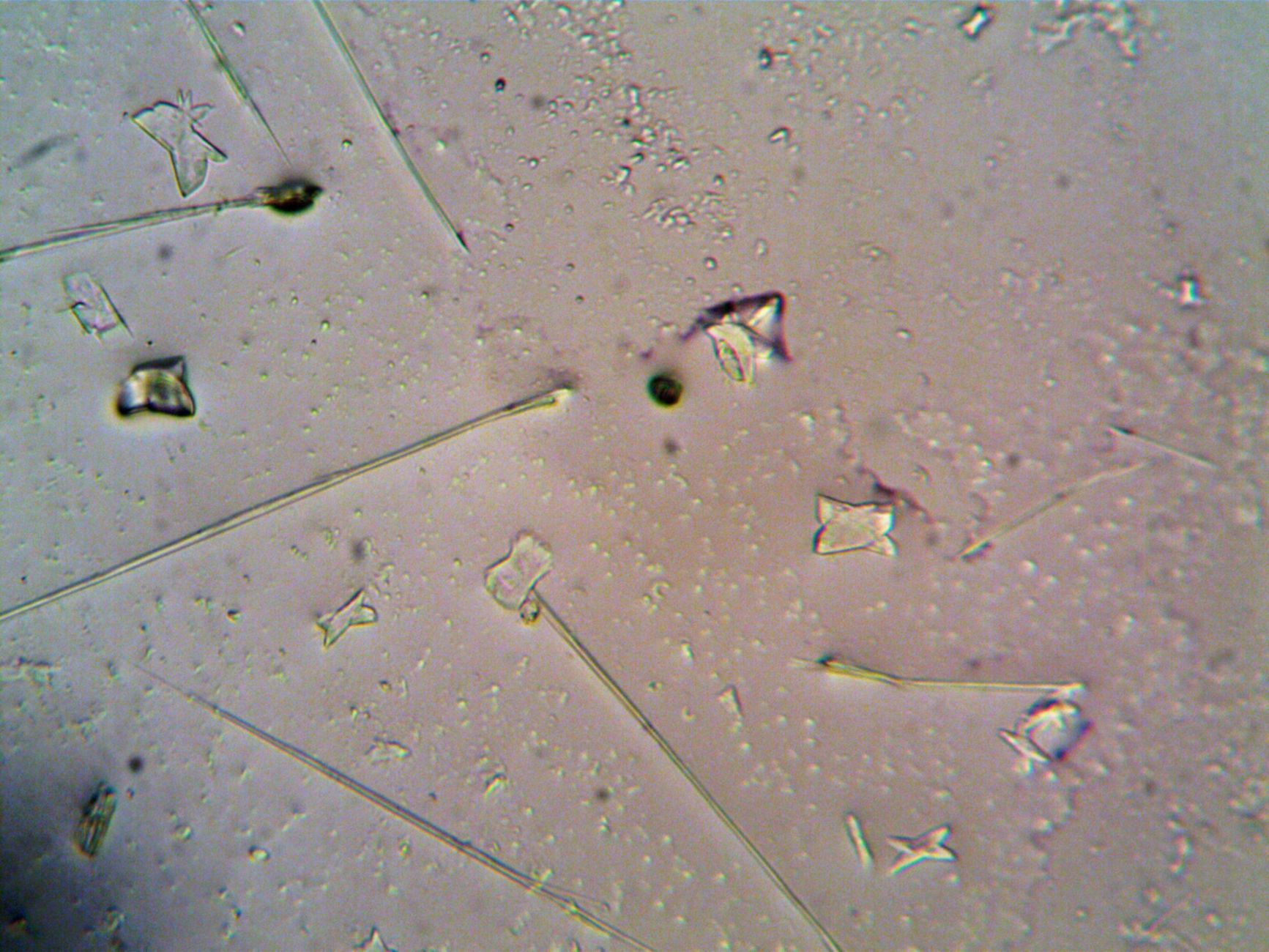
Two bags of sand can look identical to the naked eye and perform completely differently on a putting green. The difference lives in three properties that only a laboratory analysis can reveal: particle size distribution, particle shape, and mineralogy. Understanding how to read a spec sheet — and what numbers to demand from your supplier — separates a successful green renovation from an expensive mistake.
Why Particle Shape Is as Important as Size
Sand particles are described as angular, sub-angular, sub-rounded, or rounded. Angular particles interlock and resist movement — great for stability but potentially slow-draining if they pack too tightly. Rounded particles flow freely and drain well but can migrate under traffic and create inconsistent surfaces. Most agronomists recommend sub-angular to sub-rounded particles for golf greens: enough angularity to stay put, enough roundness to maintain pore space.
Particle shape is measured by a visual comparison chart in the lab and reported on the sand spec sheet. If a supplier can’t provide particle-shape data, that’s a red flag.
Silica Content and Why It Matters
The best golf course sands are high-silica (quartz) sands — typically 90–98% SiO₂ by weight. Silica is chemically inert, which means it won’t react with fertilizers, sulfur treatments, or soil amendments. It’s also hard (7 on the Mohs scale), so particles resist breakdown under mower traffic and aeration equipment. Sands with significant feldspar, limestone, or shell content break down faster, generating fines that clog pores and reduce drainage over time.
Always ask for the mineralogy report alongside the particle-size analysis. The two together tell the full story of how a sand will perform over a 20–30 year green life.
Reading a Sand Spec Sheet: the Key Numbers
A complete sand spec sheet for golf course use should include:
- Particle-size distribution (sieve analysis, % retained per fraction)
- Uniformity coefficient (Cu): ideally 2.0–2.5; lower means more uniform
- Particle shape (visual rating)
- Mineralogy (% silica)
- Organic matter content (should be near zero for raw sand)
- Saturated hydraulic conductivity of the proposed rootzone mix
Jackson Sand publishes lab-tested spec sheets for their golf course products — you can review the sand specs page before placing an order to confirm the material meets your course’s requirements.
4. Bunker Sand: a Different Spec for a Different Job
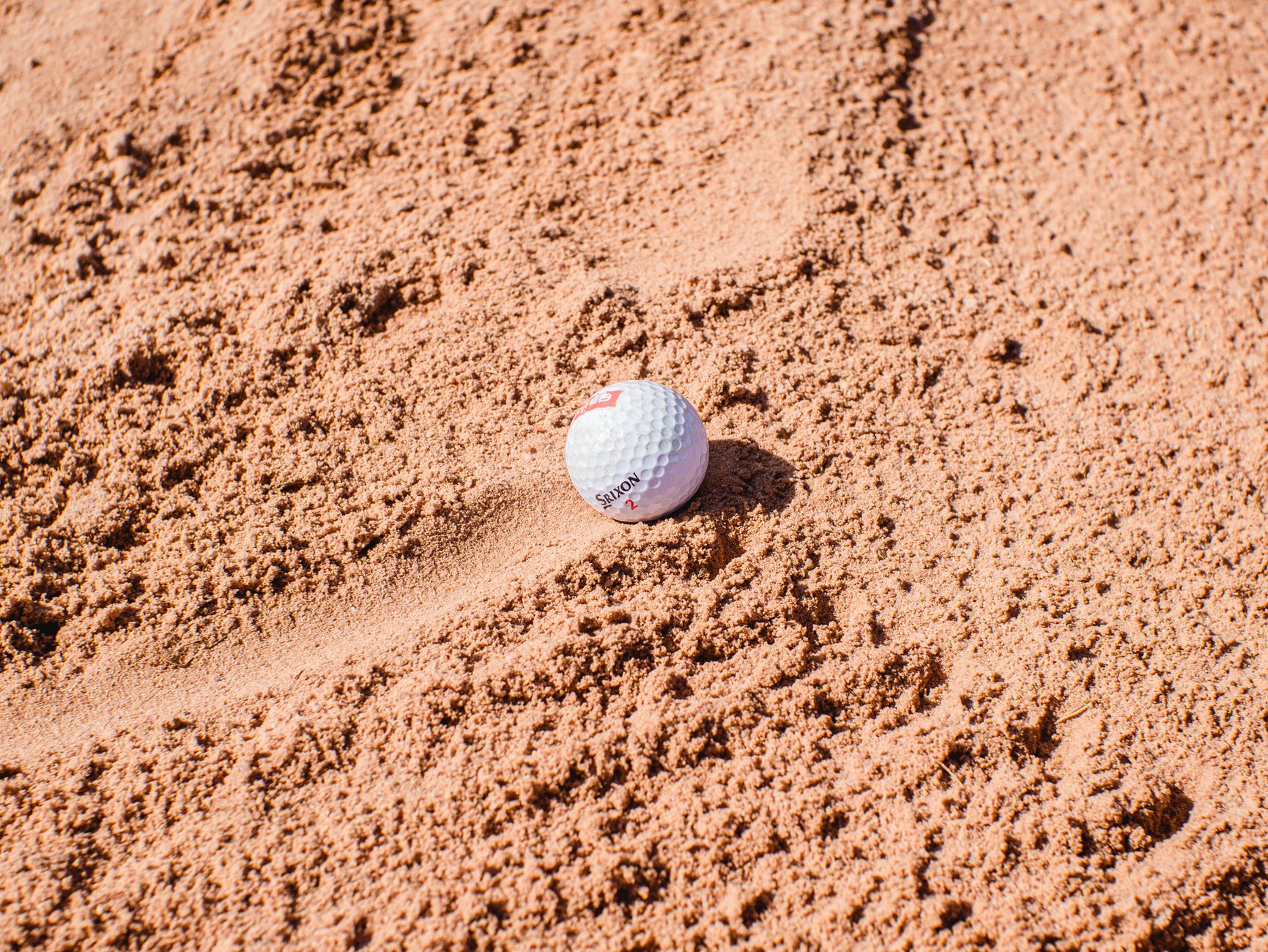
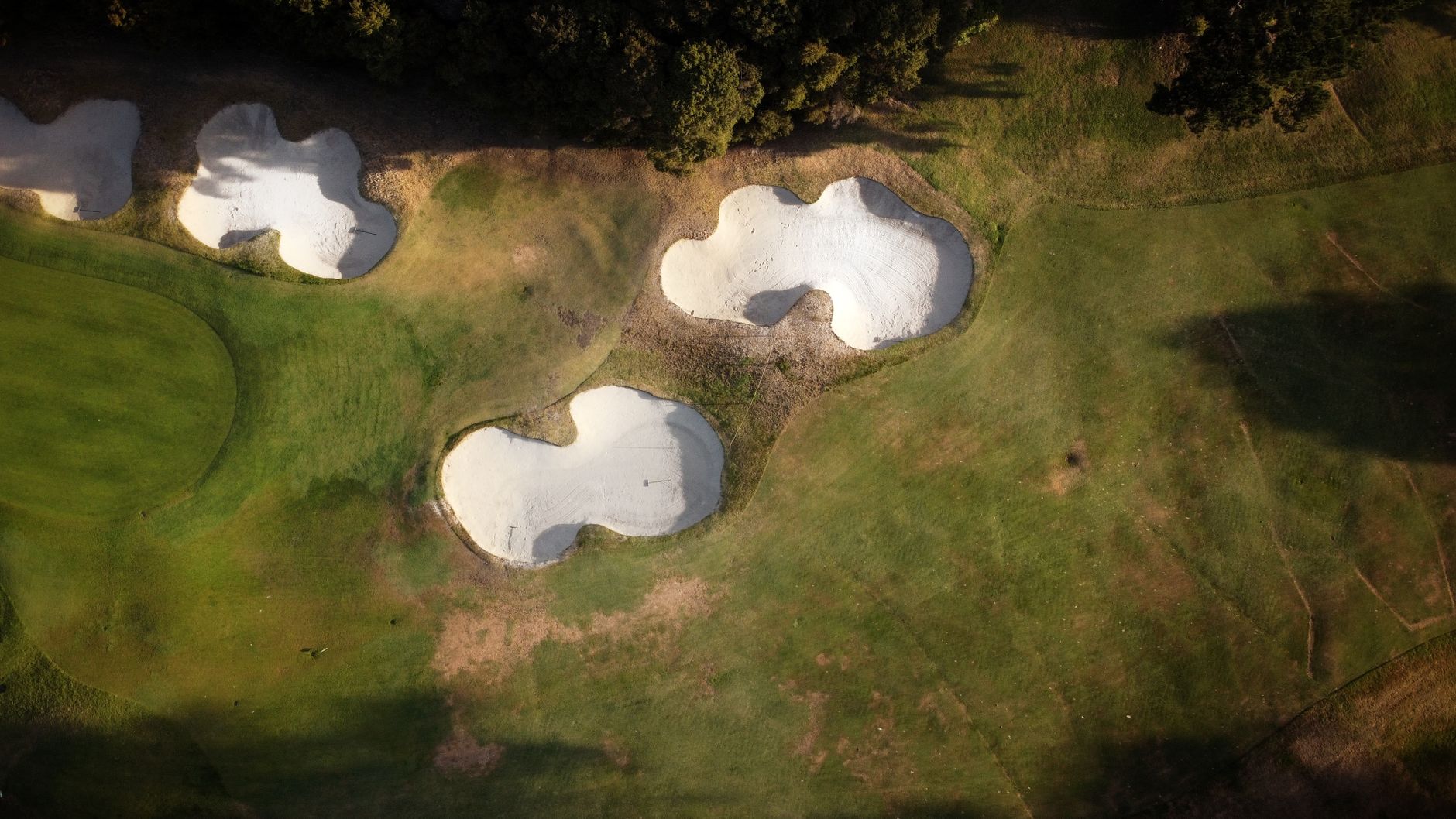
Bunkers serve two purposes: they penalize errant shots and they define the visual character of a hole. But they’re also among the most expensive features on a course to maintain. Sand migration, contamination, and poor drainage cost courses thousands of dollars per year in labor and materials. Choosing the right bunker sand specification upfront is one of the highest-ROI decisions a superintendent makes.
What Makes Bunker Sand Unique
Bunker sand is not the same as rootzone sand, and using the wrong product in a bunker creates immediate playability and maintenance problems. Bunker sand must:
- Be firm enough that a ball doesn’t plug on a normal shot
- Be loose enough that a player can take a clean swing
- Resist contamination from underlying soil (a process called “mudding”)
- Drain quickly so bunkers aren’t flooded after rain
- Stay in place on slopes — not wash to the bottom or blow away in wind
These requirements push bunker sand toward a slightly coarser, more angular specification than putting-green rootzone sand. Particle sizes of 0.5–1.0 mm are common, with angular to sub-angular shape for slope stability.
The Fried Egg Problem and How Sand Prevents It
Every golfer has hit a “fried egg” lie — the ball buried in soft sand, sitting in its own crater. This happens when bunker sand is too fine, too rounded, or too deep (more than 4–5 inches). Coarser, more angular sand resists this by providing more particle-to-particle friction. The USGA recommends testing bunker sand with a Penetrometer reading of 4.0–5.0 lbs on firm sand and no more than 2.5 lbs on the surface layer after raking. Specifying the right sand from the start is far cheaper than re-sanding bunkers every few years because playability complaints pile up.
5. Top Dressing Sand: Keeping Greens Smooth All Season
If rootzone construction is the foundation of a great green, top dressing is the maintenance habit that protects that investment year after year. No other routine practice does more to maintain surface quality, control organic matter, and extend the life of a putting green. But top dressing only works as intended when the sand is right — and “right” means matched to what’s already in the ground.
What Top Dressing Does for a Putting Green
Top dressing is the practice of spreading a thin layer of sand — typically 1/16 to 1/8 inch (1.5–3 mm) — over a putting green surface and working it into the turf canopy. Done consistently through the growing season, top dressing:
- Smooths surface irregularities caused by thatch and grain
- Dilutes organic matter accumulation in the upper rootzone
- Firms the surface, improving ball roll and reducing ball marks
- Supports healthy lateral stem growth in bermudagrass and bentgrass
Most superintendents top dress greens every 2–4 weeks during the growing season, with heavier applications (up to 1/4 inch) following core aeration events.
Why Top Dressing Sand Must Match the Rootzone
This is the rule that many budget-minded operations violate: top dressing sand must match the particle-size distribution of the existing rootzone sand. If it doesn’t, you create a layering problem — a fine-textured layer sandwiched between coarser layers, or vice versa. Layers act as barriers to water movement, creating perched water tables that suffocate roots and invite disease.
Before ordering top dressing sand, pull your rootzone spec sheet and compare particle-size distributions side by side. The D50 (median particle diameter) of the top dressing sand should be within 0.05 mm of the rootzone sand’s D50. This is another reason why lab-tested, consistently produced sand from a reliable supplier matters enormously over the long run.
Top Dressing Services vs. DIY Application
Small courses and those without a dedicated top dresser can benefit from working with a supplier that offers top dressing services — delivering sand and applying it in a single visit. This is especially practical for aeration events, where large volumes of sand are needed quickly and must be worked into aeration holes before the turf canopy closes. Jackson Sand offers both top dressing sand supply and top dressing services for courses throughout West Tennessee — a practical option when your crew is stretched thin during peak maintenance windows.
6. Aeration and Sand Backfill: Getting the Most from Your Core Program
Core aeration is the most disruptive — and most beneficial — maintenance practice in a superintendent’s annual calendar. Done right, it resets compaction, flushes organic matter, and recharges the rootzone with oxygen. Done with the wrong sand, or the wrong volume, it can create the layering problems it was meant to prevent. The sand you choose for aeration backfill is just as important as the sand in the rootzone itself.
Why Aeration Holes Need to Be Filled with Sand
Core aeration removes plugs of soil and thatch, creating channels that relieve compaction and improve gas exchange. But those channels only stay open if they’re backfilled with the right material. Leaving holes open invites soil and organic debris to collapse back in within days. Backfilling with coarse, clean sand keeps the channel open for weeks, allowing oxygen and water to penetrate deep into the rootzone long after the surface has healed.
The sand used for aeration backfill should be slightly coarser than top dressing sand — typically 0.5–1.0 mm median diameter — to maximize the drainage benefit of each hole. Some superintendents use the same sand for both top dressing and aeration fill; others specify a coarser product for aeration events. Your lab results and rootzone profile should guide that decision.
Timing and Volume: Planning Your Aeration Sand Order
A standard aeration event on an 18-hole course with 5,000 sq ft per green requires roughly 0.5–1.5 cubic yards of sand per green depending on tine size and spacing. For 18 greens, that’s 9–27 cubic yards per event — plus additional sand for tees and fairway aeration if you’re running a comprehensive program.
Ordering accurately matters. Too little sand means incomplete backfill and wasted labor. Too much means storage problems and potential contamination. Use the Jackson Sand yardage calculator to estimate your order before calling — it takes the guesswork out of volume planning and helps you avoid costly over- or under-ordering.
7. Drainage Aggregates: the Layer Below the Sand
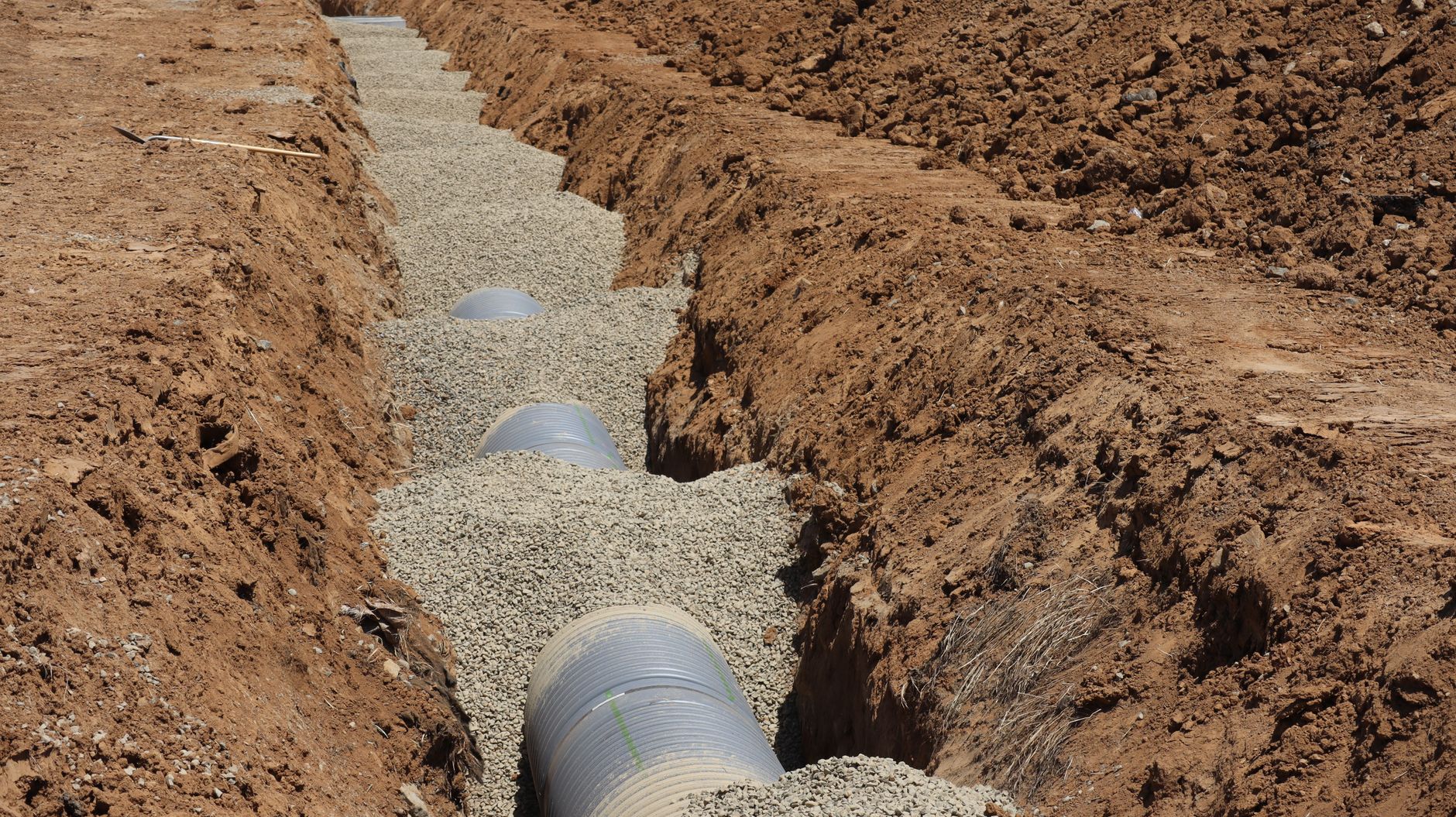
Sand gets most of the attention in greens construction, but the drainage aggregate layer beneath it does work that’s just as critical. A green that drains poorly at the surface but has a clogged or incorrectly sized gravel layer will fail just as surely as one built with the wrong sand. Understanding the full drainage system — from the rootzone down to the drain pipe — is essential for anyone planning a new green or a major renovation.
The Gravel Blanket and Why It Can't Be Skipped
In a USGA-spec green, a 4-inch layer of coarse gravel sits beneath the sand rootzone. This layer serves as a capillary break — it prevents the fine sand above from wicking water downward too slowly or from being pulled upward by capillary action during dry periods. The gravel must be sized correctly relative to the sand above it; if the gravel is too coarse, sand particles migrate into it and clog the drainage layer over time.
USGA guidelines specify that the gravel should have a D15 particle size no more than 8× the D85 of the sand rootzone. In practice, this usually means gravel in the 3/8–1/2 inch range for medium-fine rootzone sands. Getting this ratio wrong is one of the most common — and most expensive — construction mistakes on golf course projects.
Surface Drainage and Slope Around Greens
Even a perfectly built green can flood if the surrounding grade doesn’t move surface water away efficiently. Greens complexes should slope away from the putting surface at 1–2% grade on all sides, directing runoff to drainage swales, catch basins, or French drains. In West Tennessee’s clay-heavy soils, surface drainage design is especially critical — standing water around a green complex creates cart path damage, turf stress, and disease pressure that no amount of sand specification can fix.
Jackson Sand supplies drainage aggregates including gravel and drainage basin materials alongside their golf course sand products, making it practical to source your full drainage system from a single supplier.
Golf Course Sand Types at a Glance: Rootzone vs. Bunker vs. Top Dressing vs. Aeration Fill
Different areas of a golf course require different sand specifications. Use this table to match the right product to each application before placing your order.
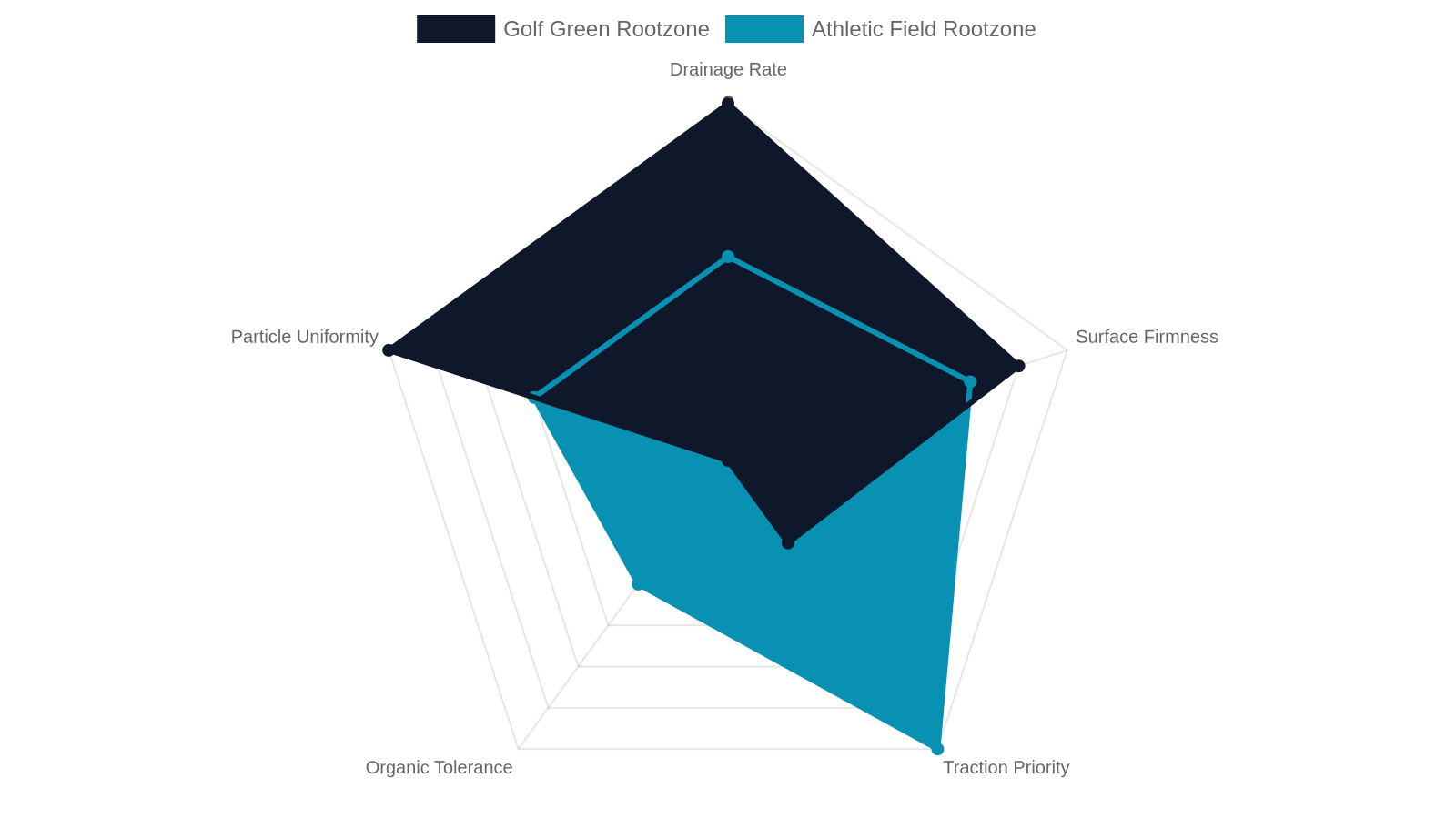
8. Sand for Athletic Fields vs. Golf Greens: Key Differences

Golf course superintendents and athletic field managers often face similar questions about sand, and sometimes the same supplier serves both. But the specifications diverge in meaningful ways, and understanding those differences helps both types of turf manager make better purchasing decisions — and avoid applying a golf-course product where an athletic-field product is needed, or vice versa.
How Athletic Field Sand Specs Differ
Athletic fields — football, soccer, baseball infields — share some sand requirements with golf greens but differ in important ways. Field rootzones prioritize stability and traction over ball roll and speed. This means slightly higher clay content is acceptable (up to 10–15% in some field mixes), and the particle-size distribution can be broader. Drainage requirements are still significant — a waterlogged football field is dangerous and unusable — but the target hydraulic conductivity is typically lower than a USGA green, often 2–6 in/hr.
Baseball infield skin areas use a completely different material: a blend of clay, silt, and fine sand engineered for firmness and workability, not drainage. The sand component in infield mix is typically very fine (0.1–0.25 mm) and serves as a binder, not a drainage medium.
Shared Principles: Why Lab Testing Matters for Both
Whether you’re managing a golf course or a multi-sport complex, the principle is the same: buy sand with a spec sheet, not by the truckload from the nearest pit. Unspecified sand introduces variability that shows up as inconsistent drainage, uneven playing surfaces, and premature rootzone failure. The cost of lab testing — typically $200–$500 per sample — is trivial compared to the cost of re-building a green or re-grading a field because the wrong material was used.
Jackson Sand serves both golf courses and athletic facilities throughout West Tennessee, supplying tested materials for each application.
9. How to Source and Order Golf Course Sand in West Tennessee
Knowing the right sand specification is only half the battle. The other half is finding a supplier who can consistently deliver that specification, on time, in the volumes you need, without contamination. In West Tennessee and the Mid-South, that’s a shorter list than you might expect — which makes working with a local specialist who understands golf course requirements genuinely valuable.
What to Ask a Sand Supplier Before You Order
Before committing to any sand purchase for a golf course project, ask your supplier these questions:
- Do you provide a lab-tested particle-size analysis? If not, walk away.
- Is the sand consistent batch to batch? Mixed-on-premises production helps ensure consistency.
- Do you own your delivery trucks? Third-party haulers introduce contamination risk and load accuracy issues.
- Can you deliver the volume I need on my schedule? Aeration events are time-sensitive.
- Do you have experience supplying golf courses? Golf sand is a specialty product — not every aggregate supplier understands the spec requirements.
Jackson Sand checks every one of these boxes. They mix sand on their own premises from high-quality materials, own their delivery trucks, and publish lab-tested spec sheets for their golf course products.
Planning Your Order: Volume, Timing, and Delivery
Golf course sand orders should be planned well in advance of aeration events and renovation projects. Lead times vary by season — spring and fall are peak demand periods in West Tennessee, and supply can tighten quickly. Best practice is to:
- Confirm your rootzone spec and calculate volume 4–6 weeks before your target date
- Use a yardage calculator to verify your estimate
- Confirm delivery scheduling with your supplier at least 2 weeks out
- Arrange on-site storage (a clean, covered area) if delivery precedes application by more than a few days
Jackson Sand includes delivery in their pricing and delivers throughout West Tennessee and the surrounding Mid-South region. Call 731-668-0440 to discuss your project timeline and confirm availability.
Ready to Order Golf Course Sand in Jackson, TN?

Whether you’re a superintendent planning a major renovation, a grounds crew manager scheduling your fall aeration program, or a parks and rec director building a new athletic surface, Jackson Sand is ready to help you get the right material for the job. We serve golf courses and sports facilities across West Tennessee and the surrounding Mid-South — and we bring the same practical, knowledgeable approach to every order, large or small.
Jackson Sand: Mixed on Premises, Delivered in Our Own Trucks
Jackson Sand has been supplying golf courses, athletic facilities, contractors, and homeowners throughout West Tennessee from our location at 139 United Dr., Jackson, TN 38305. Every load of golf course sand we deliver is mixed on our own premises from high-quality materials and hauled in our own trucks — so what you order is what arrives, clean and accurate, every time.
We publish lab-tested spec sheets for all of our golf course products, and our team understands the difference between a rootzone sand, a bunker sand, and a top dressing sand. Whether you’re building a new green, renovating bunkers, or planning your fall aeration program, we can help you get the specification right from the start.
Your Next Steps
Here’s how to move forward:
- Review our products: See our full line of golf course sand products including rootzone sand, bunker sand, and top dressing sand.
- Check the specs: Download lab-tested particle-size data from our sand specs page to confirm the material meets your course’s requirements.
- Estimate your volume: Use the yardage calculator to plan your order before you call.
- Call us: Reach Jackson Sand at 731-668-0440 to discuss your project, confirm availability, and schedule delivery throughout West Tennessee and the Mid-South.
We serve large and small jobs — from a single green renovation to a full 18-hole course re-sand. Delivery is included. Let’s get your course ready to play.
Frequently Asked Questions
What USGA sand specification do I need for a putting green?
USGA greens construction requires a rootzone sand with 60–80% of particles in the 0.25–0.5 mm range, no more than 10% very coarse sand (1–2 mm), no more than 20% fine sand (0.1–0.25 mm), and less than 5% combined very fine sand, silt, and clay. The rootzone mix (sand plus 15–20% peat by volume) should achieve saturated hydraulic conductivity of 6–24 inches per hour, ideally 12–18 in/hr.
Can I use the same sand for bunkers and putting greens?
No. Bunker sand is typically coarser (0.5–1.0 mm median diameter) and more angular than putting-green rootzone sand, which is engineered for drainage and firmness. Using rootzone sand in bunkers creates soft, plugging conditions. Using bunker sand in a rootzone can cause layering and drainage problems. Always specify each product separately.
How much sand do I need for an aeration event on 18 greens?
A typical 18-hole course with 5,000 sq ft per green needs approximately 0.5–1.5 cubic yards of sand per green per aeration event, depending on tine size and spacing. That's 9–27 cubic yards for 18 greens. Use a yardage calculator to refine your estimate based on your specific tine diameter, depth, and spacing.
Why does top dressing sand have to match the rootzone sand?
Mismatched particle sizes create a soil layering problem — a fine layer between coarser layers (or vice versa) acts as a barrier to water movement, creating perched water tables that suffocate roots and promote disease. The top dressing sand's median particle diameter (D50) should be within 0.05 mm of the existing rootzone sand's D50.
Does Jackson Sand deliver golf course sand in West Tennessee?
Yes. Jackson Sand delivers throughout West Tennessee and the surrounding Mid-South region. Delivery is included in their pricing. They mix sand on their own premises and use their own trucks to ensure clean, accurate loads. Call 731-668-0440 to discuss your project and confirm delivery scheduling.
How do I know if a sand supplier's product meets USGA standards?
Ask for a lab-tested particle-size analysis (sieve analysis) that shows the percentage of material retained in each size fraction. Compare those percentages against USGA particle-size limits. Also request mineralogy data (silica content) and, for a rootzone mix, a saturated hydraulic conductivity test result. A reputable supplier will provide all of this before you order.