

How Much Does Golf Course Maintenance Sand Cost in the Mid-South?
Quick answer: Golf course maintenance sand in the Mid-South typically varies in cost based on sand type, volume ordered, particle size specifications, and whether delivery is included. Bunker sand, top dressing sand, and topdressing services each carry different price points. Local suppliers like Jackson Sand — who mix their own sand on premises and deliver in their own trucks — can offer more consistent pricing and cleaner loads than third-party haulers. The best way to estimate your budget is to know your cubic yardage, specify your particle size requirements, and request a quote that includes delivery.
Why Golf Course Sand Pricing Is More Complicated Than It Looks

Golf course maintenance sand is one of those line items that looks simple on a budget spreadsheet but hides a surprising amount of complexity. The price you pay per cubic yard is only part of the equation. Particle size specification, delivery method, load accuracy, and supplier reliability all affect the true cost of keeping your course in top condition. Understanding these variables is the first step toward building an accurate maintenance budget — whether you’re managing a 18-hole championship course in West Tennessee or a 9-hole municipal layout.
Sand Is Not a Commodity — Spec Matters
Walk into any building supply store and you can buy a bag of “sand” for a few dollars. But golf course maintenance sand is an entirely different product. Superintendents and turf managers specify sand by particle size distribution, infiltration rate, organic matter content, and sometimes USGA conformance. A sand that fails those specs can compact, retain too much water, or introduce weed pressure — costing far more to fix than the savings from buying cheap.
That’s why reputable suppliers publish lab-tested spec sheets for every product they sell. When comparing quotes, always compare spec sheets side by side, not just price per yard.
The Hidden Costs in Sand Pricing
A low per-yard price can evaporate quickly when you factor in:
- Delivery fees — third-party haulers often add a separate freight charge per load
- Load accuracy — loose estimates on yardage mean you may receive less than you paid for
- Contamination — shared or poorly maintained trucks can introduce debris, organics, or mixed aggregate
- Re-orders — if the first delivery is short or off-spec, you pay freight again
Suppliers who own their trucks and mix on premises — like Jackson Sand in Jackson, TN — can control all three variables, which is why delivery-inclusive pricing from a dedicated supplier often beats a seemingly cheaper quote from a broker.
The Main Types of Golf Course Maintenance Sand and What Each One Does
Before you can estimate costs, you need to know which sand product you actually need — and golf courses typically use at least two or three distinct products, each with its own spec and price point. Here’s a plain-language breakdown of the main categories.
Bunker Sand
Bunker sand is the most visible sand product on any golf course, and it’s also the most scrutinized by players. It needs to be firm enough to walk on without being so loose that balls bury, and it must drain freely after heavy rain. USGA guidelines recommend a particle size distribution that keeps infiltration rates above 6 inches per hour. Bunker sand also needs to resist “crusting” — the hard surface layer that forms when fine particles migrate to the top after rain.
Jackson Sand’s bunker sand is mixed on premises from high-quality materials and comes with lab-tested spec sheets so you can verify particle size before the first truck rolls.
Top Dressing Sand
Top dressing sand is applied to greens, tees, and fairways to smooth surfaces, dilute thatch, and improve drainage. It’s typically finer than bunker sand and must be compatible with the existing root zone — otherwise layering occurs and water movement is disrupted. USGA and ASTM standards define acceptable particle size ranges for top dressing, and many superintendents request the same sand used in the original construction to maintain consistency.
Frequency of application varies from weekly light dustings on tournament greens to seasonal heavy applications after aeration. Each application method requires a different volume calculation — use the free yardage calculator at Jackson Sand to estimate cubic yards before ordering.
Drainage Aggregate and Specialty Sands
Beyond bunkers and greens, golf courses use coarse aggregate in drainage basins, catch basins, and subsurface drainage trenches. These products are priced differently from fine turf sands because the particle size range is wider and the spec requirements are less stringent. Gravel, pea gravel, and coarse drainage sand are commonly used in:
- French drain systems along cart paths and fairway edges
- Drainage basins at low points on the course
- Seepage drainage beneath greens and tees
Bundling drainage aggregate orders with your sand order from the same supplier can reduce per-load delivery costs significantly.
Key Factors That Drive the Cost of Golf Course Sand in West Tennessee
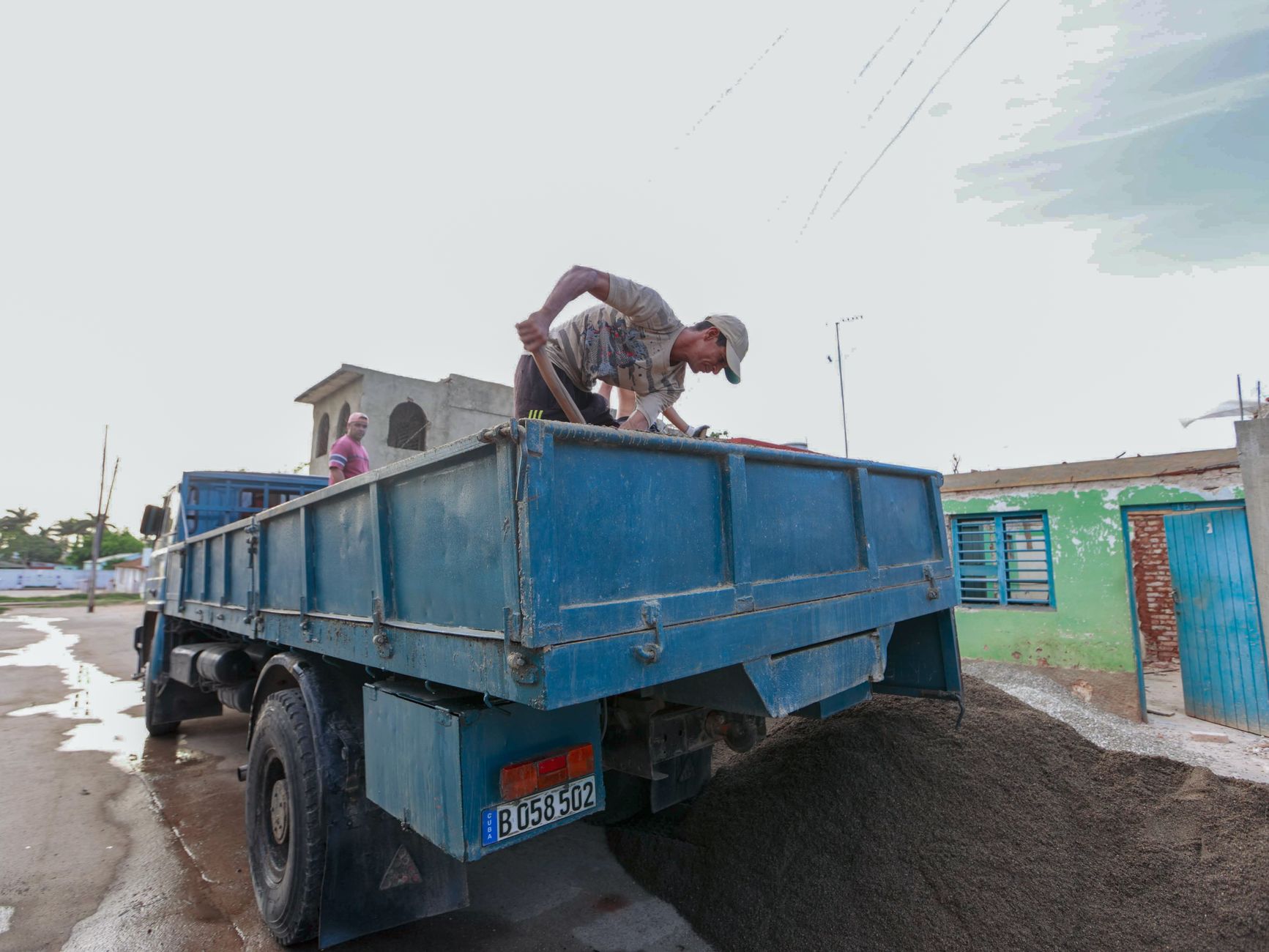
Several variables determine what you’ll actually pay for golf course maintenance sand in the Mid-South. Some are within your control as a buyer; others depend on the supplier you choose and the logistics of your location. Understanding each factor helps you build a more accurate budget and ask better questions when you call for a quote.
Volume: The Biggest Lever on Price Per Yard
Sand pricing almost always improves with volume. A small order of 5–10 cubic yards for a spot bunker repair will carry a higher per-yard cost than a 100-yard seasonal top dressing order. Most commercial golf course orders fall in the 50–500 cubic yard range per season, and suppliers price accordingly. Knowing your total annual volume — not just the next order — gives you leverage when negotiating with a supplier.
Particle Size Specification and Lab Testing
Tighter particle size specs cost more to produce. A sand blended to USGA green construction tolerances requires more careful sourcing and mixing than a general-purpose fill sand. Suppliers who invest in on-premises mixing equipment and third-party lab testing pass some of that cost on, but they also deliver a product that’s far less likely to cause agronomic problems down the road. Review the sand spec sheets from Jackson Sand to see exactly what particle size distributions are available and how they compare to USGA recommendations.
Delivery Distance and Truck Ownership
In West Tennessee and the broader Mid-South region, delivery distance from the supplier’s yard to your course is a real cost driver. Suppliers who own their own trucks — rather than contracting out to third-party carriers — typically offer more predictable delivery pricing and better load accuracy. Jackson Sand operates out of 139 United Dr., Jackson, TN 38305 and delivers in their own trucks, which means no surprise freight surcharges and cleaner, more accurate loads.
Bunker Sand vs. Top Dressing Sand: a Side-by-Side Look at Specs and Use Cases
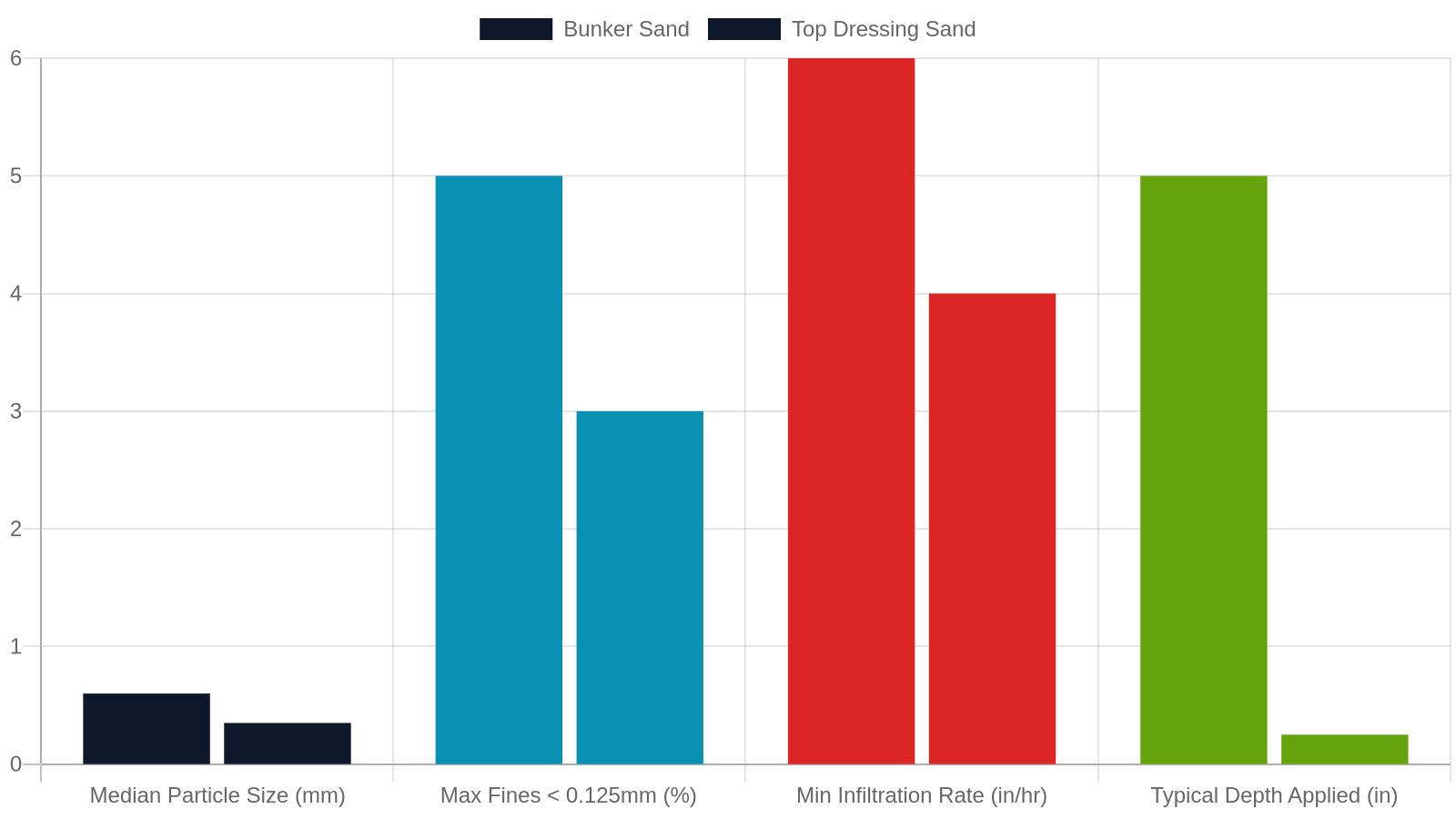
Superintendents often ask whether they can use the same sand for both bunkers and top dressing. The short answer is: sometimes, but not always. The two products serve different agronomic functions and may carry different spec requirements depending on your course’s original construction standards. Here’s how they compare.
Particle Size and Infiltration Rate
The USGA recommends bunker sand with a median particle diameter between 0.25 mm and 1.0 mm, with less than 5% of particles finer than 0.125 mm. Top dressing sand for greens typically targets a tighter range — often 0.25 mm to 0.50 mm — to match the existing root zone and avoid layering. Infiltration rates for bunker sand should exceed 6 inches per hour; top dressing sand on greens is usually evaluated for compatibility rather than raw infiltration.
Application Rates and Frequency
Top dressing rates vary widely by season and agronomic goal:
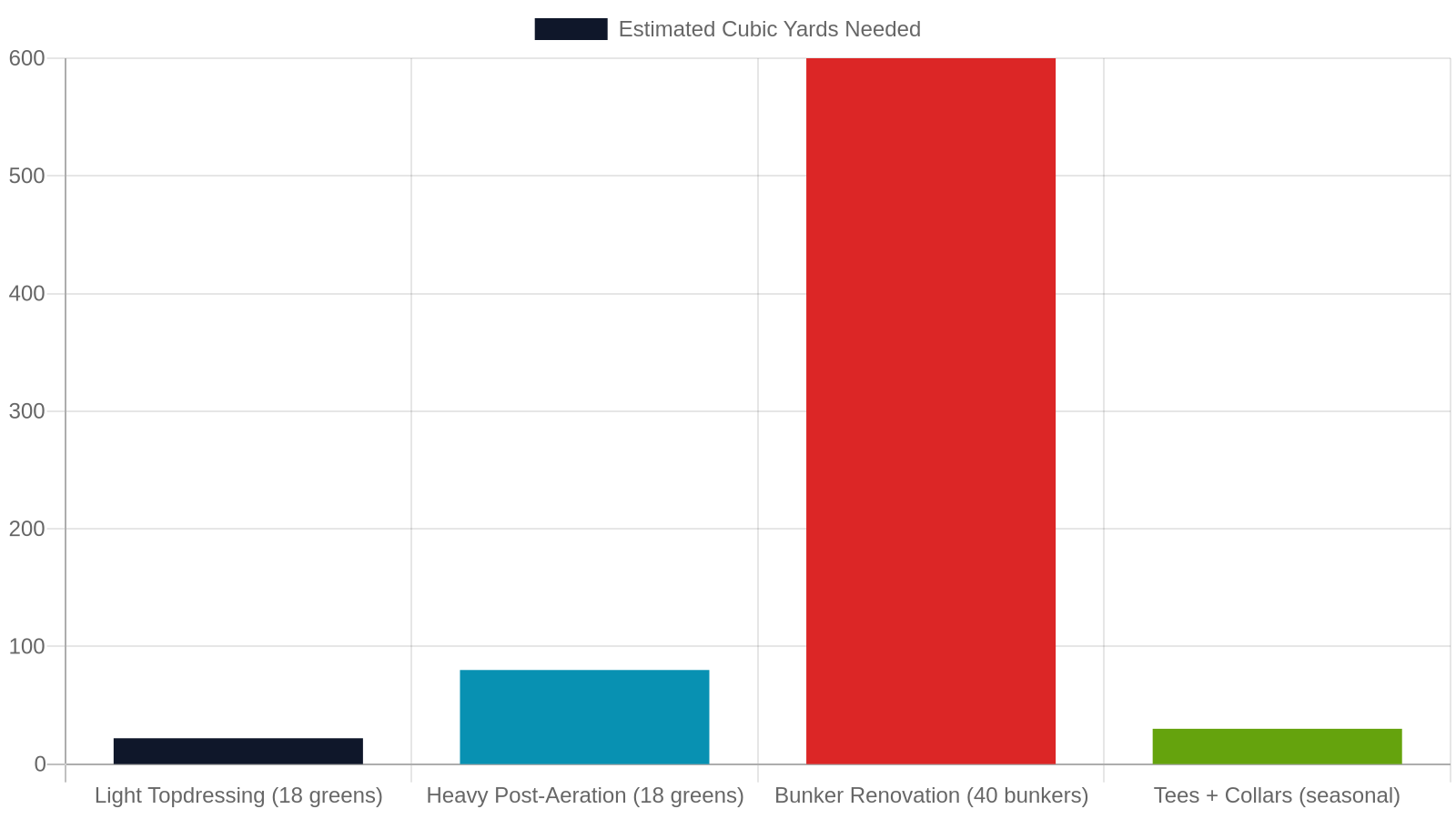
- Light topdressing: 0.1–0.25 cubic yards per 1,000 sq ft, applied every 2–4 weeks during the growing season
- Heavy topdressing post-aeration: 0.5–1.0 cubic yards per 1,000 sq ft, applied 2–4 times per year
- Bunker renovation: Typically 4–6 inches of sand depth, which translates to roughly 12–18 cubic yards per standard bunker depending on size
These numbers add up fast across an 18-hole course. A course with 40 bunkers averaging 800 sq ft each needs 480–720 cubic yards just for a full bunker renovation — before a single yard of top dressing is counted.
How to Calculate How Much Sand Your Golf Course Actually Needs
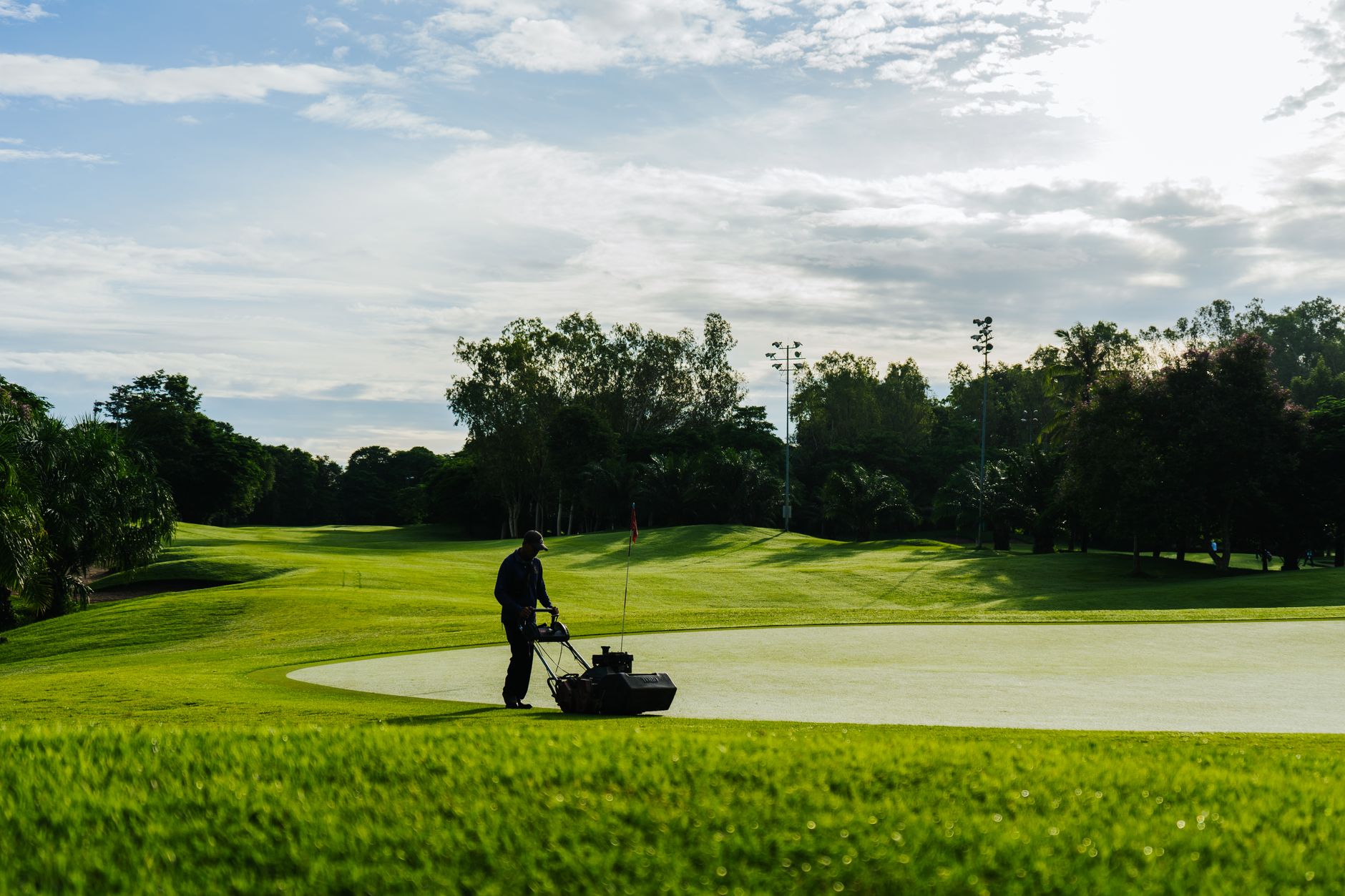
One of the most common budgeting mistakes golf course managers make is ordering sand reactively — a load here, a load there — without a seasonal plan. That approach costs more per yard and creates scheduling headaches for the supplier. Here’s how to estimate your actual needs before you pick up the phone.
Measuring Bunker Square Footage
For bunker renovation or topping off, measure the surface area of each bunker in square feet. Multiply by the desired sand depth in feet (e.g., 5 inches = 0.417 ft), then divide by 27 to convert cubic feet to cubic yards. A 1,000 sq ft bunker filled to 5 inches requires approximately 15.4 cubic yards of sand. Multiply across all bunkers and add 10–15% for waste and settling.
Calculating Top Dressing Volume for Greens and Tees
Average putting green size on a regulation course is roughly 5,000–7,000 sq ft. At a light top dressing rate of 0.2 cubic yards per 1,000 sq ft, one green requires about 1.0–1.4 cubic yards per application. Multiply by 18 greens and you’re looking at 18–25 cubic yards per light application cycle. Heavy post-aeration dressings at 0.75 cubic yards per 1,000 sq ft push that to 67–94 cubic yards for greens alone — not counting tees and collars.
These estimates are a starting point. For a precise order, plug your actual dimensions into the Jackson Sand yardage calculator before you call for pricing.
Seasonal Planning vs. Spot Orders
Courses that plan their full season’s sand needs upfront — rather than placing multiple small spot orders — almost always get better pricing and more reliable scheduling. Work with your supplier to map out:
- Spring aeration and heavy top dressing dates
- Mid-season light dressing schedule
- Fall aeration and overseeding support
- Any bunker renovation projects
Giving your supplier a seasonal volume forecast lets them schedule production and delivery more efficiently, which benefits both parties.
Top Dressing Services vs. DIY Application: What's the Cost Difference?
For many golf courses, the question isn’t just “how much does the sand cost?” — it’s “should we apply it ourselves or hire it out?” The answer depends on your crew size, equipment inventory, and how many applications you run per season. Here’s a practical breakdown to help you decide.
What a Top Dressing Service Includes
Some courses — particularly smaller municipal courses, school athletic programs, and parks and rec departments — don’t own a top dresser or have the crew hours to run one. In those cases, hiring a supplier who offers top dressing services (not just sand delivery) can be more cost-effective than purchasing equipment. Jackson Sand offers top dressing services in addition to sand delivery, which means the material and the application can come from a single vendor call.
When DIY Application Makes More Sense
Larger courses with dedicated maintenance crews and their own top dressing equipment will typically find it more economical to purchase sand by the yard and apply it themselves. The break-even point depends on your crew’s hourly cost, equipment depreciation, and how many applications you run per season. A course running 20+ top dressing events per year almost always justifies owning the equipment; a course running 4–6 events per year may be better served by a service arrangement.
Aeration as Part of the Sand Budget
Aeration and top dressing go hand in hand agronomically — aeration opens channels that sand fills to improve drainage and reduce compaction. If you’re budgeting for top dressing, budget for aeration in the same line item. Courses that aerate 2–3 times per year and follow each event with a heavy sand application will use significantly more cubic yards than courses that skip aeration or use hollow tines infrequently. Factor aeration frequency into your annual sand volume estimate.
Drainage Materials: the Often-Overlooked Sand Budget Line

Drainage aggregate rarely gets its own line in a golf course maintenance budget — it tends to get lumped in with “miscellaneous materials” until a drainage failure forces an emergency repair. Planning ahead for drainage materials alongside your sand budget can save significant money and course downtime.
Surface Drainage and Slope Aggregate
Standing water on fairways, cart paths, and approaches is one of the most common complaints from golfers — and one of the most solvable problems with the right aggregate. Coarse sand and gravel used in surface drainage channels and slope grading are priced differently from fine turf sands. These products are typically sold by the ton or cubic yard and don’t require the same tight particle size specs as bunker or top dressing sand, which often makes them more affordable per yard.
Drainage Basins and Seepage Systems
Subsurface drainage systems — including drainage basins at low points and seepage drainage beneath greens and tees — require specific aggregate sizes to function correctly. Using the wrong gravel size in a drainage basin can clog the system within a season. Jackson Sand supplies drainage aggregate for all three system types: surface drainage, drainage basins, and seepage drainage. Bundling these materials with your annual sand order is a straightforward way to reduce per-load delivery costs.
Golf Course Sand Products at a Glance: Specs, Uses, and Considerations
Use this table to quickly compare the main sand and aggregate products used in golf course maintenance. Spec values are general industry guidelines — always verify against lab-tested spec sheets for the specific product you order.
Athletic Fields and Schools: Sand Costs Beyond the Golf Course

Jackson Sand serves more than golf courses. Schools, parks departments, and college athletic programs across West Tennessee rely on the same high-quality sand products for their athletic fields. If you’re budgeting for both a golf course and athletic fields at the same institution, consolidating orders with a single supplier is one of the easiest ways to reduce per-yard cost and simplify scheduling.
Sand for Football, Soccer, and Baseball Fields
Parks and recreation departments, school districts, and college athletic programs in West Tennessee face many of the same sand budgeting questions as golf courses — but with different spec requirements. Athletic field sand needs to support heavy foot traffic, drain quickly after rain, and resist compaction under cleats. Infield mix for baseball and softball typically combines sand with clay and silt at specific ratios; football and soccer fields use sand-based root zones similar to golf greens.
Volume Differences Between Athletic Fields and Golf Courses
A standard football field (360 × 160 ft = 57,600 sq ft) requires substantially more sand per application than an average putting green. At a top dressing rate of 0.5 cubic yards per 1,000 sq ft, a single football field application uses approximately 29 cubic yards — comparable to top dressing all 18 greens on a golf course at a light rate. School districts managing multiple fields should plan seasonal volumes carefully to take advantage of bulk pricing.
How to Get an Accurate Quote: 6 Things to Have Ready Before You Call
Getting an accurate sand quote isn’t complicated, but it does require a little preparation. Suppliers can give you a much more useful number — and avoid the back-and-forth of follow-up calls — when you walk in with the right information. Here are the six things to have ready before you dial 731-668-0440.
1. Your Square Footage or Cubic Yard Estimate
Even a rough estimate is better than none. Measure your bunkers, greens, and any areas you plan to top dress. If you’re not sure how to convert square footage and depth to cubic yards, use the free yardage calculator on the Jackson Sand website before you call. Arriving at the conversation with a number — even an approximate one — speeds up the quoting process significantly.
2. Your Particle Size Requirements or USGA Spec
If your course was built to USGA specs, say so. If you have a specific particle size distribution from your original construction documents, have it handy. If you’re not sure, ask the supplier to walk you through their available products and spec sheets — a knowledgeable supplier will help you match the right product to your agronomic goals.
3. Your Preferred Delivery Schedule
Sand delivery logistics matter. Let your supplier know whether you need a single large delivery or multiple smaller loads spread across the season. Courses with limited storage space may prefer more frequent smaller loads; courses with large staging areas may prefer fewer, larger deliveries. Either way, giving your supplier advance notice — especially for large seasonal orders — ensures you get the scheduling you need.
Why Buying Local in West Tennessee Saves More Than You'd Expect
It’s easy to assume that shopping nationally or online will always yield a lower price. For bulk materials like sand, the math often works the other way. Here’s why sourcing locally in West Tennessee frequently delivers better value — not just better service.
Shorter Haul = Lower Delivered Cost
Freight is a significant component of any bulk material cost. Sand is heavy — a cubic yard of dry sand weighs approximately 2,700 pounds — and long hauls add cost fast. Sourcing from a supplier based in Jackson, TN means shorter delivery distances for most courses and contractors in West Tennessee, the Tennessee River Valley, and the surrounding Mid-South. That shorter haul translates directly into lower delivered cost per yard.
Consistency and Accountability
When you buy from a local supplier who mixes their own sand on premises, you can visit the facility, review the lab test results, and build a relationship with the people who are actually producing your product. That accountability is hard to replicate when ordering through a broker or a distant distributor. If a load arrives off-spec, a local supplier can respond quickly — not in three business days after a ticket is routed through a call center.
Ready to Plan Your Golf Course Sand Budget for the Season?
Golf course maintenance sand isn’t a one-size-fits-all purchase, and the cost isn’t a single number you can look up in a catalog. But with the right supplier relationship, a clear spec, and a seasonal volume plan, it becomes a predictable and manageable budget line. Jackson Sand has been supplying courses, athletic fields, and contractors across West Tennessee and the Mid-South with lab-tested sand products and reliable delivery — call 731-668-0440 to get started on a quote for your course.
Start With a Volume Estimate, Then Call for Pricing
The fastest path to an accurate budget is a two-step process: estimate your cubic yardage first, then call for pricing. Use the yardage calculator to get your numbers, then reach out to Jackson Sand at 731-668-0440 with your product type, volume, and preferred delivery schedule. The team can walk you through available products, spec sheets, and scheduling options for courses of any size across West Tennessee and the Mid-South.
Explore Jackson Sand's Full Golf Course Offering
Jackson Sand supplies bunker sand, top dressing sand, top dressing services, drainage aggregate, gravel, and mulch — all mixed on premises and delivered in their own trucks. Whether you’re planning a full bunker renovation, a seasonal top dressing program, or a drainage improvement project, everything can come from a single supplier with a single call. See the full golf course maintenance products and services from Jackson Sand to understand the complete range of what’s available for your course.
Frequently Asked Questions
How much does bunker sand cost per cubic yard in West Tennessee?
Bunker sand pricing varies based on volume, particle size specification, and delivery distance. Because freight is a major cost component for bulk materials, sourcing from a local supplier like Jackson Sand in Jackson, TN typically results in a lower delivered cost per yard than ordering from a distant distributor. Contact Jackson Sand at 731-668-0440 for a current quote based on your volume and location.
How many cubic yards of sand does an 18-hole golf course need per year?
Annual sand needs vary widely by maintenance program. A typical 18-hole course running a moderate top dressing program plus seasonal aeration might use 150–400 cubic yards of top dressing sand per year. Add bunker renovation or topping-off needs and that number can exceed 600–800 cubic yards. Use a yardage calculator and your actual square footage to get a precise estimate.
What particle size sand should I use for golf course bunkers?
The USGA recommends bunker sand with a median particle diameter between 0.25 mm and 1.0 mm, with less than 5% of particles finer than 0.125 mm, and an infiltration rate exceeding 6 inches per hour. Always request a lab-tested spec sheet from your supplier to verify the product meets these guidelines before ordering.
Does Jackson Sand deliver to golf courses outside of Jackson, TN?
Jackson Sand serves West Tennessee and the surrounding Mid-South region, delivering in their own trucks from their facility at 139 United Dr., Jackson, TN 38305. Call 731-668-0440 to confirm delivery availability for your specific location.
Can I use the same sand for top dressing and bunkers?
Sometimes, but not always. Bunker sand and top dressing sand often have overlapping particle size ranges, but top dressing sand for greens typically needs to match the existing root zone construction sand to avoid layering. Using mismatched sands can disrupt water movement and create long-term agronomic problems. Ask your supplier to compare spec sheets for both products before deciding.
Does Jackson Sand offer top dressing services or just sand delivery?
Jackson Sand offers both sand delivery and top dressing services, making them a single-source option for courses that don't own a top dresser or prefer to outsource the application. Call 731-668-0440 to discuss what's available for your course.