

Drainage Aggregate for Golf Course Fairways: Your 9-Point Guide for West Tennessee
Quick answer: Proper drainage aggregate beneath golf course fairways is the single biggest factor in playability after heavy rain and long-term turf health. For West Tennessee courses, that means selecting the right particle-size aggregate — typically a coarse sand or pea gravel blend — installed in a layered drainage system that moves surface water down and away before it saturates the rootzone. Jackson Sand, based in Jackson, TN, mixes drainage aggregate on-premises, delivers in their own trucks, and publishes lab-tested spec sheets so superintendents know exactly what they're getting.
1. Why Fairway Drainage Is a Make-or-Break Issue in West Tennessee
West Tennessee receives an average of 52–55 inches of rainfall per year, distributed unevenly across intense spring and summer storm events. For golf course superintendents managing fairways in and around Jackson, TN, that precipitation pattern means drainage is not a seasonal concern — it is a year-round operational priority. The right drainage aggregate, properly specified and installed, is what separates a course that bounces back in hours from one that stays closed for days.
West Tennessee's Clay-Heavy Soils Create Unique Challenges
Much of West Tennessee sits on a heavy clay subsoil that drains poorly by nature. When 2–3 inches of rain fall in a single afternoon — a common occurrence from May through September — native fairway soils can stay saturated for 24 to 72 hours. That standing water compacts the turf, invites disease pressure like Pythium blight and take-all patch, and forces cart path-only rules that frustrate golfers and hurt revenue.
Installing or renovating a drainage aggregate layer beneath the fairway profile is the most reliable long-term fix. The aggregate creates a permeable pathway that pulls water down through the rootzone and into a collection or dispersion system before it can pool on the surface.
The Revenue Argument for Better Drainage
Golf course operators often treat drainage as a capital expense to defer. The math argues otherwise. A course that loses even 15 playable days per season to wet fairways — at an average of 80 rounds per day and $40 green fee — forfeits roughly $48,000 in annual revenue. A properly drained fairway system that recovers in 2–4 hours instead of 48 hours can pay for itself in a single wet season. Drainage aggregate is not a luxury; it is infrastructure.
2. Understanding Drainage Aggregate: Definitions and Key Terms
Before specifying or ordering drainage aggregate, every superintendent and contractor needs a shared vocabulary. The terms used in drainage design — choker layer, gravel blanket, permeability rate, particle size distribution — have precise meanings that directly affect material selection and system performance. Getting these definitions right up front prevents expensive substitutions in the field.
What 'Drainage Aggregate' Actually Means
Drainage aggregate is a broad term for any granular material — sand, gravel, crushed stone, or blended combinations — placed in or beneath a turf profile to increase permeability and move water away from the rootzone. In a golf fairway context, the term usually refers to one of three things: a choker layer of coarse sand placed directly beneath the rootzone mix, a gravel blanket of pea gravel or crushed stone below the choker, or trench backfill aggregate packed around perforated drain pipes.
Each layer serves a distinct hydraulic function. Confusing them — or using a single material for all three — is one of the most common and costly mistakes in fairway drainage construction.
Particle Size: The Number That Drives Everything
Particle size determines how fast water moves through aggregate and how well layers stay separated over time. The USGA and industry research point to specific size windows for each layer:
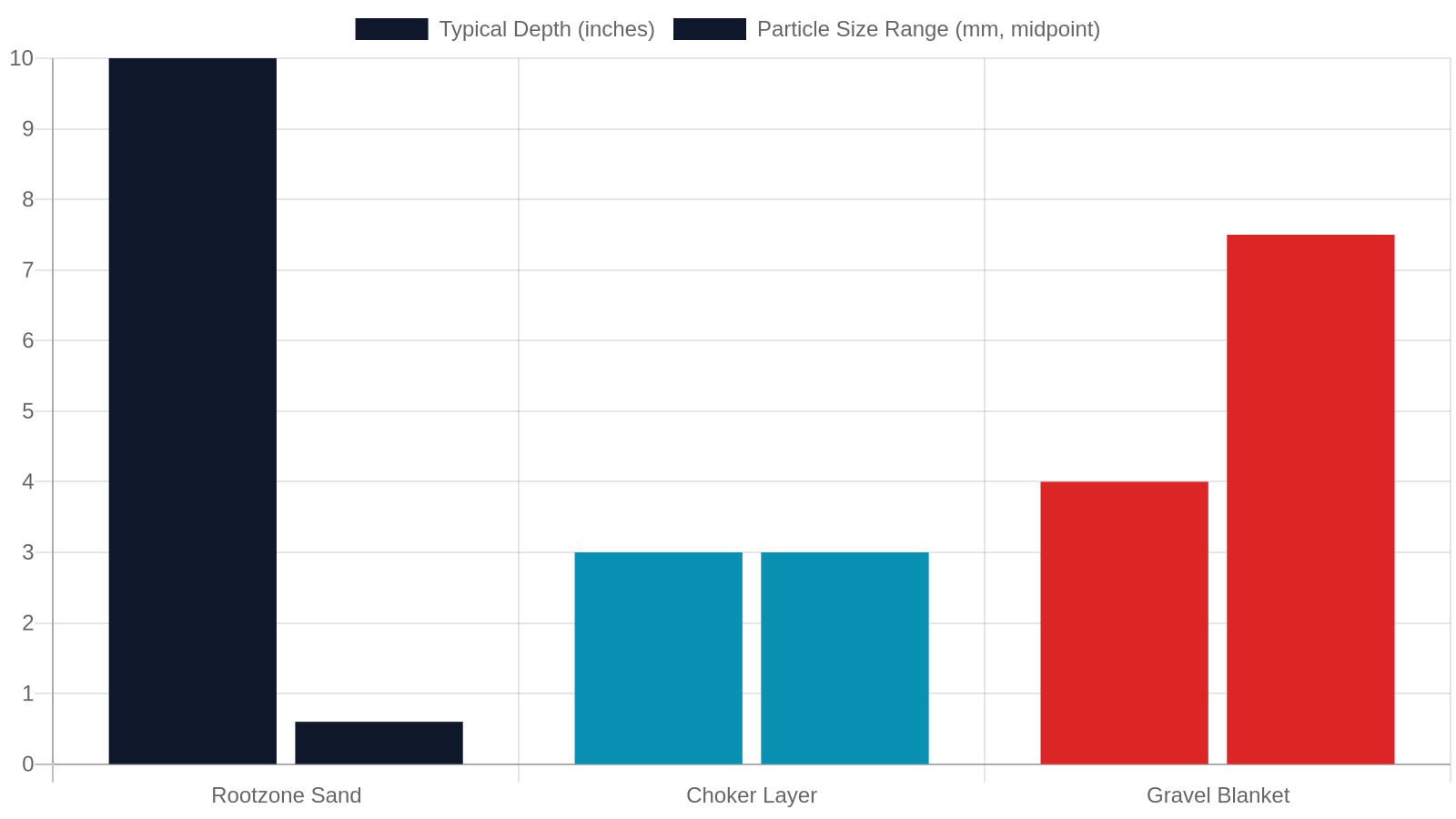
- Rootzone sand: 0.25–1.0 mm (medium to coarse sand)
- Choker/bridge layer: 2–4 mm (coarse sand to fine gravel)
- Gravel blanket: 6–9 mm (pea gravel)
When particle sizes between adjacent layers are too similar, fine particles migrate downward and clog the drainage pathway — a phenomenon called particle bridging failure. Lab-tested specs are the only reliable way to confirm you’re within the correct size range. Jackson Sand publishes lab-tested sand spec sheets for exactly this reason.
3. The Three-Layer Fairway Drainage System Explained
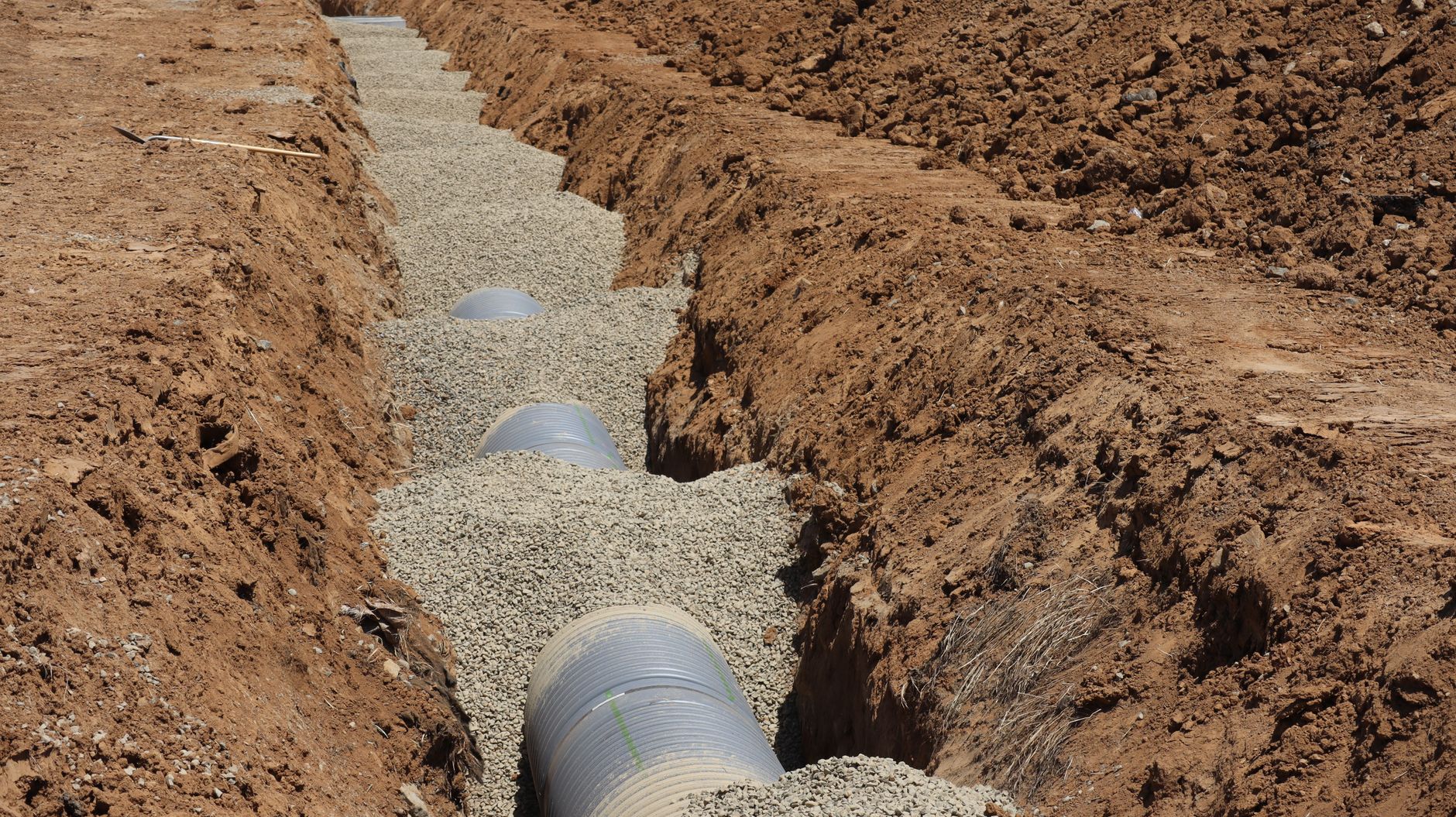
A properly engineered fairway drainage system is not a single material — it is a layered profile in which each component is sized to work with the layers above and below it. Think of it as a hydraulic filter stack: each layer passes water downward while preventing the migration of finer particles from above. Here is how each layer functions and what specifications matter most.
Layer 1 — The Rootzone Mix
The rootzone is the top 8–12 inches of the fairway profile where grass roots live and where most water infiltration begins. For high-traffic fairways, a sand-based rootzone (typically 80–85% sand by volume) is preferred over native soil because it maintains permeability even under cart and foot traffic. The sand fraction should be predominantly medium-to-coarse particles (0.25–1.0 mm) with very low silt and clay content — ideally less than 5% combined.
Layer 2 — The Choker or Bridge Layer
Placed 2–4 inches thick directly beneath the rootzone, the choker layer uses coarser particles (2–4 mm) to create a hydraulic transition between the fine rootzone sand above and the gravel blanket below. Without this layer, fine rootzone particles migrate into the gravel voids over time, reducing drainage capacity by as much as 60–80% within 5–7 years. The choker layer is the most frequently omitted component in budget-driven drainage projects — and the omission almost always proves costly.
Layer 3 — The Gravel Blanket and Pipe Trench
The gravel blanket (6–9 mm pea gravel, 4 inches deep) sits beneath the choker layer and above the perforated collection pipes. Its job is to distribute lateral water flow evenly across the pipe network and prevent soil intrusion into the pipe perforations. Trench backfill around the pipes should match the blanket aggregate or be slightly coarser — never finer. Pipe spacing on fairways typically runs 15–20 feet on center for moderate drainage goals, or as tight as 8–10 feet for high-performance renovation projects.
4. Surface Drainage vs. Subsurface Drainage: Choosing the Right Approach
Not every wet fairway needs the same solution. The right drainage strategy depends on the volume and intensity of rainfall, the existing grade, the native soil type, and the budget available. Understanding the difference between surface and subsurface drainage — and when each is appropriate — prevents over-engineering on simple problems and under-engineering on complex ones.
Surface Drainage: Slope, Grade, and Swales
Surface drainage relies on positive grade — a consistent slope of 1–2% — to move water off the fairway before it infiltrates. Properly graded fairways with well-defined swales can handle moderate rainfall events without subsurface systems. Aggregate plays a role here too: surface drainage channels and swales are often lined with graded gravel or crushed stone to prevent erosion and maintain flow velocity. Jackson Sand supplies materials suited for surface water drainage and slope applications, including gravel sized for channel lining and slope stabilization.
Subsurface Drainage: When Pipes and Aggregate Do the Work
Subsurface systems are necessary when surface grading alone cannot remove water fast enough, or when the native subsoil permeability is too low to accept infiltrating water. A perforated pipe network — backfilled with gravel aggregate and topped with a choker layer — intercepts water as it moves through the rootzone and carries it to a collection basin or outfall. Subsurface systems can achieve drainage rates of 0.5–2.0 inches per hour depending on pipe spacing, aggregate permeability, and outlet capacity.
Combination Systems for West Tennessee Conditions
Most West Tennessee fairway renovations benefit from a combination approach: surface grading to move the first inch of rain off quickly, plus a subsurface pipe-and-aggregate system to handle the volume that infiltrates. Drainage basins at low points collect and discharge water from both systems. For courses dealing with chronic wet spots in specific fairway areas, slit-drain trenches (narrow trenches filled with sand or gravel, spaced 3–5 feet apart) can be installed with minimal surface disruption and relatively low cost.
5. Specifying the Right Aggregate: What the Numbers Mean
Ordering ‘drainage gravel’ without a specification is like ordering ‘medicine’ without a prescription. The aggregate that performs well in one application can fail completely in another if the particle size, gradation, or cleanliness is wrong. Here is what the key specification numbers mean and how to use them when evaluating materials.
Gradation and the Particle Size Distribution Curve
A particle size distribution (PSD) curve — produced by sieve analysis in a certified lab — is the most important document in aggregate specification. It shows what percentage of the material passes through each sieve size, from coarse to fine. For drainage aggregate, you want a well-graded material within a defined size window, with very little material outside that window. Broadly graded aggregates (wide range of particle sizes) tend to self-segregate and lose permeability faster than narrowly graded materials.
Permeability Rate: The Performance Metric
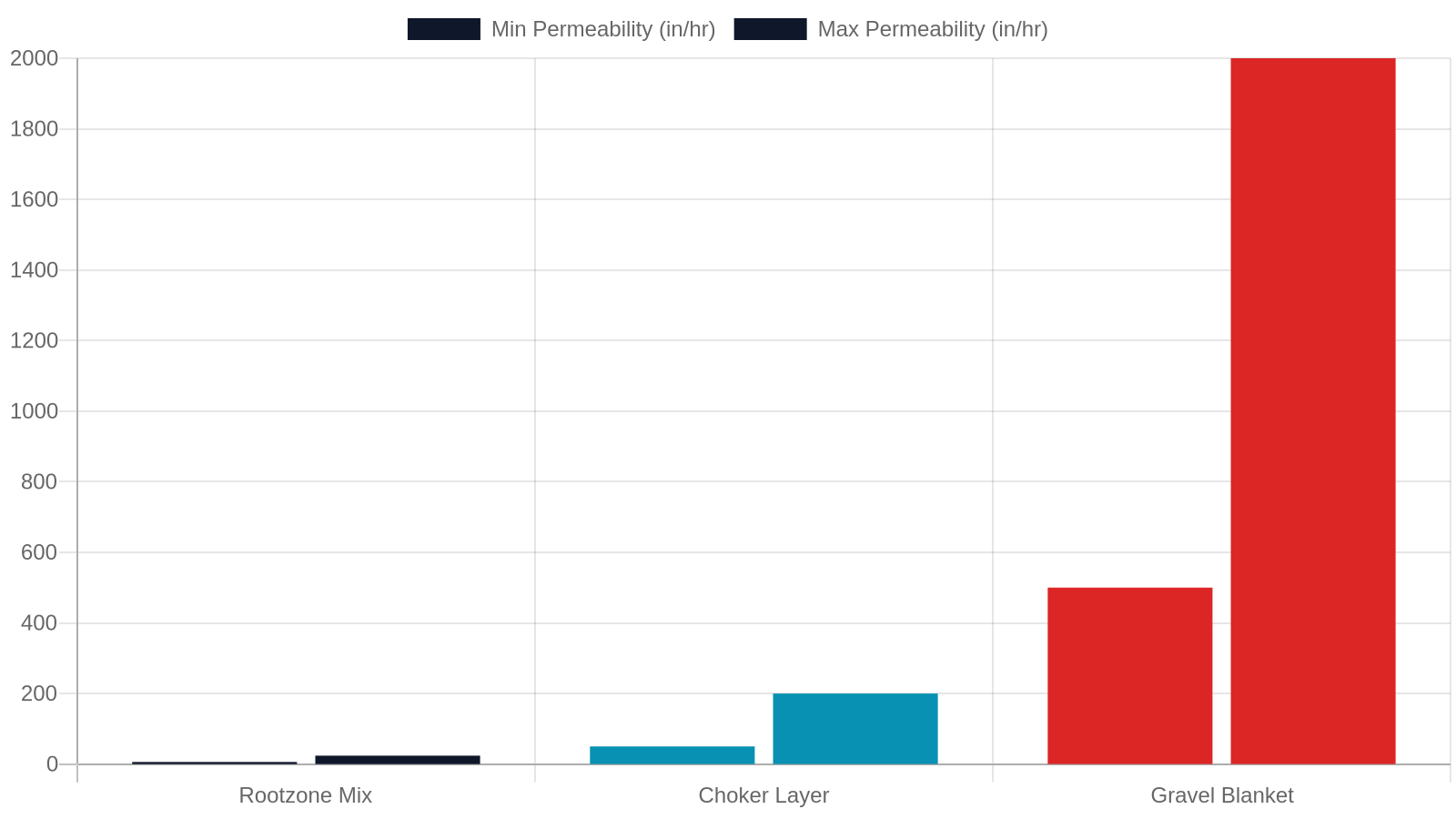
Permeability (hydraulic conductivity) is measured in inches per hour and tells you how fast water moves through the aggregate under gravity. Target values by layer:
- Rootzone mix: 6–24 in/hr (USGA recommends 6–12 in/hr for most fairways)
- Choker layer: 50–200 in/hr
- Gravel blanket: 500–2,000+ in/hr
These rates must be confirmed by lab testing, not assumed from visual inspection or vendor descriptions alone. A material that looks like the right size can still fail permeability requirements if it contains too much fine material or angular particles that pack tightly.
Cleanliness: Silt and Clay Content
Even small amounts of silt or clay contamination dramatically reduce aggregate permeability. The industry standard for drainage aggregate is a maximum of 3% passing the #200 sieve (0.075 mm). Aggregate that has been stockpiled outdoors, transported in dirty trucks, or mixed with native soil on-site can easily exceed this threshold. Jackson Sand mixes aggregate on their own premises and delivers in their own trucks — a supply chain that keeps contamination risk low from batch to finish.
6. Drainage Basins and Outfall Design: Completing the System

Aggregate selection and layer design get most of the attention in fairway drainage projects, but the system cannot function without a properly designed outfall and collection structure. Water that has no clear path to exit will find its own — usually back up through the turf profile or across adjacent areas. Drainage basins and outfall structures are the final link in the chain.
Why the Outfall Is as Important as the Aggregate
A drainage system is only as effective as its ability to discharge collected water. Perforated pipes and aggregate layers move water toward a collection point, but if the outfall — the point where water exits the system — is undersized, blocked, or discharges into a saturated area, the entire system backs up. Outfall design should account for the peak flow rate of the drainage area, typically calculated using the Rational Method (Q = CiA, where C is the runoff coefficient, i is rainfall intensity in in/hr, and A is the drainage area in acres).
Drainage Basins: Catch Basins and Detention Areas
Catch basins — precast concrete or plastic structures installed at low points — collect water from surface swales and subsurface pipes and route it to an outfall or detention pond. Properly sized catch basins prevent the system from surcharging during intense rain events. For golf courses, detention areas or retention ponds also serve as irrigation water sources, turning a drainage liability into an asset. Jackson Sand supplies aggregate materials suited for drainage basin construction, including gravel for basin floors and inlet aprons.
7. Top Dressing and Aeration: Maintaining Drainage Performance Over Time
Installing drainage aggregate is a long-term investment, but it requires ongoing maintenance to deliver long-term results. The two most powerful maintenance tools for preserving fairway drainage — aeration and top dressing — work together to keep the rootzone permeable and the connection between the surface and the drainage aggregate layers open and functional.
How Thatch and Compaction Degrade Drainage
Even a perfectly installed drainage system loses performance over time if the turf surface is not maintained. Thatch accumulation — the layer of undecomposed organic matter between the soil surface and the living turf — acts as a sponge that holds water and slows infiltration. Research shows that a thatch layer exceeding 0.5 inches can reduce surface infiltration rates by 40–60%, effectively negating the drainage capacity of the aggregate layers below. Compaction from cart traffic has a similar effect on the rootzone layer.
Aeration and Top Dressing as Drainage Maintenance
Core aeration — removing plugs of soil and thatch on 2–4 inch spacing — opens channels that allow water to reach the drainage aggregate below. Filling those cores immediately with top dressing sand (matched in particle size to the existing rootzone) accelerates the process and improves long-term drainage capacity. Annual or semi-annual aeration and top dressing is the most cost-effective maintenance practice for preserving fairway drainage performance. Jackson Sand offers both top dressing sand and top dressing services for golf courses in West Tennessee, with sand mixed on-premises to match rootzone specifications.
Drainage Aggregate Options at a Glance: Which Material Goes Where?
Use this table to quickly match the right aggregate type to the correct layer in a fairway drainage system. Particle size, permeability, and function differ significantly across layers.
8. Estimating Quantities: How Much Aggregate Do You Need?

One of the most common project planning mistakes is under-ordering aggregate — which causes delays when a second delivery is needed — or over-ordering, which wastes budget on material that has to be stored or disposed of. Accurate quantity estimation starts with knowing the area, the required depth for each layer, and a compaction factor for the specific material. Here is how to approach the math.
Basic Volume Calculations for Fairway Projects
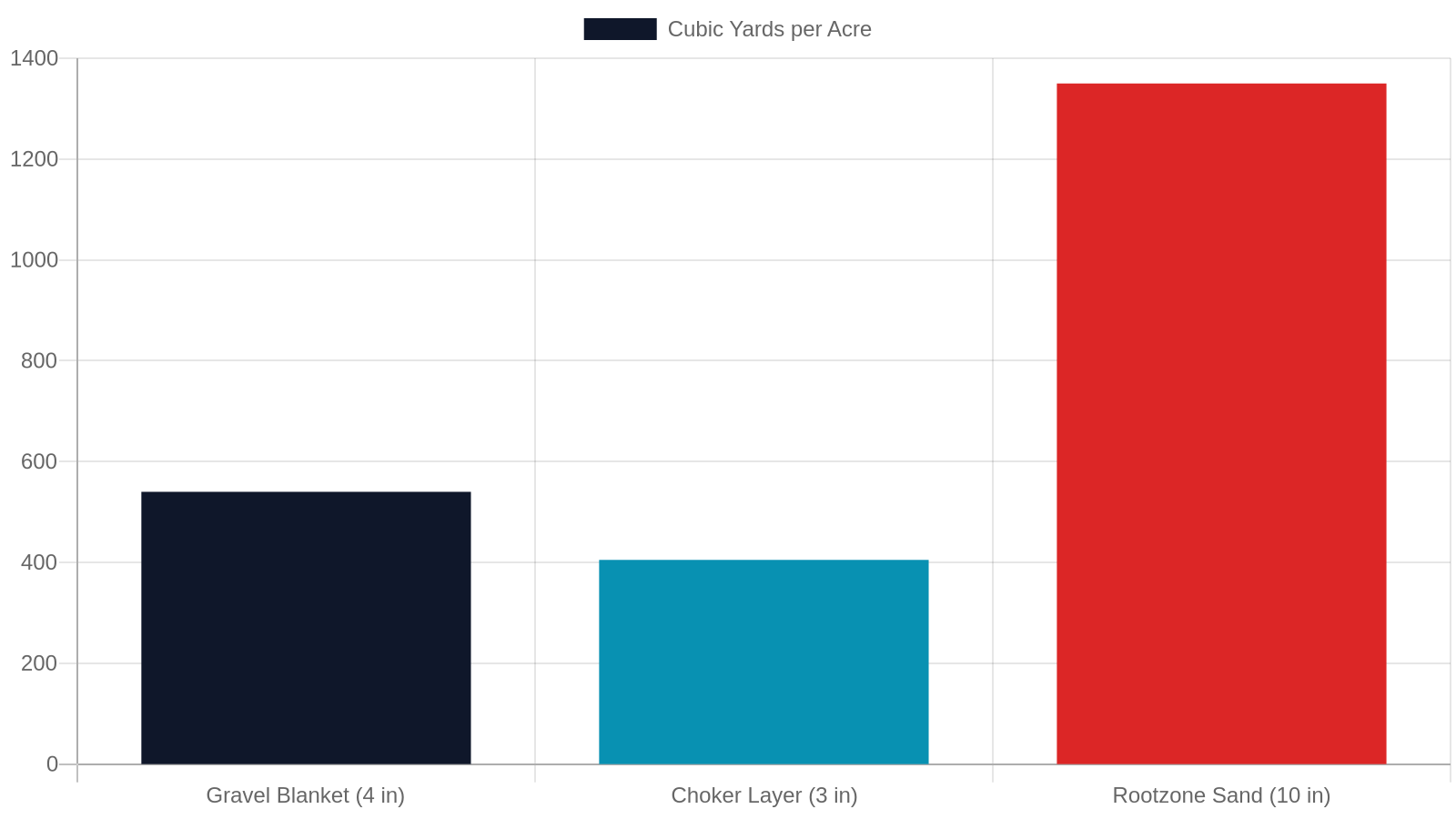
Aggregate quantities for fairway drainage are measured in cubic yards. The basic formula is: Length (ft) × Width (ft) × Depth (ft) ÷ 27 = Cubic Yards. For a typical fairway renovation covering 1 acre (43,560 sq ft) with a 4-inch gravel blanket, you would need approximately 540 cubic yards of gravel. Add the choker layer (3 inches deep over the same area) and you are looking at another 405 cubic yards of coarse sand. These are rough estimates — actual quantities depend on compaction factors, waste, and the specific geometry of the drainage trenches.
Using the Jackson Sand Yardage Calculator
Rather than doing the math by hand, use the Jackson Sand yardage calculator to get a fast, accurate quantity estimate for your project. Enter your area dimensions and desired depth, and the calculator returns the cubic yardage you need. This is especially useful when comparing material quantities across multiple fairway areas or when budgeting for a phased project. Accurate quantity estimates prevent both costly over-ordering and project-stopping shortfalls mid-installation.
9. Working with a Local Supplier: What to Look for Near Jackson, TN

Choosing the right aggregate is only half the equation. Choosing the right supplier — one who can deliver consistent, lab-verified material on time and in clean condition — determines whether the specification you wrote in the office actually shows up on the fairway. For golf courses and contractors in West Tennessee, proximity, product documentation, and delivery reliability are the three criteria that matter most.
Why Local Sourcing Matters for Aggregate Quality
Drainage aggregate sourced locally has two practical advantages over material shipped long distances: shorter transit time means less opportunity for contamination or segregation in transit, and local suppliers are more accountable for product consistency because they depend on repeat business from the same regional contractors and superintendents. A supplier who mixes their own aggregate on-premises — rather than reselling material from multiple sources — can provide consistent particle size and cleanliness batch to batch.
Delivery: Why Truck Ownership Matters
For large fairway projects, aggregate is typically delivered in multiple loads over several days. Using a supplier who owns their own trucks — rather than subcontracting to third-party carriers — gives you more control over scheduling, load accuracy, and material cleanliness. Third-party carriers may haul other materials between loads, introducing contamination risk. Jackson Sand delivers in their own trucks, which means loads arrive clean, accurately measured, and on a schedule that fits the project rather than a carrier’s availability.
Lab-Tested Specs: The Non-Negotiable
Any supplier providing aggregate for a golf course drainage project should be able to produce a current lab test report showing particle size distribution, permeability, and silt/clay content. This is not a premium service — it is a baseline expectation. If a supplier cannot provide lab data, the aggregate cannot be reliably specified or verified against USGA or design standards. Review the Jackson Sand spec sheets for an example of what a properly documented aggregate product looks like.
Ready to Improve Drainage on Your West Tennessee Course?

Fairway drainage is one of the highest-leverage investments a golf course can make in West Tennessee’s wet climate. The right aggregate, properly specified and installed, can transform a course that loses weeks of play every season into one that recovers from heavy rain in hours. Jackson Sand, located at 139 United Dr. in Jackson, TN, is ready to help you get the materials right — from the first spec sheet to the final delivery.
Start with a Conversation, Not a Purchase Order
Every fairway drainage project is different. Soil type, existing grade, pipe network condition, and budget all shape the right material selection and installation sequence. Before ordering aggregate, it is worth talking through your specific situation with a supplier who understands golf course requirements — not just one who sells gravel by the yard. Jackson Sand has experience supplying drainage aggregate, bunker sand, top dressing sand, and related materials to golf courses across West Tennessee and the Mid-South.
Get the Right Materials Delivered to Your Course
Whether you are renovating a single problem fairway or rebuilding an entire drainage network, Jackson Sand can supply the aggregate you need — mixed on-premises, delivered in their own trucks, and backed by lab-tested spec sheets. Explore the full range of golf course maintenance materials and services from Jackson Sand, or call the team directly at 731-668-0440 to discuss your project. They serve large and small jobs alike, and delivery is included.
Frequently Asked Questions
What type of drainage aggregate is best for golf course fairways?
A three-layer system works best: a medium-to-coarse sand rootzone (0.25–1.0 mm), a coarse sand or fine gravel choker layer (2–4 mm), and a pea gravel blanket (6–9 mm) above perforated drain pipes. Each layer must be lab-tested to confirm particle size and permeability before installation.
How much drainage aggregate do I need for a fairway renovation?
A one-acre fairway with a 4-inch gravel blanket and 3-inch choker layer requires roughly 540 and 405 cubic yards of aggregate respectively, before adding rootzone sand. Use the Jackson Sand yardage calculator at jacksonsand.com/yardage-calculator/ for a project-specific estimate.
How long does a properly installed fairway drainage system last?
A well-designed system with correctly specified aggregate can last 20–30 years or more. Performance degrades faster when the choker layer is omitted (allowing fines to clog the gravel blanket) or when annual aeration and top dressing are skipped, which allows thatch and compaction to reduce surface infiltration.
Can I use regular gravel from a landscape supplier for fairway drainage?
Not reliably. Landscape gravel is rarely sieved to the tight particle size windows required for drainage aggregate, and it often contains silt or clay contamination above the 3% maximum acceptable for golf course applications. Always request a lab-tested particle size distribution report before specifying any aggregate for a golf course drainage project.
Does Jackson Sand deliver drainage aggregate to golf courses in West Tennessee?
Yes. Jackson Sand, based in Jackson, TN, delivers drainage aggregate, bunker sand, top dressing sand, and other materials in their own trucks to golf courses across West Tennessee and the Mid-South. Delivery is included. Call 731-668-0440 to discuss your project.
What is the difference between surface drainage and subsurface drainage for fairways?
Surface drainage uses slope and grading (swales, channels) to move water off the fairway before it infiltrates. Subsurface drainage uses perforated pipes and aggregate layers to collect and remove water that has already infiltrated the soil. Most West Tennessee fairways benefit from a combination of both approaches.