

Building a Sand Top Dressing Program for Mid-South Golf Greens
Quick answer: A good top dressing program applies sand lightly and often during active growth, adds heavier applications to fill aerification holes, and uses one consistent sand that matches the root zone. In the Mid-South, core aerify bermudagrass greens in early to midsummer and bentgrass in spring and early fall. Use USGA-spec Regular Top Dressing as the base and Champion for light dusting on ultradwarfs.
Why a Program Beats Occasional Top Dressing
Most superintendents top dress. Far fewer run a true top dressing program, with planned rates, a calendar, a consistent sand and a way to measure results. The difference shows up over years. Greens on a steady program stay firm, drain well, and putt smoothly through the season. Greens that get sand only when someone remembers, or only after aerification, tend to build layers of organic matter separated by bands of sand. Those layers hold water, soften the surface, and limit rooting.
Turfgrass produces organic matter every day it grows. Top dressing works mainly by diluting that organic matter with sand as it forms. If sand goes down at roughly the same pace as growth, the surface zone stays a uniform blend of sand and organic material. If sand goes down in big, irregular doses, the profile records each one as a separate layer.
A program also makes budgeting and ordering predictable. When you know your annual sand volume and the timing of heavy applications, you can schedule deliveries, plan labor, and avoid emergency orders in the middle of the season.
This guide walks through the pieces of a program for greens in the Mid-South, where bermudagrass and bentgrass greens both remain common and summers are long, hot and humid. It covers goals, frequency, rates, aerification timing for each grass, matching sand to the root zone, and choosing between Jackson Sand’s Regular Top Dressing and Champion Bermuda Top Dressing. The principles also apply to tees and, at a larger scale, to fairways and athletic fields.
Set the Goals of Your Program
Before choosing rates and dates, be clear about what you want the program to accomplish. Most greens programs aim at four outcomes.
Control organic matter
This is the primary goal. Organic matter in the top inch or two of a green holds water, softens the surface and supports disease. Many superintendents track it with periodic lab testing, usually reported as percent organic matter by weight at several depths. Rising numbers mean the program is not keeping pace; stable or falling numbers mean it is.
Maintain infiltration
Greens must drain. A program that dilutes organic matter with a sand matched to the root zone keeps infiltration rates healthy. Lab tests from an accredited physical soil testing lab give you an objective baseline to compare year over year.
Improve surface quality
Smoothness, trueness and green speed improve with consistent light applications. Sand fills small irregularities and keeps the canopy tight.
Support firmness
Firm greens resist ball marks, hold their shape under traffic, and reward well-struck approach shots. A sand-rich surface is firmer than a thatchy one.
Write the goals down
Put specific targets in your program document: an organic matter trend you want to see, a target infiltration rate, and green speed goals by season. Record your starting point. Without a baseline, it is impossible to tell whether the program is working or whether it needs more sand, more aerification, or a different product.
Clear goals also help when talking with your green committee or ownership. A program grounded in lab data and measurable outcomes is easier to defend than one that rests on habit.
How Often to Top Dress
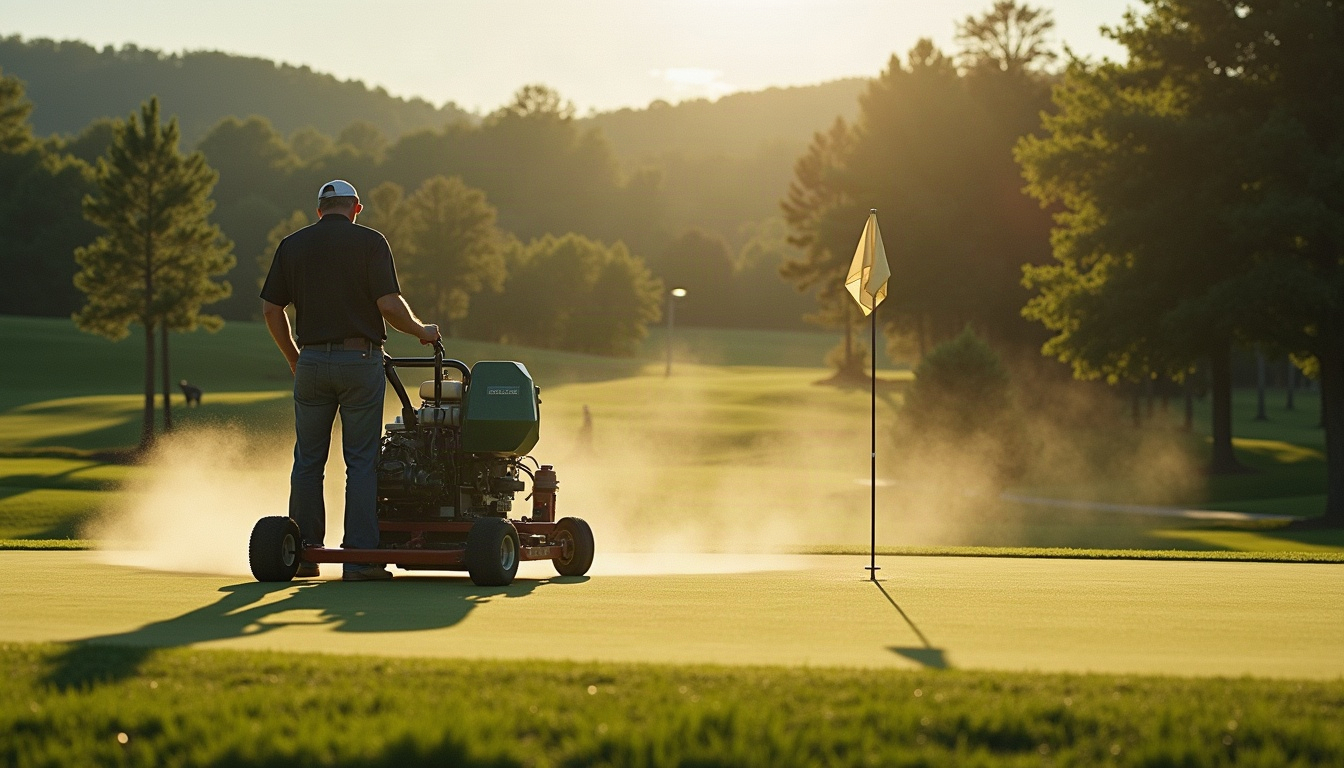
Frequency should follow growth. The faster your turf is growing, the more organic matter it produces, and the more often it needs sand. That is why the most effective programs are built around the growing season rather than a fixed calendar interval all year.
During active growth
Light applications every one to three weeks are common on greens during active growth. Ultradwarf bermudagrass greens in peak summer often sit at the frequent end of that range, around every week or two, because they produce organic matter quickly. Bentgrass greens in the Mid-South usually see lighter, less frequent applications during summer stress, with more activity in spring and fall when the turf grows well.
During slow growth or dormancy
When turf is barely growing, sand cannot be incorporated well and can abrade leaves. Bermudagrass going dormant in late fall and winter needs little or no routine top dressing. Some superintendents apply a heavier layer before dormancy to protect crowns, but routine dusting usually stops.
Adjusting on the fly
Signs you need to top dress more often include:
- Greens feeling soft or puffy underfoot
- Footprinting and deep ball marks
- Scalping when mowing heights are lowered
- Organic matter test results trending upward
Signs you may be overdoing it include sand that will not disappear into the canopy after brushing, excessive mower wear, and sand building up on the surface. Growth regulators, nitrogen rates and weather all shift how fast turf grows, so adjust frequency through the season rather than locking in a single interval.
Light vs. Heavy Application Rates
Most programs combine two kinds of applications: light, frequent dustings to keep up with growth, and heavy applications timed with aerification. Each has its own purpose.
| Application type | Typical depth | Approx. sand per 1,000 sq ft | Purpose |
|---|---|---|---|
| Very light dusting | 1/32 inch | About 2.6 cu ft | Frequent maintenance, minimal disruption to play |
| Light | 1/16 inch | About 5.2 cu ft | Routine maintenance during strong growth |
| Moderate | 1/8 inch | 10.4 cu ft (0.4 cu yd) | Leveling, after solid-tine or light venting |
| Heavy | 1/4 inch or more | About 20.8 cu ft or more | Filling core aerification holes |
Why light and frequent matters
Light applications incorporate into the canopy quickly, disrupt play little, and keep the surface zone uniform. Heavy applications at long intervals tend to create sand layers sitting on organic layers, which is exactly what a program is trying to avoid.
Why heavy applications still have a place
Aerification holes need to be filled to create sand channels through the profile. Filling them takes a lot of sand at once. That heavy application is not a layer on top of the surface; most of it goes into the holes.
Annual volume
Add up your light and heavy applications to get annual sand volume per 1,000 square feet, then multiply by total green area. Compare year over year alongside organic matter test results. If organic matter keeps climbing, your annual volume or aerification program likely needs to increase. A free yardage calculator helps convert any area and depth into cubic yards for ordering.

Aerification Timing for Mid-South Bermudagrass Greens

Bermudagrass is a warm-season grass. It grows hardest in heat, recovers fastest in summer, and goes dormant as temperatures drop in fall. That sets the calendar for aerification and heavy top dressing on bermudagrass greens in West Tennessee and the rest of the Mid-South.
Core aerification windows
The best time to core aerify bermudagrass greens is when the turf is actively growing and soil temperatures are warm, typically from late spring through midsummer. In the Mid-South, many courses schedule core aerification between late May and July. That gives the turf time to heal before cooler weather, and it puts the most disruptive work in the period of fastest recovery.
Many superintendents core aerify bermudagrass greens two or more times during the season, then supplement with solid-tine or needle-tine venting in between to keep the surface open.
Heavy top dressing after coring
After pulling cores, remove them or break them up depending on your goals, then top dress heavily enough to fill the holes. Drag or brush the sand in and repeat until the holes are full. Use a USGA-spec sand for this fill so the channels drain well.
Late season
Avoid heavy disruptive work late in the season. Bermudagrass needs time to recover before dormancy. Some superintendents apply a moderate top dressing before dormancy to protect crowns from winter injury and traffic, while routine light dusting ends as growth slows.
Spring green-up
In spring, as bermudagrass breaks dormancy, light top dressing can help smooth surfaces. Jackson Sand’s green dyed divot sand is also used as a spring top dressing for quicker green-up on bermudagrass.
Aerification Timing for Mid-South Bentgrass Greens
Creeping bentgrass is a cool-season grass. It grows best in spring and fall and struggles in the hot, humid summers typical of the Mid-South. That flips the calendar compared with bermudagrass.
Spring and fall windows
Core aerification on bentgrass greens is typically scheduled in spring, roughly March to April, and in late summer to fall, roughly late August through October, depending on weather. These are the periods when bentgrass grows actively and can recover from coring before the stress of summer or the slowdown of winter.
Summer caution
Aggressive aerification and heavy top dressing during midsummer heat can stress bentgrass badly. Many superintendents limit summer work to light venting with small solid tines to improve gas exchange and water movement, and keep top dressing applications very light, if they apply at all. Sand on stressed leaves can abrade them, and heat magnifies the damage.
Light top dressing through the season
During spring and fall growth, light applications every two to three weeks are common on bentgrass. That frequency keeps organic matter diluted without overwhelming the turf.
Choosing the sand
Regular Top Dressing, which meets USGA spec, is the standard choice for bentgrass greens, both for routine dusting and for filling aerification holes. Champion Bermuda Top Dressing is designed for ultradwarf bermudagrass and is not typically used on bentgrass.
Mixed courses
Some Mid-South courses have bentgrass greens with bermudagrass fairways and tees. That means two aerification calendars on the same property. Plan sand deliveries around both so you have the right volume on hand in spring, summer and fall.
Matching Top Dressing Sand to Your Root Zone
The most common mistake in top dressing programs is using a sand that does not match the root zone. Because regularly applied top dressing eventually becomes the upper part of the root zone, any mismatch creates a layer that changes how water moves.
Why layers form
Water moves slowly from a finer layer into a coarser one. If you apply a finer sand over a coarser root zone, water tends to hang at the interface, keeping the surface wet. If you apply a coarser sand over a finer root zone, the top can dry out and fail to hold moisture. Either way, roots and turf health suffer.
How to match
- Test the existing root zone. Send samples from several greens to an accredited physical soil testing lab and get particle size distribution, infiltration and organic matter.
- Compare to candidate sands. Look at the lab sheets side by side. Jackson Sand publishes analyses for its products on the sand specs page.
- Prioritize similar particle distribution. The coarse plus medium fraction, and the fine and very fine fractions, should be in the same general range as your root zone.
- Stay with one sand. Once you pick a sand, use it consistently. Switching sands every year builds layers just as surely as using a mismatched sand.
Regular Top Dressing as a baseline
Jackson Sand’s Regular Top Dressing is 98.9% sand with 81.4% in the coarse plus medium range and only 0.5% silt and 0.5% clay. It is built to meet USGA specifications, which makes it a good match for greens built to USGA recommendations. Older push-up greens with native soil may need a closer look before choosing a sand.
For new construction or rebuilds, greens mixes and root zone mixes blended with peat or porous ceramic Profile can be matched to your design. The top dressing page lists the available blends.
Choosing Between Regular and Champion Top Dressing
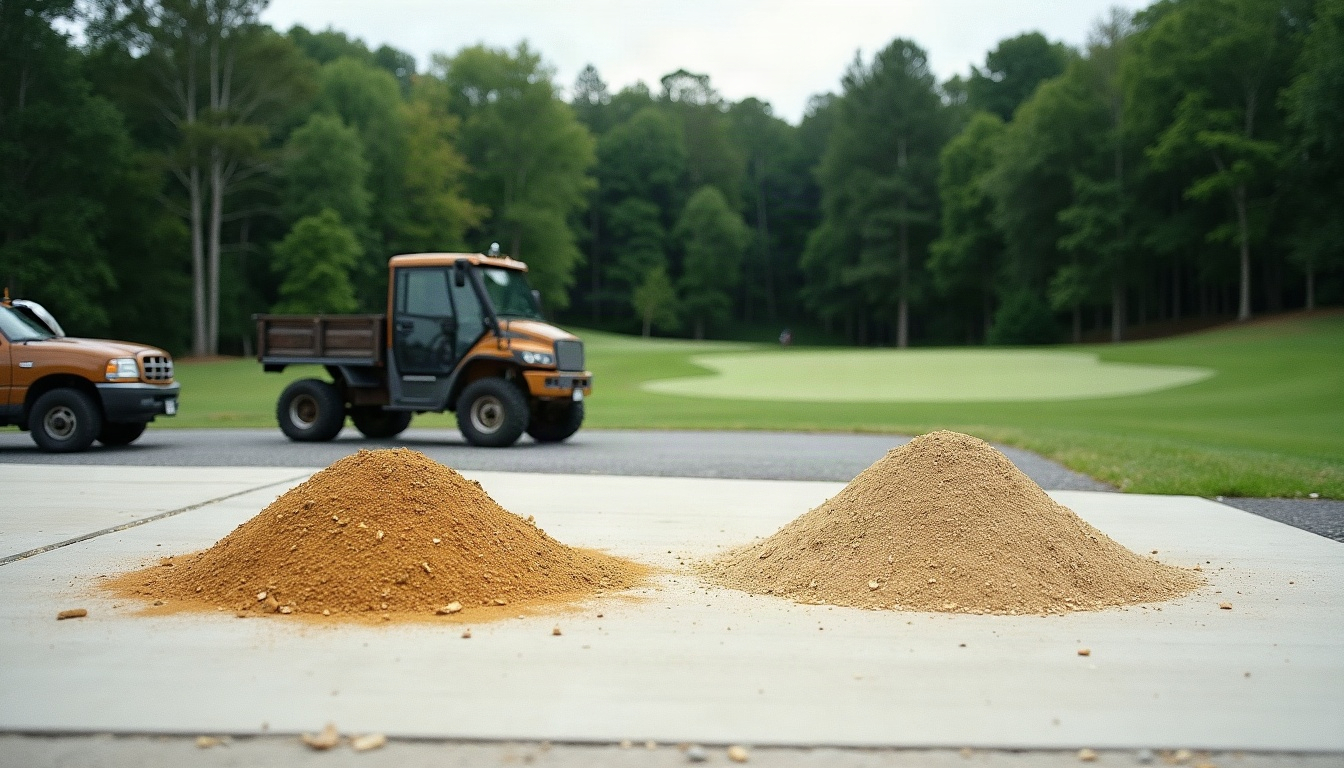
For bermudagrass and bentgrass greens, Jackson Sand offers two top dressing sands. Many ultradwarf programs use both. Here is how they compare.
| Feature | Regular Top Dressing | Champion Bermuda Top Dressing |
|---|---|---|
| USGA spec | Meets spec | Does not meet spec, by design |
| Coarse plus medium sand | 81.4% | 13.9% (medium only) |
| Fine plus very fine sand | 15.1% | 86.1% |
| Gravel and very coarse | 2.5% | 0% |
| Best for | Bentgrass, standard bermudagrass, aerification fill, tees, fairways | Ultradwarf bermudagrass greens mowed as low as 0.120 inch |
| Mower and bedknife wear | Standard | Reduced, largest particles removed |
| Effect on perc rate | Supports drainage | Lowers perc rate somewhat |
A two-sand program for ultradwarfs
A common approach on ultradwarf greens is to use Champion for routine light dusting during the season, because it works into the dense canopy quickly, spares reels and bedknives and supports faster ball roll. Then use Regular Top Dressing to fill core aerification holes. The Regular sand channels carry water through the surface and offset Champion’s effect on perc rate.
A one-sand program for bentgrass
For bentgrass greens, use Regular Top Dressing for both routine and heavy applications. One consistent sand keeps the profile uniform.
Whichever approach you choose, monitor infiltration and organic matter. If drainage trends down, shift more volume to Regular Top Dressing and increase aerification.
Ordering, Storage and Supply Planning
A program depends on having the right sand on hand when you need it. Running out in the middle of an aerification week, or receiving a load that does not match the last one, can set a program back.
Estimate annual volume
Total your planned applications for the year. For example, twenty light applications at 1/32 inch is about 52 cubic feet per 1,000 square feet. Add two core aerification fills at around 1/4 inch each, about 42 cubic feet, for a total near 94 cubic feet, or about 3.5 cubic yards per 1,000 square feet per year. Multiply by your total green area. A course with 100,000 square feet of greens would need roughly 350 cubic yards under that scenario. Your numbers will differ, but working through the math gives you a realistic order plan.
Stage deliveries
Schedule larger deliveries ahead of aerification windows and smaller ones through the season for routine applications. This keeps sand fresh and dry and limits how much storage space you need.
Store it right
- Use a clean, hard pad, ideally concrete, separate from soil and gravel.
- Cover sand to keep it dry. Wet sand clumps and spreads unevenly.
- Keep different sands in clearly separated bins to avoid mixing.
Insist on consistency
Ask for a current lab analysis and confirm that every load comes from the same product. Jackson Sand washes and classifies sand at its own plant in Jackson, mixes on its own premises, and hauls in a fleet of around 14 of its own trucks, so there is no cross-contamination from other materials. Its trucks run daily from as early as 6 a.m., which helps when you need sand in place before an aerification crew starts.
Build Your Program With Jackson Sand
A sand top dressing program comes down to a few principles: apply sand at a pace that matches growth, fill aerification holes with a USGA-spec sand, time disruptive work to the right season for your grass, match your sand to the root zone, and stay with one product. Measure organic matter and infiltration so you know the program is working.
Jackson Sand has been in production since around 1996 and has focused on golf-course-grade bunker sands, top dressings and root zone mixes since about 1998. From its yard in Jackson, Tennessee, it supplies golf courses across West Tennessee and the Mid-South, from Huntsville, Alabama to Jackson, Mississippi and Little Rock. Learn more on the golf course maintenance page.
To plan this season’s sand, request lab sheets, or schedule deliveries around your aerification calendar, call 731-668-0440 or contact Jackson Sand.
Inside the Jackson Sand Plant
Take a 90-second look at where our sand comes from: the washing plant, screens and conveyors, and the Jackson Sand truck fleet that delivers every load. President Carlton Pope tells the story of how the company grew from one truck in 1996.
Sources and Further Reading
- benefits of light and frequent topdressing (USGA research) (USGA)
- USGA: Aeration, get it done! (USGA)
- NC State Extension: aeration and topdressing rates on greens (anthracnose) (NC State Extension)
- UT Extension turfgrass topdressing guide (W161-N) (University of Tennessee Extension)
Frequently Asked Questions
How often should I top dress golf greens?
Match frequency to growth. During active growth, light applications every one to three weeks are common. Ultradwarf bermudagrass greens in summer often need sand every week or two, while Mid-South bentgrass greens see more activity in spring and fall and lighter applications in summer heat. Slow or dormant turf needs little routine top dressing.
When should bermudagrass greens be core aerified in the Mid-South?
Bermudagrass recovers fastest in warm weather, so most Mid-South courses core aerify bermudagrass greens between late May and July. That gives the turf time to heal before fall. Fill the holes with a USGA-spec top dressing sand, and avoid heavy disruptive work late in the season as bermudagrass approaches dormancy.
When should bentgrass greens be aerified in Tennessee?
Bentgrass is a cool-season grass, so core aerification is usually scheduled in spring, around March to April, and again from late August through October, depending on weather. Midsummer heat stresses bentgrass, so summer work is usually limited to light venting with small tines and very light top dressing.
How much top dressing sand do greens need per year?
It varies with growth rate and aerification program. As one example, twenty light 1/32 inch applications plus two 1/4 inch aerification fills total about 94 cubic feet, or roughly 3.5 cubic yards, per 1,000 square feet per year. Track organic matter tests to see whether your volume is keeping pace.
Why does top dressing sand need to match the root zone?
Regular top dressing eventually becomes the upper part of the root zone. If it is finer or coarser than the sand below, it creates a layer that slows water movement or dries out. Test your root zone, compare lab sheets, choose a sand with a similar particle distribution, and stay with that sand.
Should I use Regular or Champion top dressing on my greens?
Use Regular Top Dressing, which meets USGA spec, for bentgrass greens, standard bermudagrass greens and all aerification fills. On ultradwarf bermudagrass greens mowed very low, many superintendents use Champion for routine light dusting to protect mowers and boost green speed, then fill aerification holes with Regular to protect drainage.
Ready to order or have a question about the right material? Call Jackson Sand at 731-668-0440 or send us a message and we will help you pick the right product and quantity.
Leave a Reply