

Regular Bunker Sand: Lab Spec, Drainage and Playability Guide
Quick answer: Regular Bunker Sand from Jackson Sand in Jackson, Tennessee is a clean, medium-centered bunker sand: 99.3% sand, under 1% silt and under 1% clay, with 78.6% of particles between 0.25 and 1.0 mm. Its D85 of 0.49 mm and uniformity coefficient of 2.0 point to fast drainage, consistent lies and easy raking for golf courses across West Tennessee.
What Regular Bunker Sand Is and Who It Is For
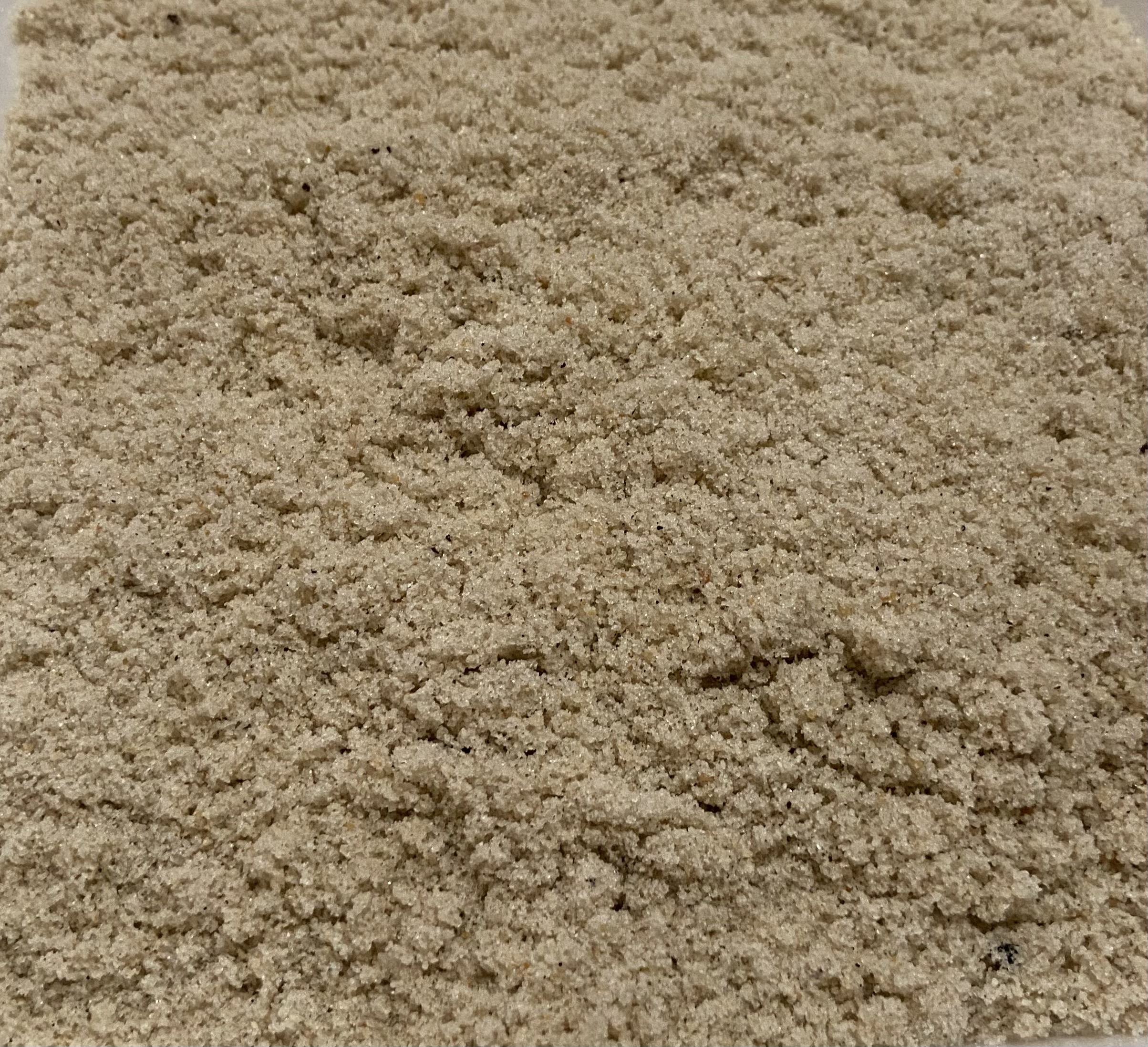
Regular Bunker Sand is the everyday workhorse bunker sand from Jackson Sand in Jackson, Tennessee. It is built for golf course bunkers that need to drain fast, hold a consistent lie and stand up to daily raking, mowing traffic and summer storms across West Tennessee and the Mid-South. It is not a decorative fill sand and it is not a top dressing. It is a graded, washed-clean sand whose particle sizes are concentrated in the range that golf course agronomists recommend for hazards.
The people who order it tend to fall into three groups:
- Golf course superintendents refreshing worn bunkers, topping up floors that have thinned below playable depth, or replacing contaminated sand after a renovation.
- Golf course builders and contractors filling new or rebuilt bunkers who need a sand that will match a written spec and behave predictably once installed.
- Private owners and practice facilities building a backyard short-game area or a practice bunker who want the same material a course would use instead of play sand from a big-box store.
The reason a lab report matters is simple. Two sands can look identical in a pile and play completely differently in a bunker. One drains in minutes and gives a clean lie; the other crusts, holds water and buries every ball that lands softly. The only reliable way to tell them apart before you install 100 tons is to read the particle size analysis. This guide walks through Jackson Sand’s Regular Bunker Sand report line by line and explains what each number means on the golf course. For the full set of reports on every product, see the sand specs page.
The Full Lab Report at a Glance

Here is the particle size distribution for Regular Bunker Sand as reported by the lab. The sieve sizes are the standard ones used in golf course sand testing, and each percentage is the share of the sample by weight that falls in that size class.
| Size class | Particle diameter | Regular Bunker Sand | What it does in a bunker |
|---|---|---|---|
| Gravel | over 2.0 mm | 0.1% | Rocks that can damage clubs and catch rakes; should be near zero |
| Very coarse sand | 1.0 to 2.0 mm | 1.5% | Adds stability but can scatter and feel stony at high levels |
| Coarse sand | 0.5 to 1.0 mm | 10.7% | Firms the surface, resists wind, drains freely |
| Medium sand | 0.25 to 0.5 mm | 67.9% | The core of a good bunker sand: drainage plus playable texture |
| Fine sand | 0.15 to 0.25 mm | 18.0% | Fills voids, adds firmness, slows drainage if excessive |
| Fine sand (lower band) | 0.10 to 0.15 mm | 1.1% | Small fraction; little effect at this level |
| Very fine sand | 0.05 to 0.10 mm | 0.2% | Can migrate and seal pores when present in quantity |
| Silt | 0.002 to 0.05 mm | under 1.0% | Main cause of crusting and slow infiltration |
| Clay | under 0.002 mm | under 1.0% | Binds surface into a crust, stains, holds water |
Two summary values round out the report: a D85 of 0.49 mm and a uniformity coefficient (Cu) of 2.0. Total sand content is 99.3%.
If you add the coarse and medium fractions together you get 78.6% of the sample sitting between 0.25 and 1.0 mm. That is the single most useful number on the page, and it is well above the 65% minimum that is widely used as a guideline for bunker sand. The rest of this guide explains why.
99.3% Sand and Under 1% Silt and Clay: Why the Fines Matter Most
Start with the bottom of the table, because that is where most bunker problems come from. Silt and clay are the particles too small to see individually. In a bunker they act like glue. After rain or irrigation they wash down between the sand grains, then dry into a thin surface crust or a dense layer a few inches down. Either one slows water movement and changes how the ball sits.
Regular Bunker Sand tests at 99.3% sand with less than 1.0% silt and less than 1.0% clay. Practically, that means very little material is available to form a crust or to plug the bunker drain. A few things follow from that:
- Faster recovery after storms. Low-fines sand lets water move straight down to the drainage system instead of ponding on the surface. Crews spend less time pushing up washouts and pumping low spots.
- Cleaner lies. A crusted surface can deflect a ball, then let it settle into a softer layer underneath. Low silt and clay keeps the surface texture consistent from the lip to the floor.
- Less staining and color change. Clay tends to discolor sand and stain balls, shoes and equipment. Keeping it under 1% keeps the bunker looking clean longer.
- Healthier drains. Fines are what eventually clog drain lines and gravel layers. Starting low buys years of service.
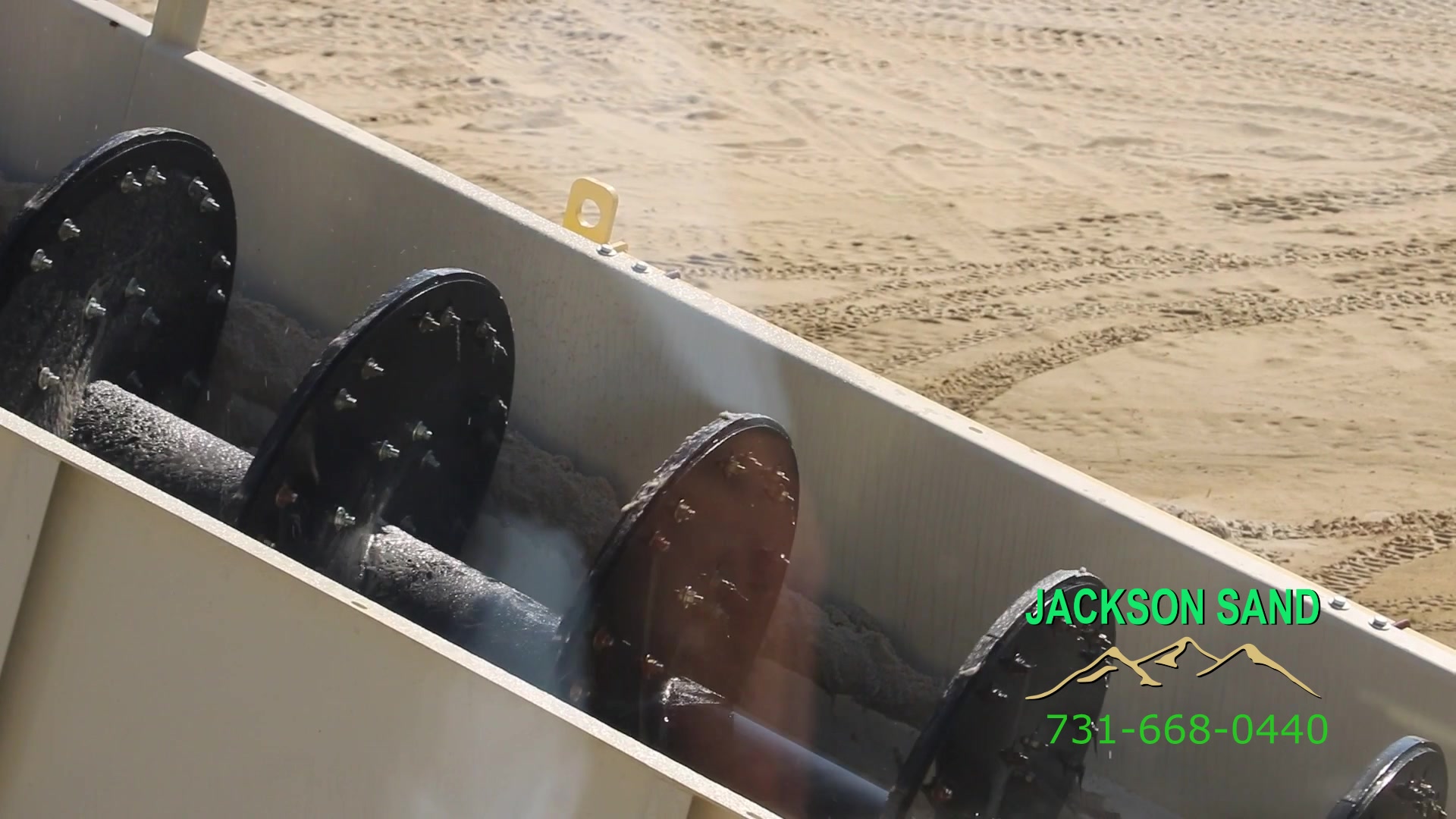
Clean sand starts at the plant. Jackson Sand washes its sand through screw classifiers and dewatering screens before it is stockpiled, which strips out much of the silt and clay before the material ever reaches a truck.
Keep in mind that fines are not only something you buy; they are something a bunker collects. Soil washes in from the surrounding turf, organic matter breaks down, and wind deposits dust. That is why starting with the cleanest sand you can get matters. Jackson Sand runs its own trucks, which means no leftover topsoil or gravel from someone else’s load gets mixed into your bunker sand on the way to the course. Contamination from a dirty truck bed can add exactly the fines you paid to avoid.
The Medium Fraction: 67.9% Between 0.25 and 0.5 mm
The medium sand fraction is where a bunker sand earns its keep. Particles between 0.25 and 0.5 mm are large enough to leave generous pore spaces for water to drain, yet small enough to give the sand a soft, uniform texture that responds well to a rake and to a club.
At 67.9% medium sand, Regular Bunker Sand is heavily centered on that range. Why does a tight concentration help?
- Predictable playability. When most of the grains are about the same size, the bunker plays the same way in the front, the back, the face and the floor. Golfers get the same splash and the same release on every shot.
- Good drainage. Similar-sized grains do not nest tightly together, so the pore network stays open. Water moves through quickly.
- Easy raking. Medium sand moves easily under a hand rake or a mechanical rake and smooths out without leaving clumps.
The trade-off with a sand dominated by one size class is that it can be a bit softer underfoot than a broader blend. That is where the coarse and fine fractions come in. They add enough variety to the grading to let the grains lock together somewhat, which firms the surface and reduces buried lies, without filling all the pores. You will see that balance reflected in the uniformity coefficient later in this guide.
For most parkland courses in West Tennessee, a medium-dominant sand like this is the right starting point. It handles the region’s heavy spring rains and humid summers, it plays well for golfers of all handicaps, and it does not demand specialized equipment or unusual maintenance.
Coarse, Very Coarse and Gravel: Firmness, Splash and Wind

Above the medium fraction sit three classes: coarse sand (0.5 to 1.0 mm), very coarse sand (1.0 to 2.0 mm) and gravel (over 2.0 mm). Regular Bunker Sand reports 10.7% coarse, 1.5% very coarse and 0.1% gravel.
Coarse sand adds structure
Coarse particles are the skeleton of a firm bunker. They resist displacement when a ball lands, which helps the ball sit up rather than plug. They also resist wind. On exposed holes, a bunker with too little coarse material can lose sand off the faces during a dry, windy week. About a tenth of the sample in the coarse class gives Regular Bunker Sand some of that structure while keeping it soft enough to play from comfortably.
Very coarse sand and gravel should stay low
Above 1.0 mm, the benefits start to come with costs. Very coarse grains can feel stony, scatter onto greens during explosion shots and nick club faces. Gravel is worse: it chips leading edges, catches in rake tines and ends up on putting surfaces where it can damage reel mowers. Most bunker sand guidance calls for very little very coarse sand and essentially no gravel. With 1.5% very coarse and 0.1% gravel, Regular Bunker Sand keeps both at levels you will rarely notice.
Splash onto the green
Every bunker shot throws sand onto the putting surface. Over a season that adds up to a meaningful layer around the collars and approaches. A sand with very little material above 1.0 mm is far kinder to greens mowers and to the putting surface than a sand with a heavy coarse tail. That is one of the quieter reasons superintendents care about the top end of the distribution.
The Fine Tail: 18% at 0.15 mm and What It Does
Below the medium fraction, Regular Bunker Sand reports 18.0% fine sand in the 0.15 to 0.25 mm band, 1.1% in the 0.10 to 0.15 mm band and 0.2% very fine sand. Altogether, about 19.3% of the sample is finer than 0.25 mm.
Fine sand is not the enemy that silt and clay are. In moderate amounts it is useful. Fine grains slip into the spaces between medium and coarse grains, which increases contact between particles and makes the surface firmer. A firmer surface means fewer buried lies and less of the dreaded fried-egg lie, where a ball lands and sits in its own crater.
Too much fine sand, however, has three downsides:
- Slower drainage. Fine grains reduce pore size. Past a certain point, water moves noticeably slower.
- More crusting potential. Fine and very fine sand can pack into a thin skin on the surface after heavy rain, especially when combined with silt.
- Wind and migration. Fine particles blow and wash more easily, which can change the grading of the bunker over time.
The useful observation here is where the fines sit. Almost all of Regular Bunker Sand’s finer material is in the upper part of the fine range, right below 0.25 mm. Only 1.3% falls below 0.15 mm. That pattern gives the firming benefit of fine sand while keeping the drainage-robbing very fine material to a minimum. It is one of the reasons the sand can be both reasonably firm and fast draining.
D85 = 0.49 mm and a Uniformity Coefficient of 2.0
The last two numbers on the report summarize the whole distribution in a way engineers and architects can drop straight into a specification.
D85: the size that 85% of the sand is smaller than
D85 means 85% of the sample by weight is finer than that diameter. For Regular Bunker Sand, D85 is 0.49 mm, just under the 0.5 mm boundary between medium and coarse sand. That agrees with the table: roughly 88% of the sample is finer than 0.5 mm.
D85 matters most when bunker sand sits on top of a gravel drainage layer or a liner system. The question is whether the sand will stay put or wash down into the gravel. Golf construction borrows a bridging rule from USGA putting green guidance: the D15 of the gravel should be no more than about five times the D85 of the material above it. With a D85 of 0.49 mm, that works out to a gravel D15 of roughly 2.45 mm or smaller. Your architect or bunker liner manufacturer will have the final word, but D85 is the number they will ask for.
Cu: how uniform the sand is
The uniformity coefficient is D60 divided by D10, where D60 and D10 are the sizes that 60% and 10% of the sample are finer than. A Cu near 1 would mean every grain is the same size. Larger numbers mean a broader spread of sizes.
A Cu of 2.0 describes a fairly uniform sand. In practical terms:
- It drains well, because uniform grains leave open pores.
- It rakes smoothly and plays consistently.
- It is less prone to packing into a hard, concrete-like layer than a broadly graded sand.
- It is somewhat softer than a broadly graded sand, so depth control and moisture matter for lie quality.
Put D85 and Cu together and you have a picture of a medium-centered, uniform, clean bunker sand that drains and plays predictably.
Drainage, Depth and Installation Tips
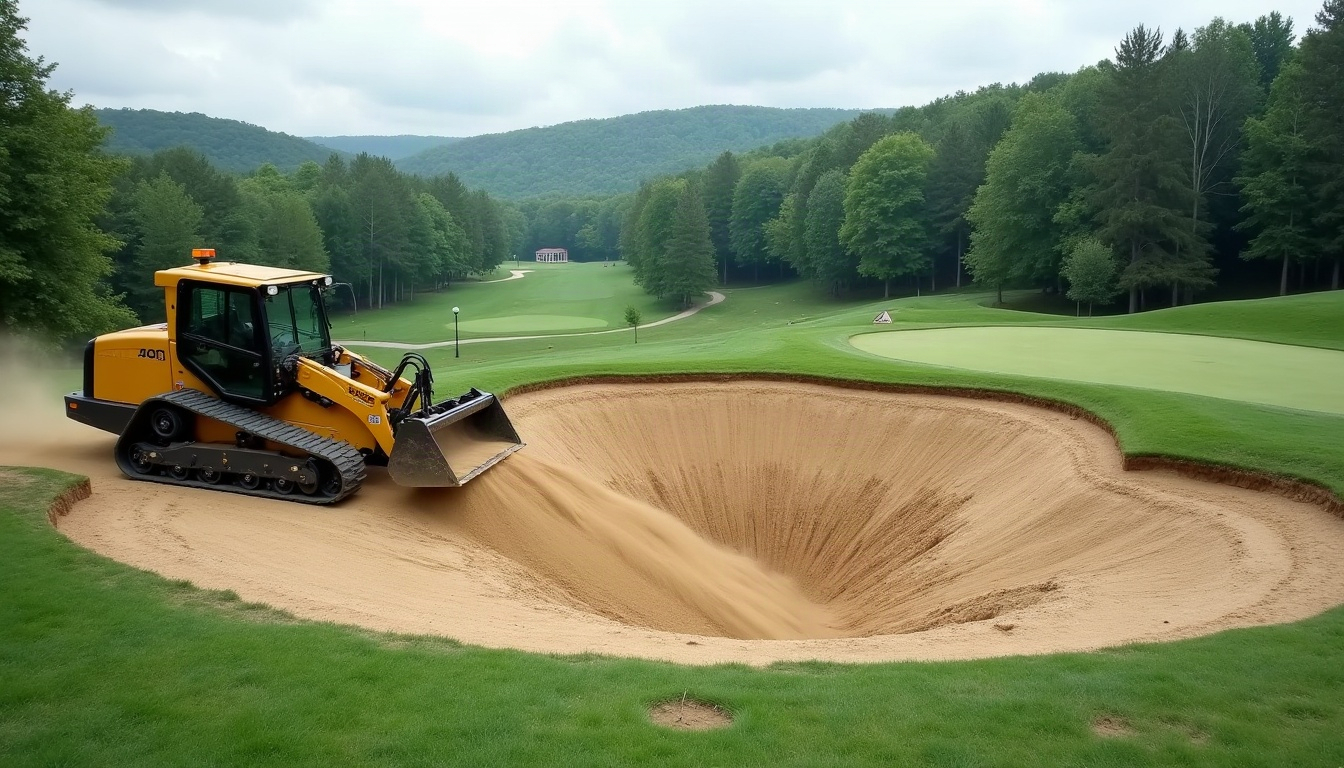
A good lab report only pays off if the sand goes in correctly. A few installation practices make a big difference in how Regular Bunker Sand performs.
Depth
Plan for a minimum of 4 inches of sand on bunker floors after settling. Thinner floors let the subsoil contaminate the sand, expose liners and drain lines, and produce hard, inconsistent lies. Faces can run thinner because sand migrates downhill, but floors should be checked with a probe after installation and again every season.
Ordering the right quantity
Measure the bunker’s length and width in feet, multiply by the depth in feet, and divide by 27 to get cubic yards. A 40 by 20 foot bunker at 4 inches (0.33 ft) needs about 9.9 cubic yards before allowing for irregular shapes and compaction. Jackson Sand’s free yardage calculator does the math for you, and the team can help convert yards to the tonnage you need.
Drainage below the sand
Even a fast-draining sand needs somewhere for water to go. Bunker floors should have drain lines in clean gravel at the low points, and the surrounding grades should shed surface water away from the bunker rather than into it. Jackson Sand has published guides on seepage drainage and on surface water and slope that cover the basics.
Placement and settling
Place sand from the floor outward, spread it with tracked or low-pressure equipment, and avoid driving heavy wheels across liners or drain lines. Let the sand settle with irrigation or a rain event, probe the depth again, and top up where needed before opening the bunker for play.
Keeping It Playing Well: Maintenance and Replacement
Every bunker sand changes once it is in the ground. Bunker sand acts as a filter, catching soil, clippings, leaves and dust. Over time those materials raise the fines and organic matter content and slow infiltration. One documented example saw a bunker’s infiltration rate fall from 24 inches per hour to 12 inches per hour in three years, while organic matter rose from about 0.3% to roughly 1%. The sand was the same sand; it had simply collected contaminants.
Practical steps to slow that decline:
- Edge cleanly. Keep turf from creeping into the sand, and remove clippings after edging.
- Control washouts. Repair faces quickly after storms and remove any soil that washes in from the surrounds.
- Probe depth regularly. Check floors and faces at least seasonally, and top up before the floor falls below 4 inches.
- Test periodically. A physical lab test every few years tells you whether fines and organic matter are building up to the point that replacement is due.
- Rake consistently. Uniform raking keeps the surface even and spreads any fines rather than letting them concentrate in one area.
When a bunker does need new sand, top it up with the same product that is already there. Mixing two different sands can change the grading and create layers that drain at different rates. Regular Bunker Sand is a stocked product, so you can come back to the same material season after season. Jackson Sand’s golf course maintenance resources cover bunker care alongside top dressing and aeration.
If your course is choosing between this sand and a bright white option, compare the two reports side by side on the bunker sand page before deciding.
Order Regular Bunker Sand from Jackson Sand
Jackson Sand mixes its sand on its own premises at 139 United Dr. in Jackson, Tennessee, and delivers in its own trucks. That combination is the reason customers across West Tennessee and the Mid-South get exactly the sand they ordered, without contamination picked up along the way. “Sand from the source” is more than a slogan when the sand in your bunker has to match a lab report. The company has been in production since around 1996 and turned to golf-course-grade material, including bunker sands, top dressings and root zone mixes, around 1998. Today its own fleet of roughly 14 trucks hauls that material from Huntsville, Alabama to Jackson, Mississippi, Little Rock and Owensboro, Kentucky.
When you call, have these details ready:
- The number of bunkers and their approximate dimensions, or a total cubic yard figure from the yardage calculator.
- Whether this is new construction, a full replacement or a top-up of existing sand.
- Any written spec from your architect, including requirements for D85, Cu or penetrometer values.
- Site access notes for the delivery truck.
The team can send the current lab report, talk through whether Regular Bunker Sand or Tennessee White Bunker Sand fits your course, and set up delivery. If you are also planning greens or tee work, ask about top dressing and greens mixes at the same time.
Call 731-668-0440 or reach the team through the contact page to request a quote on Regular Bunker Sand.
Inside the Jackson Sand Plant
Take a 90-second look at where our sand comes from: the washing plant, screens and conveyors, and the Jackson Sand truck fleet that delivers every load. President Carlton Pope tells the story of how the company grew from one truck in 1996.
Sources and Further Reading
- USGA guide to selecting the right bunker sand (USGA Green Section Record)
- physical properties that impact bunker sand performance (USGA)
- How to Select the Best Sand for Your Bunkers (USGA, PDF) (USGA Green Section Record)
- USGA research on bunker sand depth (USGA Green Section Record)
Frequently Asked Questions
What is the particle size of Jackson Sand's Regular Bunker Sand?
Most of it is medium sand. The lab report shows 67.9% between 0.25 and 0.5 mm and 10.7% between 0.5 and 1.0 mm, so 78.6% of the sample falls in the 0.25 to 1.0 mm range recommended for bunkers. Fine sand makes up about 19%, and gravel is only 0.1%.
Does Regular Bunker Sand drain well?
Yes. It is 99.3% sand with less than 1% silt and less than 1% clay, and its uniformity coefficient of 2.0 indicates a fairly uniform grading that leaves open pore space. Real-world drainage still depends on installation depth, the drain system under the floor and how well the bunker is kept free of washed-in soil.
What does D85 = 0.49 mm mean on the bunker sand report?
It means 85% of the sand by weight is finer than 0.49 mm. Designers use D85 to check whether bunker sand will stay on top of a gravel drainage layer. Under the common bridging rule, the gravel's D15 should be no more than about five times the sand's D85, or roughly 2.45 mm here.
How deep should bunker sand be installed?
Plan on at least 4 inches on bunker floors after the sand settles. Faces can be thinner because sand drifts downhill. Probe the depth after installation and at least once a season, and top up before floors drop below 4 inches to avoid hard lies and contamination from the subsoil.
How much Regular Bunker Sand do I need?
Multiply length by width by depth, all in feet, and divide by 27 to get cubic yards. A 40 by 20 foot bunker at 4 inches deep needs about 9.9 cubic yards. Jackson Sand's free yardage calculator handles the math, and the team can convert your figure to tonnage.
Can I mix Regular Bunker Sand with the sand already in my bunkers?
It is best to top up with the same sand that is already in place. Mixing sands with different gradings can create layers that drain and play differently. If the existing sand is heavily contaminated, a full replacement with Regular Bunker Sand usually gives better results than blending.
Ready to order or have a question about the right material? Call Jackson Sand at 731-668-0440 or send us a message and we will help you pick the right product and quantity.
Leave a Reply