
Surface Drainage, Slope and Catch Basins: A Practical Field Guide
Quick answer: Good surface drainage starts with slope: at least 1 percent (1 foot of fall per 100 feet) on paved surfaces and 2 percent on turf. Shoot grade with a string line or laser to confirm it, shape swales to carry water across the site, and collect it in catch basins or riser grates piped with 3 to 6 inch pipe to a free outlet. Gravel beds the structures and pipe; sand top dressing fine-tunes the turf surface.
Why Surface Drainage Comes First
When a lawn, a sports field or a golf hole stays wet, the first instinct is often to bury a pipe. In most cases the better first move is to look at the surface. During a storm, the majority of water that causes problems is moving across the ground, not through it. If the surface is shaped to shed that water quickly, the soil only has to deal with what soaks in, and subsurface drains have far less to do.
Surface drainage is the combination of slope, channels and collection points that moves runoff off a site before it ponds. It is usually the cheapest drainage to build and the easiest to maintain, because there is nothing hidden that can clog without you seeing it. On heavy West Tennessee soils, where infiltration after a hard rain can be painfully slow, getting the surface right is the difference between a field that is playable the next morning and one that is closed for two days.
This guide covers the core pieces: how much slope you need, how to measure it, how swales carry water, how catch basins and riser grates collect it, how big the pipe should be, and where sand and gravel fit. For water that is coming up from below, such as seeps and high water tables, see our companion page on seepage drainage. Most well-drained properties use both approaches together.
The 1 Percent and 2 Percent Slope Rules
Two numbers cover most surface drainage design:
- Paved surfaces: minimum 1 percent slope. Concrete and asphalt are smooth and do not absorb water, so a modest grade moves runoff along.
- Turf and planted areas: minimum 2 percent slope. Grass blades, thatch and small surface irregularities slow water down, so turf needs about twice the fall to drain reliably.
Percent slope is simply rise over run times 100. One percent means 1 foot of vertical drop for every 100 feet of horizontal distance. Here is what the common values look like in field terms:
| Slope | Fall per 10 ft | Fall per 100 ft | Typical use |
|---|---|---|---|
| 0.5% | 0.6 in | 6 in | Too flat for turf; ponding likely |
| 1% | 1.2 in | 12 in | Minimum for paved surfaces and drain pipe |
| 2% | 2.4 in | 24 in | Minimum for lawns, fields and turf surrounds |
| 3% | 3.6 in | 36 in | Comfortable turf drainage, swale bottoms |
| 5% | 6 in | 60 in | Grade away from foundations for the first 10 ft |
Those minimums are not targets for the whole site. They are the floor. Long, flat runs at exactly 2 percent tend to develop birdbaths as the soil settles unevenly, so many designers aim higher where the site allows. Around buildings, a common practice is a steeper fall of about 5 percent (6 inches in 10 feet) away from the foundation before easing into the general site grade.
Our surface water drainage and slope page summarizes these rules for quick reference.
How to Shoot Grade
You cannot judge 2 percent by eye. A surface that looks like it drains often has a flat spot or a reverse slope of an inch or two, and that is all it takes to hold water. Measure it.
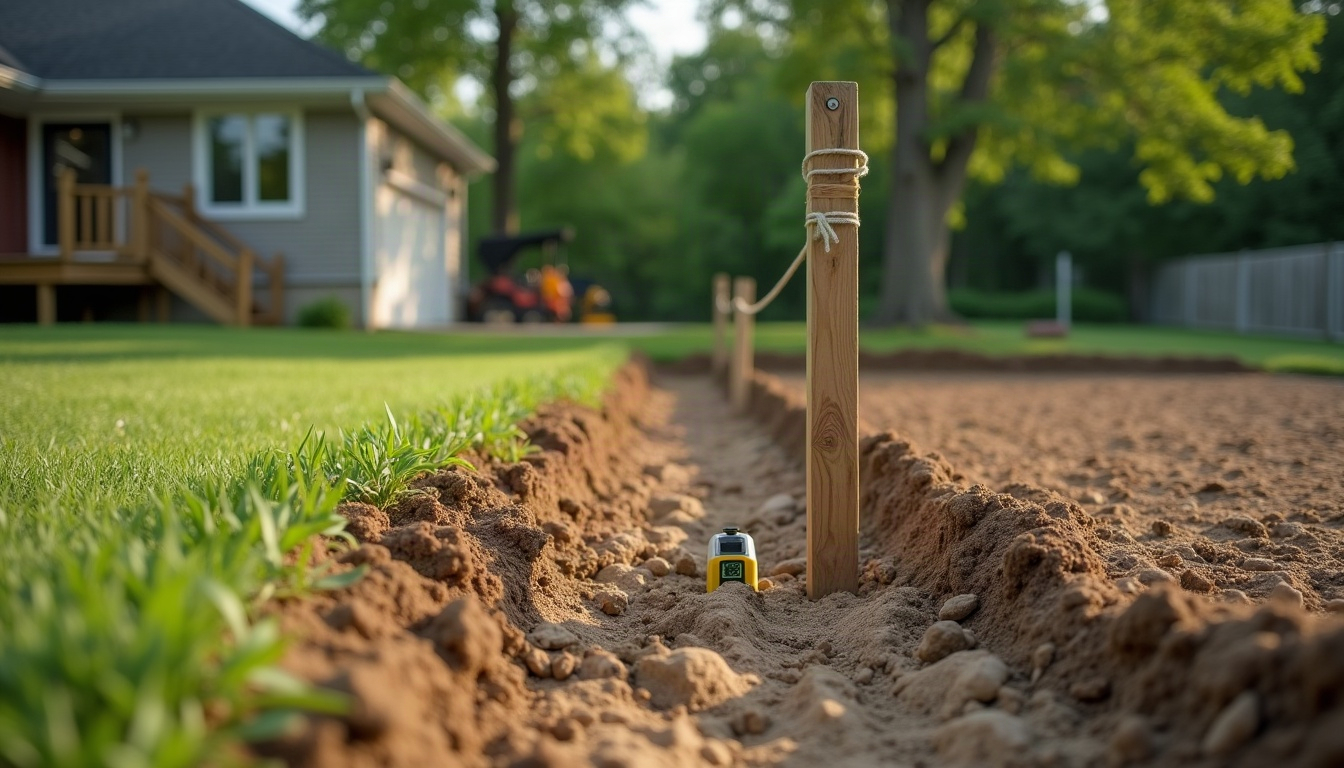
String line and line level
For small residential areas, drive two stakes, run a mason’s string between them, and level it with a line level. Measure down from the string to the ground at each stake and at intervals in between. The difference between readings, divided by the horizontal distance, gives you the slope. Over 10 feet, a 2.4 inch difference is 2 percent.
Builder’s level or laser and rod
For larger areas, set up a builder’s level or rotating laser and take rod readings on a grid, often every 10 to 25 feet, plus every high spot and low spot you can see. Higher rod readings mean lower ground. Record them on a sketch and you have a quick topographic picture of the site. The low readings that are surrounded by higher ones are your ponding spots.
Turning readings into a plan
- Identify the outlet: the lowest point where water can legally and safely leave, such as a ditch, storm inlet or daylight point on a slope.
- Work backward from the outlet and set target elevations that keep at least the minimum slope all the way to the high side.
- Compare targets to existing readings. Where the ground is too high, cut; where it is too low, fill.
- Re-shoot after rough grading and again after final grading, before sod or seed goes down.
The re-shoot step is the one people skip, and it is where most problems get caught. Fill settles, and equipment leaves ruts that become puddles.
Swales: Moving Water Across the Site
A swale is a shallow, broad channel shaped into the ground to collect sheet flow and carry it toward an outlet. On a golf course it might be a gentle grass hollow between a green complex and a fairway. In a neighborhood it is often the low line along a shared property boundary.
Shape
Good swales are wide and shallow rather than narrow and deep. Gentle side slopes (often 4:1 or flatter, meaning 4 feet horizontal for every 1 foot vertical) can be mowed safely and do not erode. A swale for a typical backyard might be 6 to 10 feet wide and only 4 to 8 inches deep at the center.
Slope along the bottom
The bottom of the swale needs continuous fall toward its outlet, generally at least 2 percent in turf. If the site is too flat to achieve that, plan catch basins along the swale to pick water up before it stalls.
Lining
Most swales are turf-lined. Where flow is concentrated or the slope is steep, a rock-lined channel resists erosion better. Rounded stone such as red river rock makes an attractive dry creek bed that handles occasional heavy flow and looks deliberate the rest of the year. Bed the rock on fabric so it does not sink into the soil.
Keep it working
Swales fail when they are filled in: a new flower bed, a pile of mulch, a fence post line or a shed pad across the flow path. Walk your swales once a year and after any landscaping work to confirm water can still move freely from one end to the other.
Catch Basins vs. Riser Grates
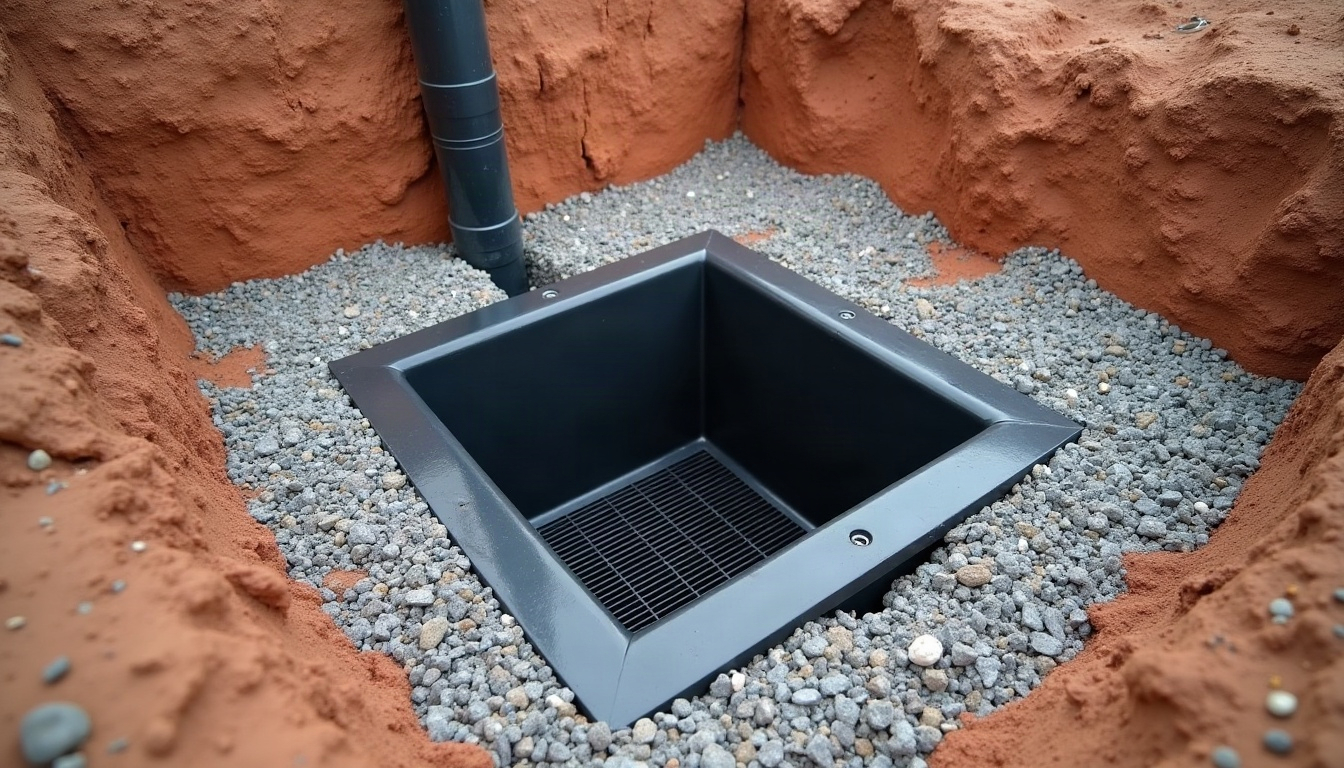
Where a swale or slope delivers water to a low point, a surface inlet takes it underground. The two most common types are catch basins and riser grates (sometimes called drop inlets or atrium grates when domed). Our drainage basins page covers the basics; here is how they compare.
| Feature | Catch basin | Riser grate |
|---|---|---|
| What it is | Box or structure with a sump below the outlet pipe | Grate set on top of a vertical riser pipe |
| Sediment handling | Sump traps grit and debris below the outlet | Little or no sump; debris passes into the pipe |
| Capacity | Higher; larger grate and box | Lower; sized to the riser pipe |
| Maintenance | Clean sump periodically | Keep grate clear; flush lines as needed |
| Footprint | Larger excavation | Small, easy to place in turf |
| Best use | Driveways, parking, swale ends, heavy flow, sediment-laden runoff | Golf greens surrounds, bunkers, lawn low spots, light flow |
Choosing between them
If the water arriving carries grit, mulch or clippings, choose a catch basin. The sump catches that material where you can scoop it out instead of letting it build up inside the pipe. If the area is turf with light flow and you want something low-profile, a riser grate set flush with the finished surface is simpler and cheaper.
Setting the inlet
Either type should sit slightly below the surrounding finished grade, often about 1/2 to 1 inch in turf, so water flows into it rather than around it. Set the structure on a compacted gravel base so it does not settle and tilt.
Pipe Sizing: 3 to 6 Inches
Most residential and light commercial surface drainage uses pipe in the 3 to 6 inch range. The right size depends on how much area drains to the inlet, how hard it rains and how much slope the pipe has.
| Pipe diameter | Typical application |
|---|---|
| 3 in | Single downspout, small bed or planter drain, short runs with light flow |
| 4 in | Most residential lawn inlets, multiple downspouts, bunker and greens-surround inlets |
| 6 in | Collector mains, driveway and parking inlets, swale outlets, several inlets joined together |
A few rules apply regardless of size:
- Use solid pipe for surface inlets. Water collected at a grate should travel in solid, smooth-wall pipe to the outlet. Perforated pipe is for subsurface collection; using it under an inlet lets surface water leak back into the soil along the way.
- Maintain slope. Keep at least 1 percent fall (about 1/8 inch per foot) on the pipe. More is better for self-cleaning.
- Never reduce downstream. Pipe size should stay the same or increase as lines join. A 4 inch line should never discharge into a 3 inch line.
- Prefer smooth-wall over corrugated for long runs. Smooth interior pipe carries more water at the same diameter and is easier to clean.
- Protect the outlet. A pop-up emitter, a headwall or a rock apron at daylight keeps the end from clogging and stops erosion where the water leaves.
For larger sites or commercial work, pipe should be sized by an engineer using rainfall intensity and drainage area. For a typical yard, 4 inch solid pipe from each inlet, joined into a 4 or 6 inch main, is the common pattern.
Where Sand and Gravel Fit in the System
Surface drainage is mostly about shape, but the right granular materials make each piece last longer.
Gravel under structures
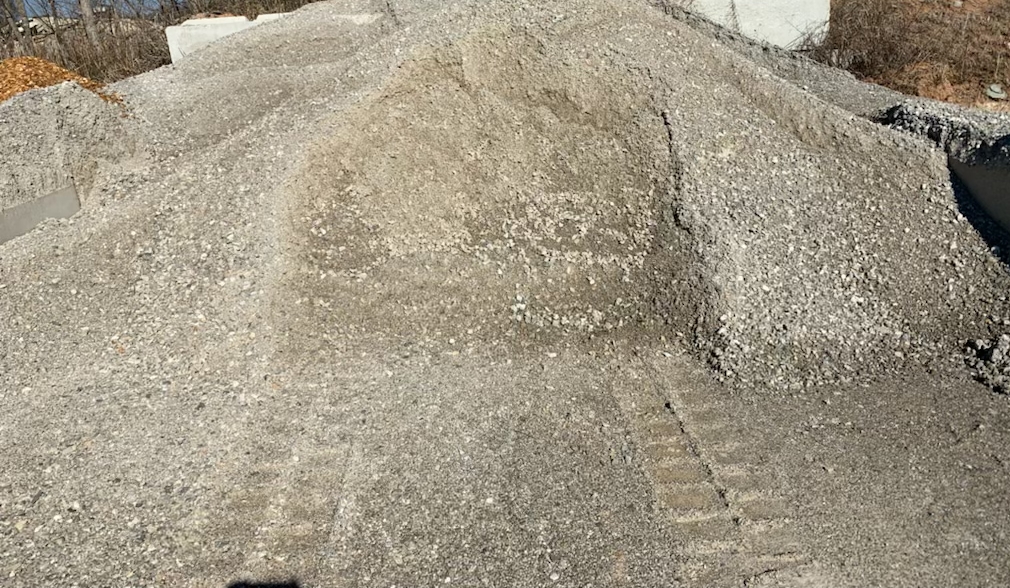
Set catch basins and riser grates on a compacted gravel base, typically 4 to 6 inches deep. Crushed stone such as 33C limestone gravel locks together and resists settling, which keeps inlets at the right elevation for years. Bed the pipe on a few inches of gravel as well so it holds grade and does not sag in soft clay.
Gravel around inlets
A collar of clean stone around a riser grate in a planting bed, or a rock apron at a pipe outlet, prevents erosion and keeps soil from washing into the grate. Rounded pea gravel or red river rock both work and look finished. See our full gravels lineup.
Sand in the turf surface
After rough grading, the final shaping of a turf surface often happens with sand. Top dressing fills small depressions, smooths the surface so water sheets off evenly, and over time improves infiltration in the top layer of soil. On golf courses and sports fields, regular core aeration followed by sand top dressing is how managers keep a firm, draining surface. Our top dressing sands are built for that work.
Sand-capped slits
Where a subsurface drain runs under turf, many sports-field managers backfill the top of the trench with sand so surface water reaches the gravel and pipe below. It is a bridge between surface and subsurface drainage, and it works best when the sand is clean and correctly sized.
Golf Course Examples
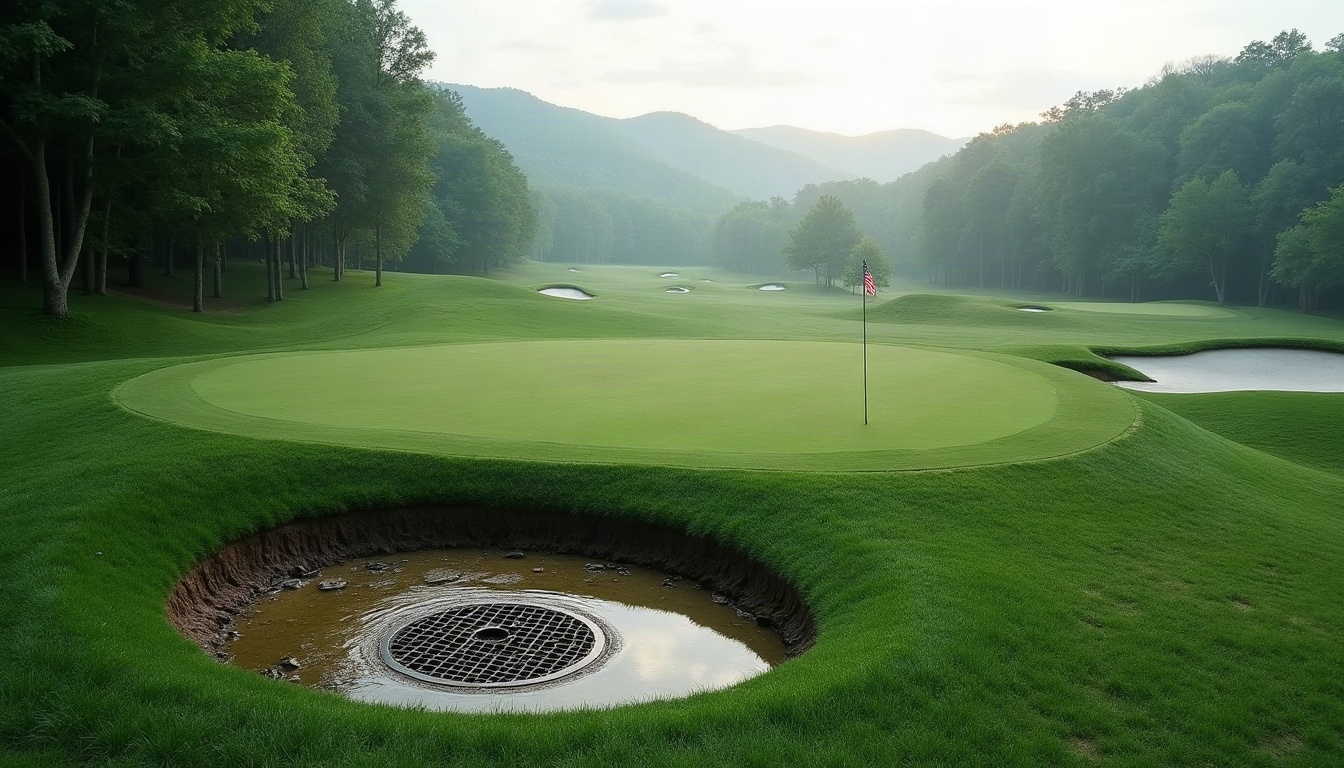
Golf courses show every surface drainage principle on one property.
Green complexes
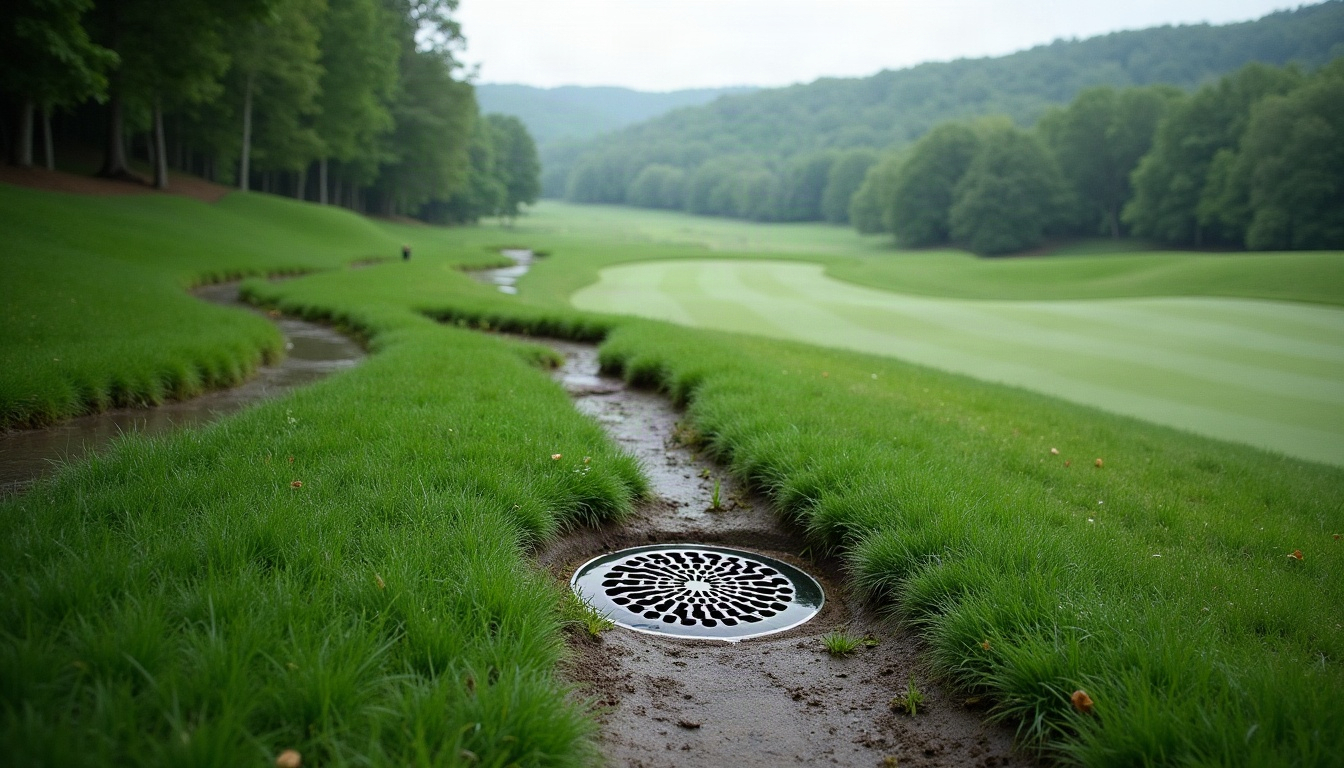
A putting green is typically shaped to shed surface water off two or three sides, away from the front entry where golfers and mowers travel. Surrounds are graded so that water leaving the green flows into swales or collection areas, not across the approach. Riser grates in the low corners of surrounds pick up that water and pipe it away.
Bunkers
Bunkers sit lower than the turf around them, so they naturally collect water. Surrounding turf should be graded to divert runoff away from the bunker lip wherever possible. Inside, the floor is shaped toward subsurface drain lines, and the bunker sand acts as a filter. Over time, silt and organic matter washed in from the surface reduce the sand’s infiltration rate; one documented example fell from 24 to 12 inches per hour in three years as organic matter rose from 0.3 percent to about 1 percent. Good surface diversion slows that decline. Learn more on our bunker sand page.
Fairways and cart paths
Fairways are commonly built with gentle crowns or side slopes feeding swales in the rough, with catch basins at the swale ends. Cart paths need at least 1 percent fall and should never be the low point that collects fairway runoff; a curb cut or inlet beside the path keeps water from running down it.
Residential Examples
The same principles scale down neatly to a house lot.
Downspouts
Roof water is concentrated and arrives fast. Connect downspouts to solid 3 or 4 inch pipe and run it to a daylight outlet, a pop-up emitter or a dry well well away from the foundation. Do not tie downspouts into a perforated French drain.
Backyard low spot
Shoot grade across the yard. If the low spot has a natural path to a lower edge of the property, shape a shallow swale to it. If it does not, set a catch basin at the low point and pipe it to the lowest available outlet. Then top dress the surrounding turf to blend the new grade.
Foundation grading
Soil against a house should fall away at about 5 percent for the first 10 feet. Settled backfill along foundations is one of the most common causes of wet crawlspaces in older homes. Bringing in fill and re-establishing that slope often solves the problem without any pipe.
Driveways
A driveway that slopes toward the garage needs a trench drain or catch basin at the bottom. One that sheds water across the lawn may need a swale on the downhill side to carry it to the street or a ditch.
For any of these, our yardage calculator will tell you how much fill, gravel or top dressing sand to order.
Get Drainage Materials from Jackson Sand
Jackson Sand supplies the gravel and sand that make surface drainage systems work, from crushed limestone for basin bases to clean rounded stone for aprons and dry creek beds, plus top dressing sands for finishing turf surfaces. We serve golf courses, sports fields, landscapers, contractors and homeowners in Jackson and across West Tennessee and the Mid-South.
We have been producing sand since 1996 and have supplied golf-course-grade bunker sand, top dressing and root zone mixes since the late 1990s. Our sand is washed and mixed on our own premises, and we deliver in a fleet of around 14 trucks we own, so the material that arrives is clean and is exactly what you ordered. That matters on a drainage job, where the wrong fines in the wrong place can undo good grading.
Before you call, sketch the area, mark the low spots and the outlet, and note the size of any inlets and the length of pipe runs. With those details we can recommend a base stone for the structures, a decorative stone for aprons or swale linings, and a top dressing sand for blending the finished turf, and give you quantities that match the plan instead of a guess.
Tell us about the job, the area and the materials you think you need. Call 731-668-0440 or send a note through our contact page, and we will help you put together the right order.
Inside the Jackson Sand Plant
Take a 90-second look at where our sand comes from: the washing plant, screens and conveyors, and the Jackson Sand truck fleet that delivers every load. President Carlton Pope tells the story of how the company grew from one truck in 1996.
Sources and Further Reading
- homeowner's guide to managing stormwater runoff (PDF) (USDA NRCS)
- EPA: disconnect and redirect downspouts (U.S. EPA)
- stormwater management for homeowners: grass swales (Virginia Cooperative Extension)
- grading and drainage to prevent basement moisture (University of Minnesota Extension)
- design and construction of dry wells (PDF) (Penn State PHRC)
Frequently Asked Questions
What is the minimum slope for good surface drainage?
Use at least 1 percent slope on paved surfaces and at least 2 percent on turf and planted areas. One percent equals 1 foot of fall per 100 feet, or about 1.2 inches per 10 feet. Two percent is about 2.4 inches per 10 feet. Near buildings, many designers use a steeper 5 percent fall for the first 10 feet away from the foundation.
How do I measure slope in my yard?
For short distances, stretch a mason's string between two stakes, level it with a line level, and measure down to the ground at each end. Divide the difference by the distance and multiply by 100 for percent slope. For larger areas, a builder's level or rotating laser with a measuring rod gives faster, more accurate readings across a grid.
Should I use a catch basin or a riser grate?
Use a catch basin where runoff carries sediment, mulch or debris, or where flow is heavy, such as at driveways and swale outlets. Its sump traps grit before it enters the pipe. Use a riser grate in turf areas with lighter flow, such as lawn low spots and golf green surrounds, where a small, flush grate is easier to fit and mow around.
What size pipe do I need for a yard drain?
Most residential inlets use 4 inch solid pipe. A single downspout or small planter can use 3 inch, and collector mains joining several inlets often step up to 6 inch. Keep at least 1 percent slope on the pipe, never reduce pipe size downstream, and use solid pipe rather than perforated pipe for surface inlets.
What gravel goes under a catch basin?
A compacted base of 4 to 6 inches of crushed stone, such as 33C limestone gravel, keeps a catch basin from settling and tilting. Crushed stone interlocks better than rounded gravel under load. Bed the connecting pipe on a few inches of gravel too, so it holds grade in soft clay soils.
How does sand top dressing help drainage?
Sand top dressing fills small depressions so water sheets evenly off a turf surface instead of puddling. Combined with core aeration, it also gradually improves the infiltration of the top layer of soil. Golf courses and sports fields rely on this routine to keep surfaces firm and draining between storms.
Ready to order or have a question about the right material? Call Jackson Sand at 731-668-0440 or send us a message and we will help you pick the right product and quantity.
Leave a Reply