

Regular vs. Tennessee White Bunker Sand: Side-by-Side Comparison
Quick answer: Both bunker sands from Jackson Sand in Jackson, Tennessee are clean and meet the common 65% guideline for particles between 0.25 and 1.0 mm. Regular Bunker Sand is natural-toned and medium-dominant (78.6% coarse plus medium, Cu 2.0), easy to maintain. Tennessee White is bright white with broader grading (73.5% coarse plus medium) for a firmer surface and premium look, but it needs more upkeep.
Two Bunker Sands, One Decision
Jackson Sand in Jackson, Tennessee stocks two bunker sands for golf courses: Regular Bunker Sand and Tennessee White Bunker Sand. Superintendents, green committees and course builders across West Tennessee and the Mid-South regularly ask the same question: which one should we use?
The honest answer is that both are good bunker sands. Each one tests clean, each one has the large majority of its particles in the size range that bunker guidance recommends, and each one is mixed on Jackson Sand’s own premises and delivered in the company’s own trucks. The differences are real, though, and they show up in three places:
- Grading. Regular Bunker Sand is concentrated in the medium size class. Tennessee White spreads more evenly across coarse, medium and fine sand.
- Color and presentation. Tennessee White is a bright white sand chosen partly for looks. Regular Bunker Sand is the standard, natural-toned option.
- Maintenance load. White sand shows every footprint, leaf and washout. Natural-toned sand hides more.
This article puts the two lab reports side by side, explains what the differences mean on the course, and then matches each sand to the course types, budgets and styles it suits best. If you want the full product pages first, start with bunker sand and the sand specs library.
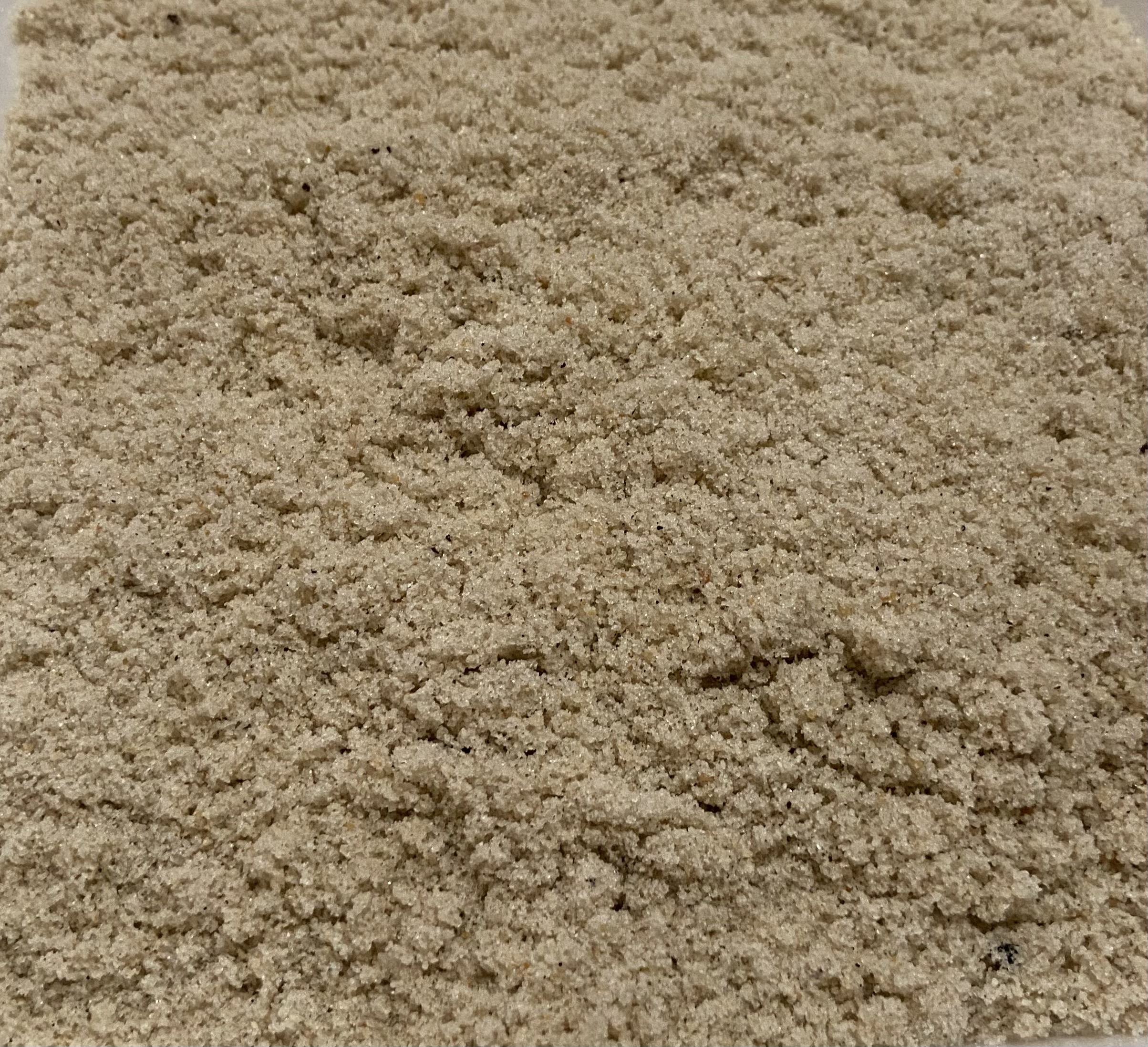
The Lab Reports Side by Side

Here are both particle size analyses in one table. Regular Bunker Sand’s report splits the fine band into two sieves; those are combined below so the classes line up.
| Measure | Particle size | Regular Bunker Sand | Tennessee White Bunker Sand |
|---|---|---|---|
| Total sand | 0.05 to 2.0 mm | 99.3% | 99.6% |
| Silt | 0.002 to 0.05 mm | under 1.0% | 0.2% |
| Clay | under 0.002 mm | under 1.0% | 0.1% |
| Gravel | over 2.0 mm | 0.1% | 0.1% |
| Very coarse sand | 1.0 to 2.0 mm | 1.5% | 2.1% |
| Coarse sand | 0.5 to 1.0 mm | 10.7% | 22.8% |
| Medium sand | 0.25 to 0.5 mm | 67.9% | 50.7% |
| Fine sand | 0.15 to 0.25 mm | 18.0% | 22.3% |
| Very fine sand | 0.05 to 0.15 mm | 1.3% | 1.7% |
| Coarse + medium | 0.25 to 1.0 mm | 78.6% | 73.5% |
| D85 | size 85% is finer than | 0.49 mm | not on quoted report |
| Uniformity coefficient (Cu) | D60 / D10 | 2.0 | not on quoted report |
| Color | Natural-toned | Bright white |
The most commonly cited benchmark for bunker sand is that at least 65% of the particles should fall between 0.25 and 1.0 mm. Both sands clear it with room to spare: 78.6% for Regular and 73.5% for Tennessee White.
If your project spec requires D85, Cu or a penetrometer value for Tennessee White, ask Jackson Sand for the complete current report so the number comes straight from the lab rather than an estimate.
Where the Two Sands Are Alike
Before getting into differences, it is worth noting how much the two products share. These similarities are why either sand is a safe choice for a well-built bunker.
Both are very clean
Regular Bunker Sand reports less than 1% silt and less than 1% clay. Tennessee White reports 0.2% silt and 0.1% clay. Silt and clay are what cause crusting, staining and slow infiltration, so low numbers on both reports mean both sands should drain freely and play consistently after rain. Tennessee White is the cleaner of the two on paper, which matters more for a white sand because any clay would show as discoloration.
Both control the top end
Gravel is 0.1% in both. Very coarse sand is 1.5% and 2.1%. That means very few particles large enough to scratch clubs, catch rake tines or end up on putting greens and dull mower reels.
Both keep very fine sand low
Very fine sand, the 0.05 to 0.15 mm range that can migrate down and seal pores, is 1.3% in Regular and 1.7% in Tennessee White. Neither is high enough to cause drainage trouble on its own.
Both come from the same washing plant and trucks
Jackson Sand washes its sand through screw classifiers and dewatering screens, stockpiles it on site and loads it into its own dump trucks, a fleet that has grown to roughly 14 trucks. Clean washing removes fines at the source, and dedicated trucks keep other customers’ topsoil or gravel out of your load. That process is the same for both products.
Where They Differ: Shape of the Distribution
The biggest technical difference between the two sands is how their particles are spread across the size classes.
Regular Bunker Sand: medium-dominant and uniform
Two thirds of Regular Bunker Sand, 67.9%, sits in the medium class. Coarse sand is only 10.7% and fine sand 18.0%. Its uniformity coefficient of 2.0 confirms a fairly uniform sand. Uniform sands leave open, well-connected pores, so they drain quickly and rake smoothly. They also tend to be a little softer, because similar-sized grains do not interlock as tightly.
Tennessee White: broader and more balanced
Tennessee White is roughly 23% coarse, 51% medium and 22% fine. That broader spread lets smaller grains fill the gaps between larger ones. More grain-to-grain contact generally means a firmer surface. Because the fines doing that filling are mostly true fine sand rather than silt and clay, drainage stays strong.
What that means in plain terms
- Regular Bunker Sand: more uniform, a slightly softer feel, very predictable from bunker to bunker.
- Tennessee White: more structure from both the coarse and fine sides, generally a firmer surface and good resistance to wind on exposed faces.
Neither pattern is better in every situation. A softer, uniform sand suits courses where golfers like a traditional splash and where bunker faces are not steep. A firmer, broader sand suits steep faces, windy sites and courses where fried-egg lies are the most common complaint. Firmness is ultimately measured with a penetrometer and depends on particle shape as well as size, so request lab penetrometer data if firmness is a deciding factor.

Playability Compared

Here is how the grading differences tend to show up in play. These are general tendencies based on the particle size data; depth, moisture and raking practices can shift any of them.
| Playing factor | Regular Bunker Sand | Tennessee White Bunker Sand |
|---|---|---|
| Surface feel | Uniform, slightly softer | Broader grading, generally firmer |
| Buried and fried-egg lies | Controlled mainly through proper depth and moisture | Broader grading helps hold the ball up |
| Consistency after rain | Very good; low fines limit crusting | Very good; extremely low fines |
| Wind resistance on faces | Moderate | Stronger, due to 22.8% coarse sand |
| Splash onto greens | Minimal coarse material in the splash | Minimal; top end still small |
| Raking | Very easy; smooths quickly | Easy; rake marks more visible on white |
Golfer perception
Most golfers cannot tell you a sand’s D85, but they can tell you whether the ball plugged and whether they could get it out. A uniform medium sand gives a classic, forgiving explosion shot. A firmer, broader sand rewards a cleaner strike and leaves fewer buried lies. Many clubs choose based on which complaint they hear most: “the bunkers are too soft” points toward a firmer sand; “the bunkers are like concrete” points toward depth management or a more uniform sand.
Depth matters more than the brand
Whichever sand you choose, keep at least 4 inches on bunker floors after settling. Thin floors make any sand play hard and inconsistent. Overfilled floors make any sand play soft.
Drainage and Long-Term Performance
Both sands drain well when new. The question superintendents should really ask is how each will perform in year three or year five.
Every bunker sand degrades in place. Bunker sand works as a filter, catching soil from washouts, clippings from edging, leaves and wind-blown dust. One documented case saw infiltration drop from 24 inches per hour to 12 inches per hour within three years, while organic matter climbed from about 0.3% to roughly 1%. Starting cleaner gives you more margin before performance slips.
How each sand ages
- Regular Bunker Sand starts with a uniform, open pore structure. That gives it a buffer: it can absorb some contamination before drainage slows enough for golfers to notice.
- Tennessee White starts extremely low in silt and clay, which delays crusting. Its broader grading packs somewhat tighter, but the very low dust content keeps pores working. Contamination will show visually long before it shows in drainage.
Protect either sand the same way
- Make sure surrounds shed water away from bunkers. Turf slopes generally need at least 2% fall. Jackson Sand’s guide to surface water drainage and slope covers the details.
- Keep drain lines in clean gravel and confirm outlets actually flow.
- Repair washouts promptly so subsoil does not mix into the sand.
- Test the sand every few years to track fines and organic matter.
- Top up with the same product already in the bunker.
Try before you commit
If the committee cannot agree, build a test. Fill one practice bunker, or one bunker on a busy hole, with each sand at the same 4-inch depth. Let it go through several rain events and a few weeks of normal play and raking. Ask the crew how long each took to maintain, and ask regular players which they preferred. A simple field trial settles debates that no spreadsheet will, and it costs far less than converting a whole course and changing your mind later.
While the trial runs, record infiltration with a simple ring test after installation and again at the end, and probe both bunkers for depth weekly. Those two numbers will tell you whether either sand is migrating off faces or slowing down.
Looks and Maintenance Load
Color is where many decisions actually get made, so treat it honestly.
The case for white
Bright white bunkers frame greens, define fairways and photograph well against dark Tennessee turf. For clubs focused on events, membership growth or a premium daily-fee experience, that presentation has real value.
The cost of white
White sand shows everything: footprints, rake lines, clippings, fall leaves from surrounding hardwoods, and any soil that washes in. Crews on white-sand courses typically spend more time on edging cleanup, leaf blowing and washout repair. On bright afternoons, white sand also reflects noticeable glare.
The case for natural-toned sand
Regular Bunker Sand hides minor contamination and wear far better. For courses with lean staffing, steep surrounds that wash often, or heavy tree cover, that forgiveness keeps bunkers looking acceptable between maintenance passes.
Consistency across the course
Mixing white and natural bunkers on the same course usually looks unfinished. If you go white, plan to convert every bunker, or at least complete whole holes or nines at a time. If you are only topping up existing natural sand, stay with Regular so the color matches.
A quick rule of thumb: if your crew already struggles to keep up with bunker edging and washouts, choose the sand that hides more. If your crew has the capacity and presentation is a priority, white is worth it.
Which Sand Fits Which Course

Here is a practical way to match the sand to the property.
| Situation | Better fit | Why |
|---|---|---|
| Municipal or daily-fee course with lean staffing | Regular | Hides wear and contamination; easy to maintain |
| Private club prioritizing presentation and events | Tennessee White | Strong visual definition; very clean sand |
| Steep bunker faces or exposed, windy holes | Tennessee White | More coarse sand for structure and wind resistance |
| Complaints about fried-egg lies | Tennessee White (verify with penetrometer data) | Broader grading tends to firm the surface |
| Topping up existing natural-toned bunkers | Regular | Avoids color and grading mismatch |
| Heavy tree cover and fall leaf drop | Regular | Less visible staining and debris |
| Practice facility or backyard short-game area | Either | Choose on look and how much upkeep you want |
| Full renovation with new drainage and liners | Either | Decide on style and maintenance budget |
Courses in Jackson and across West Tennessee have a lot in common: heavy spring rain, hot humid summers, bermudagrass or bentgrass surrounds and plenty of hardwoods. Both sands handle that climate. The choice comes down to style and staffing more than weather.
For a broader look at how bunker sand fits with top dressing and root zone materials, see Jackson Sand’s golf course sand overview.
Budget: Thinking About Total Cost
Sand price per ton is only one line in a bunker budget. Ask Jackson Sand for current delivered pricing on both products, then weigh these factors:
- Quantity. Both sands are installed at the same depth, so the yardage is the same. Length times width times depth in feet, divided by 27, gives cubic yards. A course with 50 bunkers averaging 2,000 square feet at 4 inches needs roughly 1,235 cubic yards. Use the yardage calculator to check your own figures.
- Removal of old sand. Switching to white usually means full removal of the old sand. Topping up natural bunkers with Regular may not.
- Surround and drainage repairs. White sand rewards fixing washing surrounds before installation. That work is good practice either way, but it is more urgent with white.
- Ongoing labor. Budget extra crew hours for edging cleanup and debris removal on white bunkers.
- Replacement interval. Contaminated white sand looks tired sooner, so clubs often replace or refresh it on a shorter visual cycle even when drainage is still acceptable.
- Delivery. Jackson Sand hauls golf-course-grade material across a wide region, from Huntsville, Alabama to Jackson, Mississippi, Little Rock, Owensboro, Kentucky and Tullahoma, Tennessee. Ask how distance affects freight for your site.
When the numbers are close, the deciding factor is usually labor, not material. A sand that costs a little more but saves a crew member several hours a week during the growing season can be the cheaper choice over five years. The reverse is also true: if the budget cannot support the extra upkeep white sand needs, a premium look will fade into a maintenance headache.
Get Both Lab Reports and a Quote
Jackson Sand has been in production since about 1996 and has focused on golf-course-grade bunker sands, top dressings and root zone mixes since around 1998. It mixes material on its own premises at 139 United Dr. in Jackson, Tennessee and delivers in its own trucks, so the sand that reaches your bunker matches the report you approved.
When you call, have these details ready:
- Number of bunkers and total square footage or cubic yards.
- Whether you are topping up, replacing or building new.
- Your architect’s spec, if there is one.
- Which complaint you hear most from golfers: soft, hard, wet or dirty bunkers.
The team can send current lab reports for both sands, talk through which fits your course and set up delivery. Call 731-668-0440 or use the contact page to get started.
Inside the Jackson Sand Plant
Take a 90-second look at where our sand comes from: the washing plant, screens and conveyors, and the Jackson Sand truck fleet that delivers every load. President Carlton Pope tells the story of how the company grew from one truck in 1996.
Sources and Further Reading
- USGA guide to selecting the right bunker sand (USGA Green Section Record)
- physical properties that impact bunker sand performance (USGA)
- fighting firmness in bunkers (USGA Green Section Record)
- why bunker sand is never the same (USGA Green Section Record)
Frequently Asked Questions
What is the main difference between Regular Bunker Sand and Tennessee White Bunker Sand?
Regular Bunker Sand is natural-toned and medium-dominant, with 67.9% medium sand and a uniformity coefficient of 2.0. Tennessee White is bright white with a broader grading of about 23% coarse, 51% medium and 22% fine sand. Both are very clean and both exceed the common 65% guideline for particles between 0.25 and 1.0 mm.
Which bunker sand is firmer?
Based on particle size, Tennessee White's broader grading generally produces a firmer surface than a uniform medium sand, which can reduce fried-egg lies. Actual firmness depends on particle shape, depth and moisture, so ask Jackson Sand for lab penetrometer values if firmness is the deciding factor for your course.
Which sand drains better?
Both drain well when new because both are very low in silt and clay. Regular Bunker Sand has a more uniform, open pore structure, while Tennessee White has extremely low fines of 0.3% combined. Long-term drainage depends more on keeping soil and organic debris out of the bunker than on which of these two sands you choose.
Is white bunker sand worth it?
It is worth it when presentation is a priority and the crew has time for extra edging cleanup, leaf removal and washout repair. White sand shows contamination quickly. For lean-staffed courses or tree-heavy properties, Regular Bunker Sand often gives a better result for the effort available.
Can I mix Regular and Tennessee White sand in the same bunker?
It is not recommended. Different colors will look patchy, and the two gradings can drain and play differently in layers. Choose one sand per bunker, and ideally one sand for the whole course, then top up with the same product each season.
Where does Jackson Sand deliver bunker sand?
Jackson Sand is based in Jackson, Tennessee and hauls golf-course-grade material in its own trucks across a wide region, from Huntsville, Alabama to Jackson, Mississippi, Little Rock, Arkansas, Owensboro, Kentucky and as far east as Tullahoma, Tennessee. Call 731-668-0440 to discuss delivery to your site.
Ready to order or have a question about the right material? Call Jackson Sand at 731-668-0440 or send us a message and we will help you pick the right product and quantity.
Leave a Reply