

Top Dressing Sand Delivery for Golf Courses in West Tennessee: Your Complete Guide
Quick answer: Top dressing sand delivery for golf courses in West Tennessee means getting the right particle-size sand — mixed on-premises for consistency — delivered directly to your course so crews can apply it without hauling or blending. Jackson Sand, based in Jackson, TN, supplies lab-tested top dressing sand, mixes it on-site, and delivers in their own trucks to golf courses across West Tennessee and the Mid-South. Proper top dressing smooths greens, improves drainage, dilutes thatch, and firms playing surfaces — and doing it right starts with the correct sand spec and a reliable local supplier.
What Is Top Dressing Sand and Why Does It Matter for Golf Courses?
Before you schedule a delivery or calculate yardage, it helps to understand exactly what top dressing sand is — and what separates a quality product from a generic fill sand that can do more harm than good. For golf course superintendents in West Tennessee, choosing the right material is as important as the application itself.
The Basic Definition
Top dressing sand is a finely graded, washed sand applied in thin layers directly to turfgrass surfaces — most often putting greens, tees, fairways, and surrounds. Unlike fill sand or construction sand, top dressing sand is engineered to a specific particle-size distribution so it integrates with the existing rootzone without creating layering problems or impeding drainage.
For golf courses, the stakes are high: a sand that is too fine can seal the surface and slow percolation; one that is too coarse can create a grainy, inconsistent putting surface. The sweet spot is a carefully graded medium sand that matches — or closely matches — the sand already in the rootzone.
Why Particle Size Is Everything
The USGA recommends that top dressing sand used on putting greens fall predominantly in the medium-to-coarse sand range, with at least 60% of particles between 0.25 mm and 1.0 mm, and strict limits on fine sand (less than 0.15 mm) and silt/clay content. These thresholds exist because fine particles migrate downward and can create an impermeable layer — a drainage-killing interface — between the top dressing and the existing rootzone.
- Medium sand (0.25–0.5 mm): The workhorse fraction for most green top dressing applications
- Coarse sand (0.5–1.0 mm): Adds firmness and speeds drainage on high-traffic surfaces
- Fines (<0.15 mm): Should be kept below 3% to prevent layering
Jackson Sand publishes full lab-tested spec sheets so superintendents can verify particle distribution before the first load arrives. You can review those specs at the Jackson Sand spec sheet page.
Top Dressing vs. Other Sand Applications on the Course
It’s worth separating top dressing sand from the other sands a golf course uses regularly. Bunker sand, for example, is selected for playability, firmness, and resistance to splash — different criteria than top dressing. Rootzone sand for new construction or renovation is often blended with organic matter and must meet USGA method specifications for the entire profile. Top dressing sand occupies its own niche: it must be compatible with the existing profile, fine enough to work into the canopy, and consistent load to load.
The Core Benefits of Regular Top Dressing on Golf Course Greens

A top dressing program is one of the highest-return maintenance investments a golf course superintendent can make. The benefits compound over time — each application builds on the last — and the playing quality improvements are measurable. Here’s what consistent top dressing actually does for your greens.
Thatch Dilution and Organic Matter Management
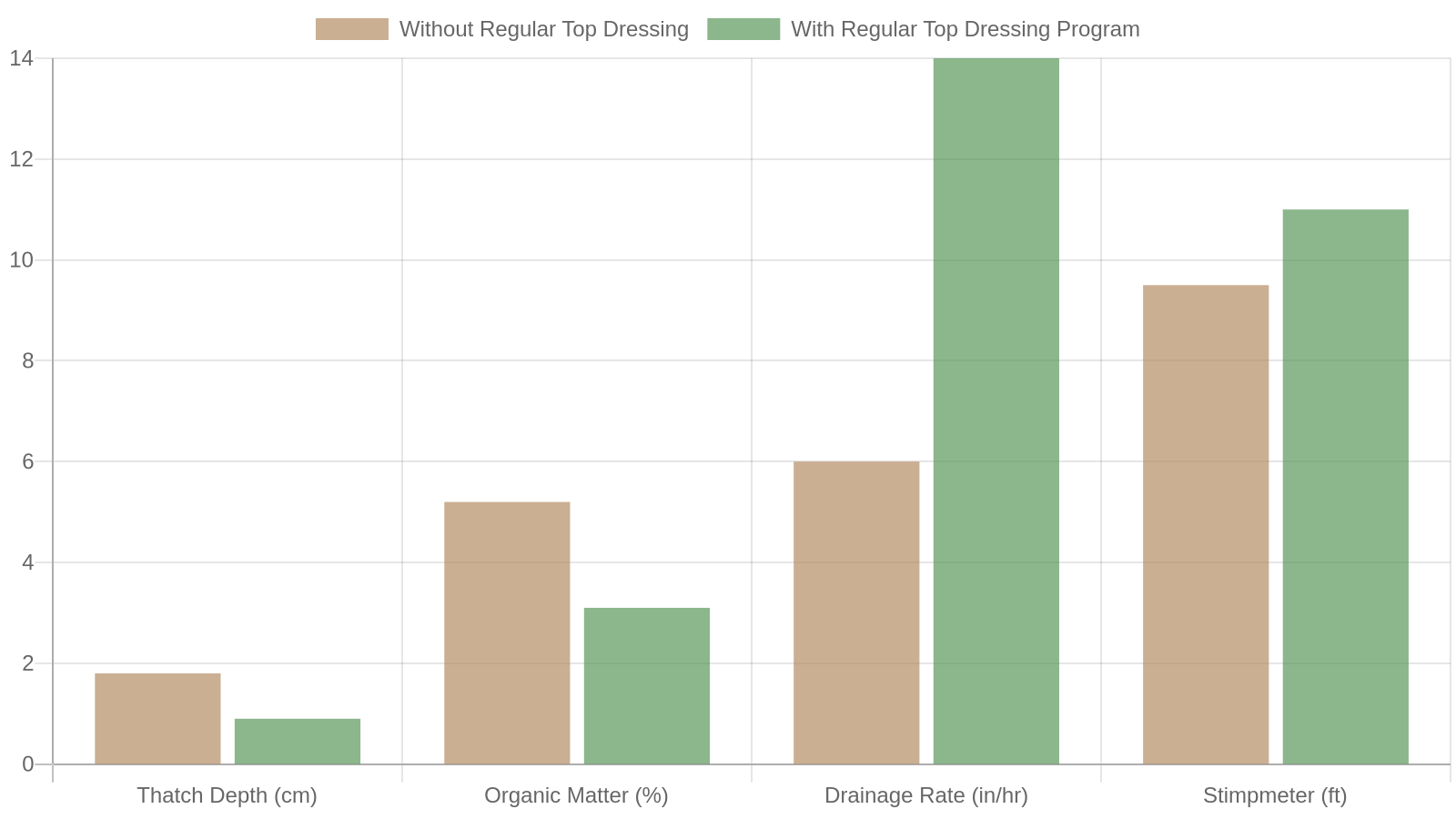
Thatch — the layer of undecomposed organic material just above the soil — is the enemy of firm, fast greens. Research from turfgrass universities consistently shows that maintaining organic matter in the top 10 cm of a putting green below 3–4% by weight produces the smoothest, most consistent surfaces. Regular sand top dressing dilutes organic matter by physically mixing sand into the canopy and rootzone, slowing thatch accumulation without the stress of aggressive mechanical removal alone.
A program of light, frequent top dressing (typically 1–2 cubic yards per 1,000 square feet per application) applied every 2–4 weeks during the growing season keeps organic levels in check and reduces the need for disruptive hollow-tine aerification events.
Surface Smoothness and Ball Roll
Golfers notice top dressing indirectly — through the trueness of a putt. Consistent sand applications level minor surface irregularities caused by foot traffic, mowing, and natural turf growth patterns. Studies using stimpmeter measurements have documented improvements of 0.5 to 1.5 feet of ball roll distance on greens that receive regular top dressing programs compared to those that do not, all else being equal.
The key is applying sand in thin enough layers — typically no more than 1/8 inch per application — so it can be worked into the canopy quickly and the green is returned to play within hours, not days.
Drainage Improvement and Firmness
West Tennessee’s clay-heavy native soils and humid summers create conditions where surface drainage can deteriorate quickly on older greens. Top dressing with a properly graded sand gradually improves the hydraulic conductivity of the upper rootzone, helping greens drain faster after rain events and recover more quickly from cart traffic or heavy foot traffic. Firmer greens also hold approach shots better — a playing quality benefit that members and guests notice immediately.
How to Build a Top Dressing Schedule for West Tennessee Conditions

Getting the timing right is just as important as getting the material right. West Tennessee’s climate — hot, humid summers and mild winters — creates a specific window for effective top dressing, and a well-planned schedule means you’re never scrambling for material when the turf needs it most.
Warm-Season vs. Cool-Season Timing
Most West Tennessee golf courses grow bermudagrass on their greens and fairways — a warm-season grass that thrives from May through September and goes dormant in winter. Top dressing is most effective when the turf is actively growing and can recover quickly, so the core top dressing window for bermudagrass courses in the Mid-South runs from late April through early October.
Avoid top dressing during heat stress events (sustained temperatures above 95°F) or immediately before a tournament when you need greens at peak smoothness. A light drag or brush-in application 5–7 days before a major event, however, can actually improve ball roll by leveling micro-irregularities.
Frequency Guidelines by Surface Type
Different surfaces on the course have different top dressing needs:
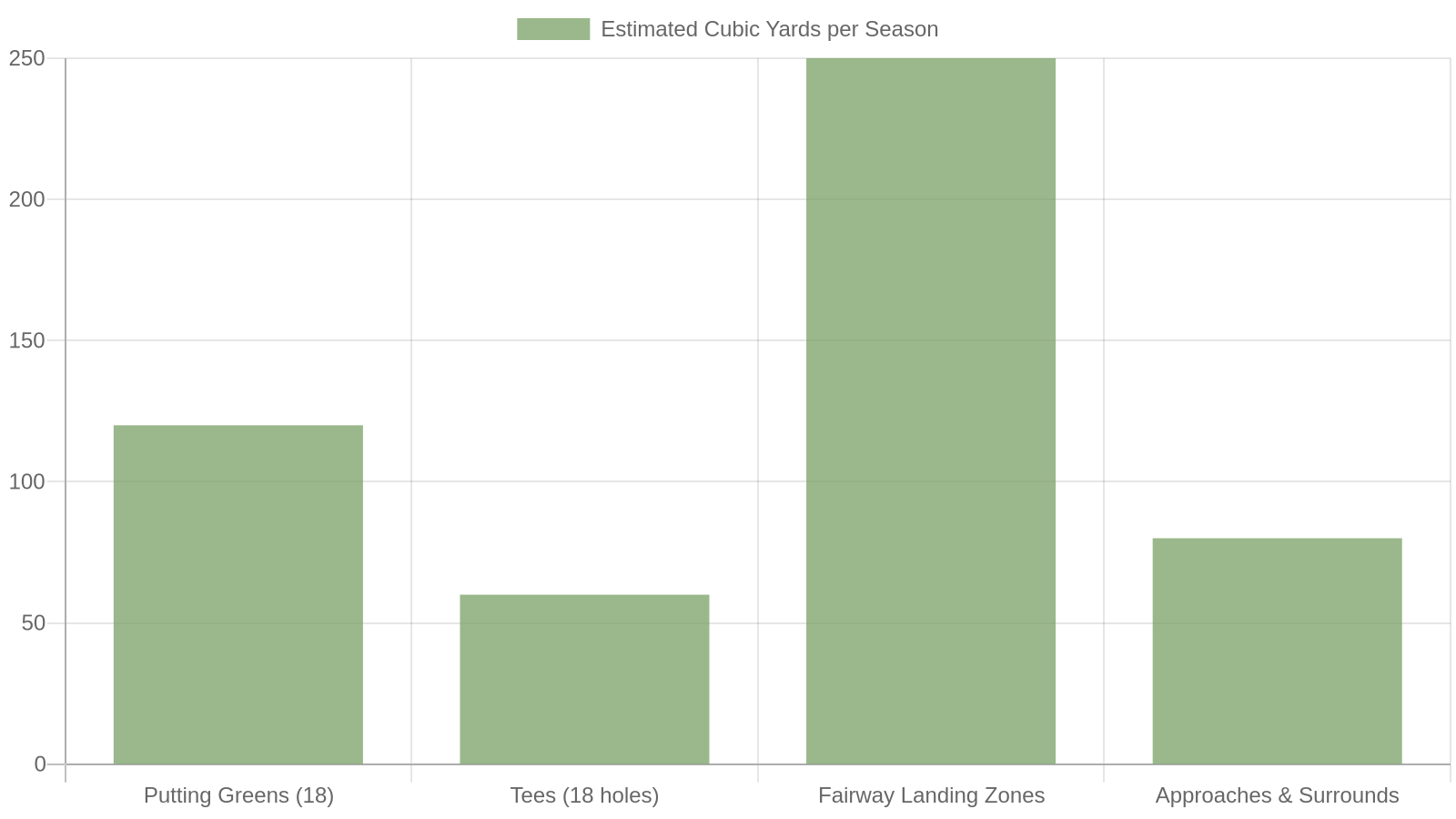
- Putting greens: Every 2–4 weeks during the growing season; heavier applications (up to 1/4 inch) paired with hollow-tine or solid-tine aerification in spring and fall
- Tees: Monthly during the growing season, heavier after divot repair or renovation work
- Fairways: 2–3 times per season, typically coinciding with aerification; quantities are much larger — plan for 15–25 cubic yards per acre
- Surrounds and approaches: As needed, typically 3–4 times per season
Planning your schedule in advance lets you coordinate deliveries efficiently and avoid last-minute scrambles during peak season.
Coordinating Delivery with Aerification Events
The most impactful top dressing applications happen immediately after aerification — when hollow-tine or solid-tine cultivation opens channels for sand to migrate deep into the rootzone. For these events, you’ll need significantly more material than a routine light dressing: a typical 18-hole course might use 40–80 cubic yards of top dressing sand for a full-green aerification cycle. Scheduling your delivery to arrive the morning of — or the afternoon before — the aerification event keeps the operation moving and minimizes green closure time.
Jackson Sand delivers in their own trucks, which means load sizes are accurate and you’re not guessing at what actually arrived on site.
Calculating How Much Top Dressing Sand You Actually Need
Ordering the right quantity of top dressing sand is part science, part experience. Too little and you’re stopping mid-operation; too much and you’re paying to store material you didn’t need. Here’s how to get the number right before you pick up the phone.
The Basic Formula
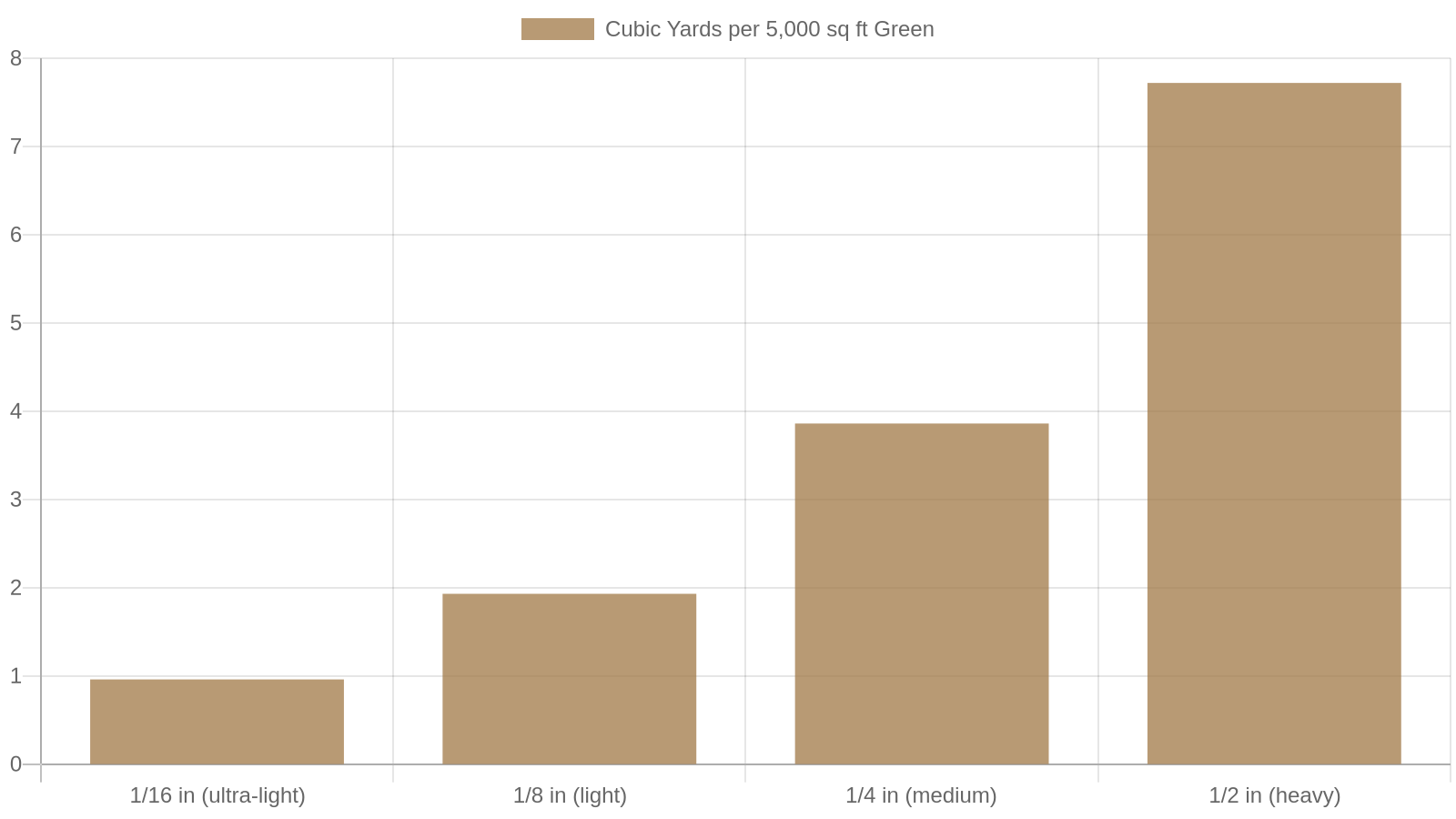
Top dressing sand quantities are calculated by multiplying the surface area (in square feet) by the application depth (in feet) to get cubic feet, then dividing by 27 to convert to cubic yards. For example, a standard 5,000-square-foot putting green top dressed at 1/8 inch (0.0104 feet) requires approximately 1.9 cubic yards per application. Multiply that across 18 greens and you’re looking at roughly 34 cubic yards for a single light application cycle.
The math gets more complex when you factor in tees, fairways, and surrounds — which is exactly why Jackson Sand offers a free yardage calculator on their website. Plug in your dimensions and application depth and it does the work for you.
Common Application Depths and Their Uses
Application depth drives both the quantity of material needed and the recovery time for the turf:
- 1/16 inch (ultra-light): Used for routine smoothing between aerification events; minimal disruption, greens playable same day
- 1/8 inch (light-standard): The most common routine top dressing depth; typically worked in within 24–48 hours
- 1/4 inch (medium): Used after solid-tine aerification or for targeted leveling; greens may be closed 1–2 days
- 3/8–1/2 inch (heavy): Post hollow-tine aerification; significant sand incorporation; greens closed 3–5 days minimum
Ordering Enough Without Over-Ordering
One of the most common mistakes superintendents make is under-ordering for an aerification event and having to pause operations while waiting for a second delivery. A good rule of thumb: calculate your exact need, then add 10–15% as a buffer for uneven surfaces, spillage, and any areas that need extra attention. Leftover sand can be stockpiled on-site for divot repair, bunker touch-ups, or the next routine application. Jackson Sand mixes their sand on-premises, so consistent quality is maintained from load to load — your stockpile will match your next delivery.
Understanding Top Dressing Sand Specs: What the Lab Numbers Mean
Not all sand is created equal — and on a golf course, the difference between a sand that meets spec and one that doesn’t can mean the difference between a green that drains beautifully and one that develops chronic layering problems. Here’s how to read the numbers that matter.
Reading a Particle Size Distribution Report
A particle size distribution (PSD) report shows the percentage of sand retained on each sieve size — from coarse (2.0 mm) down to very fine (0.05 mm) and below. For top dressing sand, you want to see the bulk of the material — ideally 60–80% — concentrated in the medium sand fraction (0.25–0.5 mm), with minimal material in the very fine, silt, and clay fractions.
Key numbers to check on any PSD report:
- Percent passing 0.15 mm: Should be under 3% to minimize layering risk
- Percent coarser than 1.0 mm: Should be under 10% to avoid grainy putting surfaces
- Uniformity coefficient (Cu): A lower Cu (closer to 1.0) means a more uniform particle size, which is generally preferred for top dressing
Why Consistency Across Loads Matters
A single lab test is only useful if every load that arrives on your course matches that test. Sand sourced from multiple pits or blended inconsistently can vary significantly from delivery to delivery — creating the very layering problems you’re trying to avoid. Jackson Sand mixes their sand on their own premises from high-quality materials, which means the spec you approve is the spec you get, load after load. This consistency is especially important for courses that top dress frequently throughout the season.
Matching Top Dressing Sand to Your Existing Rootzone
If your greens were built or renovated to USGA specifications, you should have documentation on the original rootzone mix and the sand used. The goal is to match your top dressing sand as closely as possible to that original material. Significant differences in particle size between the rootzone sand and the top dressing sand can create hydraulic discontinuities — essentially invisible barriers that slow water movement through the profile. If you don’t have your original rootzone specs, a simple sieve analysis from a turfgrass lab (typically $50–$150 per sample) can give you the data you need to make a smart purchasing decision.
Top Dressing Application Methods: Equipment and Best Practices
The best sand in the world won’t help if it’s applied incorrectly. Understanding your equipment, your application rate, and the post-application steps that get sand into the canopy quickly will determine how fast your greens recover and how good they look for your members.
Drop Spreaders and Spinner Spreaders
The two most common top dressing machines for golf greens are drop-style spreaders (which deposit sand directly beneath the hopper in a controlled band) and spinner-style spreaders (which broadcast sand in a wider pattern). Drop spreaders give more precise, even coverage and are preferred for light routine applications on putting greens. Spinner spreaders cover ground faster and are better suited for tees and fairways where precision is slightly less critical.
For either machine, calibration is essential. Run a test pass on a tarp, collect and weigh the material, and calculate your actual application rate before you start on the greens. A miscalibrated spreader can easily apply 50% more or less sand than intended.
Working Sand Into the Canopy
Applying sand is only half the job — getting it down into the turf canopy is the other half. Common methods include:
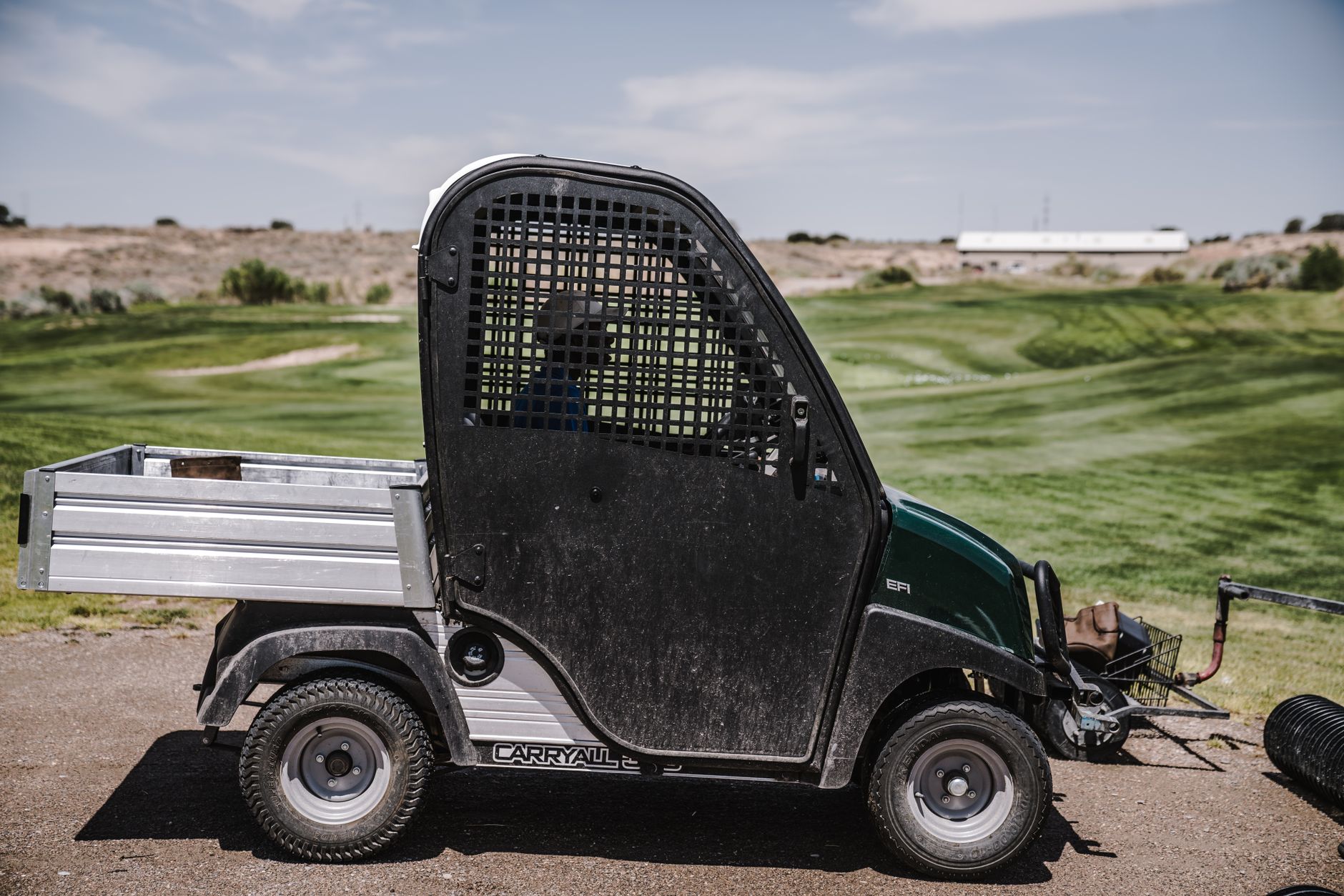
- Steel drag mats: Pulled behind a walk-behind unit or utility vehicle; effective for light applications
- Brush attachments: Rotating brushes work sand into the canopy while standing up the turf
- Vibratory rollers: Used after heavier applications to firm the surface and work sand into aeration holes
Timing matters here too: sand works into the canopy most easily when the turf is slightly dry and the grass blades are upright. Avoid working sand into wet, matted turf — it will sit on the surface and create an uneven, bumpy putting surface until the next mowing cycle.
Irrigation and Post-Application Care
After a top dressing application, a light syringe irrigation (just enough to settle the sand without washing it off the surface) helps move particles into the canopy and reduces the abrasive effect on mower reels. Avoid heavy irrigation for 24 hours after a medium or heavy application. Resume normal mowing at your standard height — typically 0.100–0.125 inches on bermudagrass greens — once the sand has been worked in and the surface is firm enough to support the mower without tracking.
Top Dressing for Fairways and Tees: Bigger Scale, Same Principles
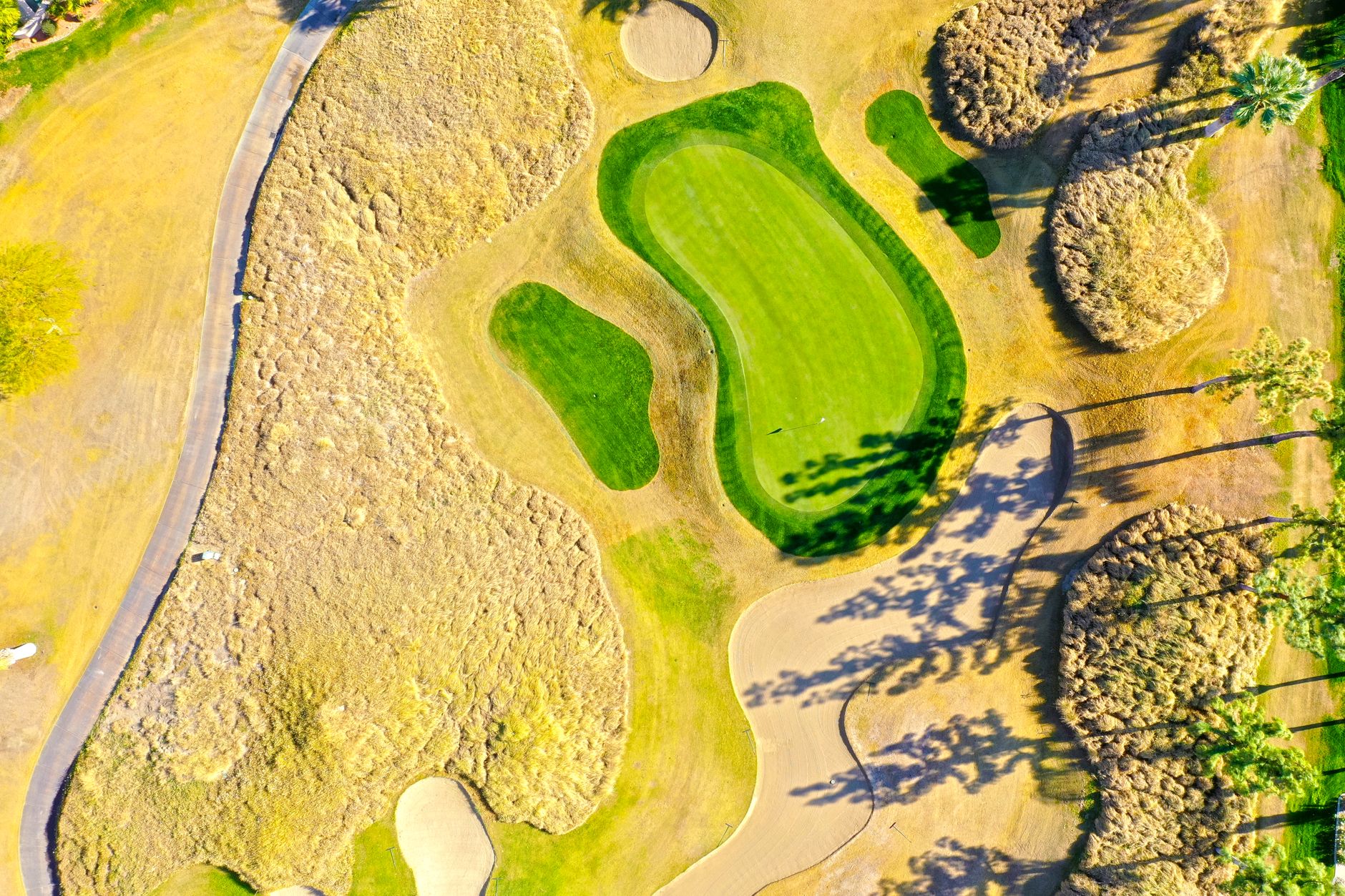
Greens get most of the attention in top dressing discussions, but tees and fairways benefit just as much from a consistent sand program. The logistics are different — you’re moving more material over more ground — but the principles are the same: right sand, right rate, right timing.
Fairway Top Dressing: Quantities and Logistics
Fairway top dressing is a different logistical challenge than greens work — the scale is simply much larger. A typical 18-hole course has 80–120 acres of maintained fairway, though most courses top dress only the most-trafficked areas (landing zones, approaches) rather than the entire fairway corridor. Even so, a fairway top dressing event for a mid-size course can require 200–400 cubic yards of sand — a significant delivery and staging operation.
Plan your staging areas carefully. Sand should be delivered to locations that minimize haul distance for your equipment and avoid long drives across soft turf. Multiple smaller deliveries staged at different points on the course often work better than a single massive pile at the maintenance facility.
Tee Top Dressing: Divot Recovery and Leveling
Tees take a beating — especially par-3 tee boxes, which concentrate divot damage in a small area. Top dressing tees 4–6 times per season with a medium-to-heavy application helps fill divots, level uneven surfaces caused by repeated mowing, and improve the firmness that golfers expect when teeing the ball. Many courses use a divot mix — a blend of sand and seed — for routine divot repair between top dressing events, reserving pure sand applications for scheduled maintenance windows.
Sand Specs for Fairways vs. Greens
Fairway top dressing sand can tolerate a slightly wider particle size distribution than green sand — the playing quality demands are lower and the turf is typically more robust. However, the same basic principles apply: avoid very fine sands that will seal the surface, and match the top dressing sand to the existing soil profile as closely as practical. For fairways with significant clay content in the native soil, a coarser top dressing sand can help break up the surface over time and improve drainage in low spots and compacted areas.
How Jackson Sand's Delivery Process Works for Golf Courses
Knowing your supplier’s process matters as much as knowing the product spec. Here’s how Jackson Sand handles the logistics of getting top dressing sand from their facility in Jackson, TN to your course — and why their approach reduces the headaches that come with inconsistent or poorly managed deliveries.
Mixed On-Premises for Consistency
Jackson Sand mixes their top dressing sand on their own premises at 139 United Dr., Jackson, TN. That means every load is blended from the same high-quality source materials, screened to spec, and loaded directly from their facility — not sourced from a third-party pit and re-sold. For a superintendent who has approved a specific particle size distribution, this on-premises mixing is a significant quality assurance advantage. You’re not relying on a broker’s word that the material matches the spec sheet; you’re getting material produced under consistent, controlled conditions.
Delivery in Their Own Trucks
Jackson Sand delivers in their own trucks — not contracted carriers. This matters for two reasons: load accuracy and cleanliness. When a supplier uses their own equipment, they control how the truck is loaded, how the load is covered in transit, and how it’s placed on your site. Contamination from a dirty third-party truck — residual concrete, clay, or incompatible aggregate — is a real risk when you’re buying sand from a supplier who relies on outside haulers. Jackson Sand’s own fleet eliminates that variable. Delivery is included, so the price you’re quoted is the price you pay.
Serving Golf Courses Across West Tennessee and the Mid-South
Jackson Sand serves golf courses, athletic facilities, contractors, and homeowners throughout West Tennessee and the surrounding Mid-South region. Whether you’re managing a private club in Jackson, a municipal course in a neighboring county, or a regional facility planning a major renovation, Jackson Sand can supply the top dressing sand you need and deliver it on a schedule that works with your maintenance calendar. For large or time-sensitive orders, it’s worth calling ahead — 731-668-0440 — so the team can coordinate delivery timing with your aerification or top dressing schedule.
Top Dressing Sand vs. Other Common Golf Course Sands at a Glance
Not all sands on a golf course serve the same purpose. Use this table to quickly compare the key attributes of top dressing sand, bunker sand, rootzone sand, and fill sand.
Top Dressing Sand vs. Other Golf Course Sands: a Side-by-Side Look
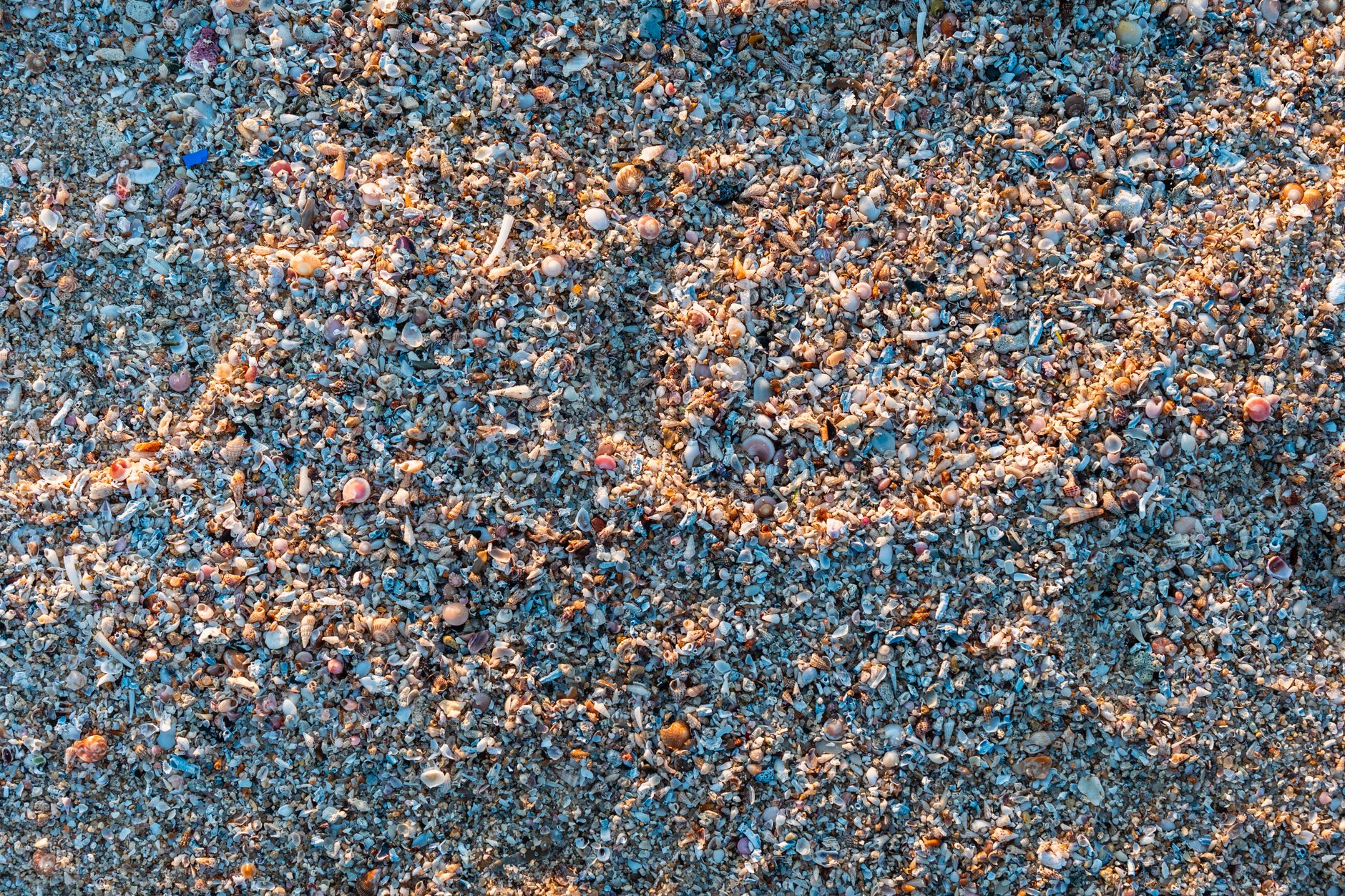
Golf courses use several different types of sand, and it’s important to understand that they are not interchangeable. Using the wrong sand in the wrong application can create problems that take seasons to correct. Here’s how top dressing sand compares to the other sands commonly found on a course.
Top Dressing vs. Bunker Sand
Bunker sand is selected for entirely different criteria than top dressing sand. Golfers expect bunker sand to be firm enough to support a stance, coarse enough to resist splash from rain, and bright enough to be visible from a distance. Top dressing sand, by contrast, needs to integrate invisibly into the turf canopy. Using bunker sand as top dressing — a shortcut some courses attempt — can create a grainy, inconsistent putting surface and may not match the rootzone particle size distribution. These are separate products that serve separate purposes. Jackson Sand supplies both; see their bunker sand page for specifications on that product.
Top Dressing vs. Construction/Fill Sand
Generic construction or fill sand is the most common — and most damaging — substitution for proper top dressing sand. Fill sand is typically ungraded, may contain significant silt and clay fractions, and is not washed or screened to any turf-specific standard. Applied to a putting green, fill sand can seal the surface within a single growing season, creating perched water tables, anaerobic conditions, and a putting surface that is soft, slow, and prone to disease. The cost savings are not worth the agronomic consequences. Always use a sand that has been lab-tested and spec’d for turf applications.
Common Top Dressing Mistakes and How to Avoid Them
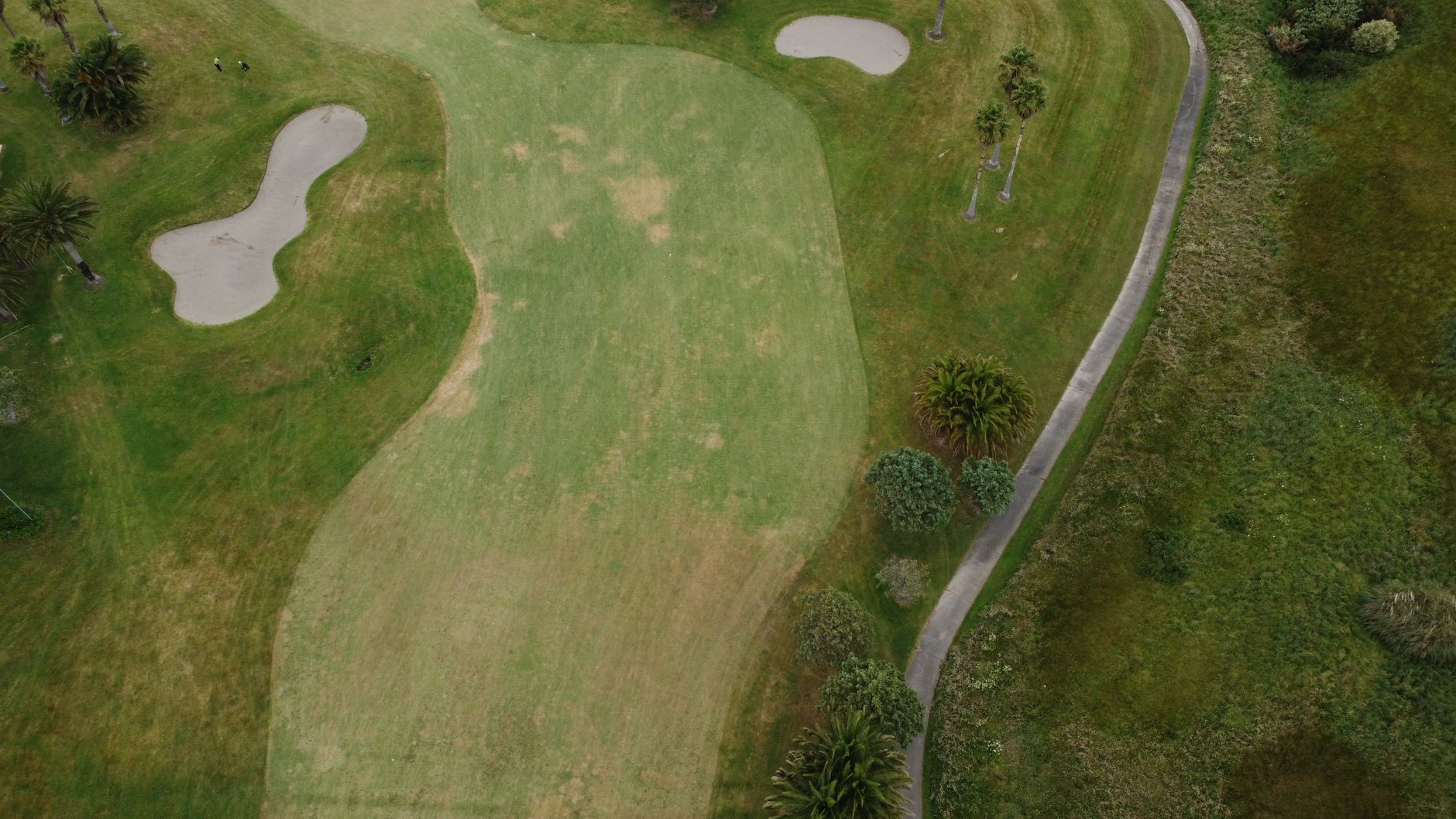
Even experienced turf managers make top dressing mistakes — usually under time pressure or budget constraints. Knowing the most common errors and their consequences helps you avoid them and make the case to management for doing the program right.
Applying Too Much Sand at Once
One of the most common mistakes — especially for courses new to a top dressing program — is applying too heavy a layer in a single pass. Sand that can’t be worked into the canopy within 24–48 hours sits on the surface, smothers the turf, and creates a bumpy, uneven surface that takes weeks to recover. The rule of thumb: if you can’t see the grass blades through the sand after application, you’ve applied too much. Light and frequent beats heavy and infrequent every time.
Using Sand That Doesn't Match the Rootzone
As discussed in the specs section, applying a top dressing sand with a significantly different particle size distribution than your existing rootzone creates hydraulic layering — an invisible problem that compounds over years. Before switching suppliers or trying a new product, get a sieve analysis done on your existing rootzone material and compare it to the spec sheet of the new sand. Jackson Sand’s published spec sheets make this comparison straightforward.
Skipping the Program During Stress Periods
Some superintendents pause their top dressing program during summer heat stress or drought — understandable, but a mistake if extended too long. While you should avoid heavy applications during peak stress, light applications every 3–4 weeks keep the program moving and prevent organic matter from accumulating to problem levels. A brief pause of 2–3 weeks during extreme heat is fine; abandoning the program for an entire summer is not. The organic matter that builds up during a missed season can take two full growing seasons of aggressive top dressing to correct.
Top Dressing Services: When to Let a Pro Handle the Application

Not every course has the equipment or the crew bandwidth to handle top dressing applications in-house — especially during busy aerification seasons or renovation projects. Knowing when to bring in outside help can save time, protect turf quality, and keep your maintenance calendar on track.
What a Top Dressing Service Includes
Some golf courses — particularly smaller operations, municipal courses with lean maintenance staffs, or private clubs undergoing renovation — benefit from contracting out the top dressing application rather than doing it in-house. A professional top dressing service brings calibrated equipment, experienced operators, and the ability to complete the work quickly and correctly without pulling your own crew off other tasks. Jackson Sand offers top dressing services in addition to sand supply, so you can get the material and the application from a single local source.
Situations Where Contracted Top Dressing Makes Sense
Consider contracting the application when:
- Your course doesn’t own a top dressing spreader and the rental cost approaches the service cost
- You’re managing a large aerification event and need to move quickly across all 18 greens in a single day
- Your maintenance crew is stretched thin during peak season
- You’re renovating tees or fairways and need a heavier, more precise application than your standard equipment can deliver
For courses in West Tennessee that want to explore both sand supply and application services, the Jackson Sand top dressing services page outlines what’s available and how to get started.
Ready to Schedule Your Top Dressing Sand Delivery in West Tennessee?

Your top dressing program is only as good as the sand behind it — and the sand is only as good as the supplier delivering it. Jackson Sand has been mixing and delivering quality sand products in Jackson, TN and across West Tennessee for golf courses, athletic fields, contractors, and homeowners. Here’s how to get the process started.
What to Have Ready When You Call
To get an accurate quote and schedule your delivery efficiently, have the following information ready when you contact Jackson Sand:
- The square footage of the surfaces you’re top dressing (greens, tees, fairways — separately)
- Your planned application depth
- Your target delivery date and any flexibility in the schedule
- Your site address and the best access point for a delivery truck
- Whether you need top dressing services (application) in addition to sand supply
If you’re not sure on quantities, use the free yardage calculator on the Jackson Sand website before you call — it takes about two minutes and gives you a solid starting number.
Serving Golf Courses of All Sizes Across the Mid-South
Jackson Sand works with golf courses ranging from small 9-hole operations to full 18-hole private clubs across West Tennessee and the surrounding Mid-South. There is no job too small or too large — they serve large and small jobs alike, and delivery is included. The team at Jackson Sand — led by President Carlton Pope and Manager Wes Lipford — brings practical, plainspoken expertise to every order. They’re not a national distributor; they’re a local supplier who knows the region, knows the turf conditions, and is invested in the quality of what they deliver.
Call 731-668-0440 to talk through your top dressing needs, request a quote, or schedule a delivery. You can also explore the full range of golf course maintenance materials and services Jackson Sand offers — from top dressing sand to bunker sand to drainage aggregate — all available for delivery throughout West Tennessee.
Frequently Asked Questions
How often should I top dress putting greens on a bermudagrass golf course in Tennessee?
For bermudagrass greens in West Tennessee, a good baseline is every 2–4 weeks during the active growing season (late April through early October), with heavier applications timed to aerification events in spring and fall. Light, frequent applications are more effective and less disruptive than infrequent heavy ones.
What particle size should top dressing sand be for golf greens?
Top dressing sand for putting greens should have at least 60% of particles in the medium sand range (0.25–0.5 mm), with less than 3% passing the 0.15 mm sieve. This minimizes layering risk and matches USGA rootzone specifications. Always compare the top dressing sand spec to your existing rootzone material before ordering.
Can I use bunker sand for top dressing greens?
No — bunker sand and top dressing sand are designed for different purposes. Bunker sand is typically coarser and selected for playability, not for integration into a turf rootzone. Using bunker sand as top dressing can create an uneven putting surface and may not match your rootzone particle size, leading to drainage problems over time.
How much top dressing sand do I need for 18 greens?
It depends on your green sizes and application depth. As a rough estimate, 18 greens averaging 5,000 sq ft each, top dressed at 1/8 inch, requires about 34 cubic yards per application cycle. Use the free yardage calculator at jacksonsand.com to get a precise number based on your actual dimensions and planned depth.
Does Jackson Sand deliver top dressing sand to golf courses outside of Jackson, TN?
Yes — Jackson Sand serves golf courses, athletic facilities, and contractors throughout West Tennessee and the surrounding Mid-South region. They deliver in their own trucks with delivery included in the price. Call 731-668-0440 to confirm delivery availability for your location.
What is the difference between top dressing sand and regular construction sand?
Construction or fill sand is ungraded and often contains significant amounts of silt, clay, and very fine particles that can seal a turf surface and impede drainage. Top dressing sand is washed, screened, and graded to a specific particle size distribution designed for turf applications. Using fill sand on golf greens can cause serious, long-lasting agronomic problems.