
Best Gravel for French Drains: Sizing, Trench Build and Layouts
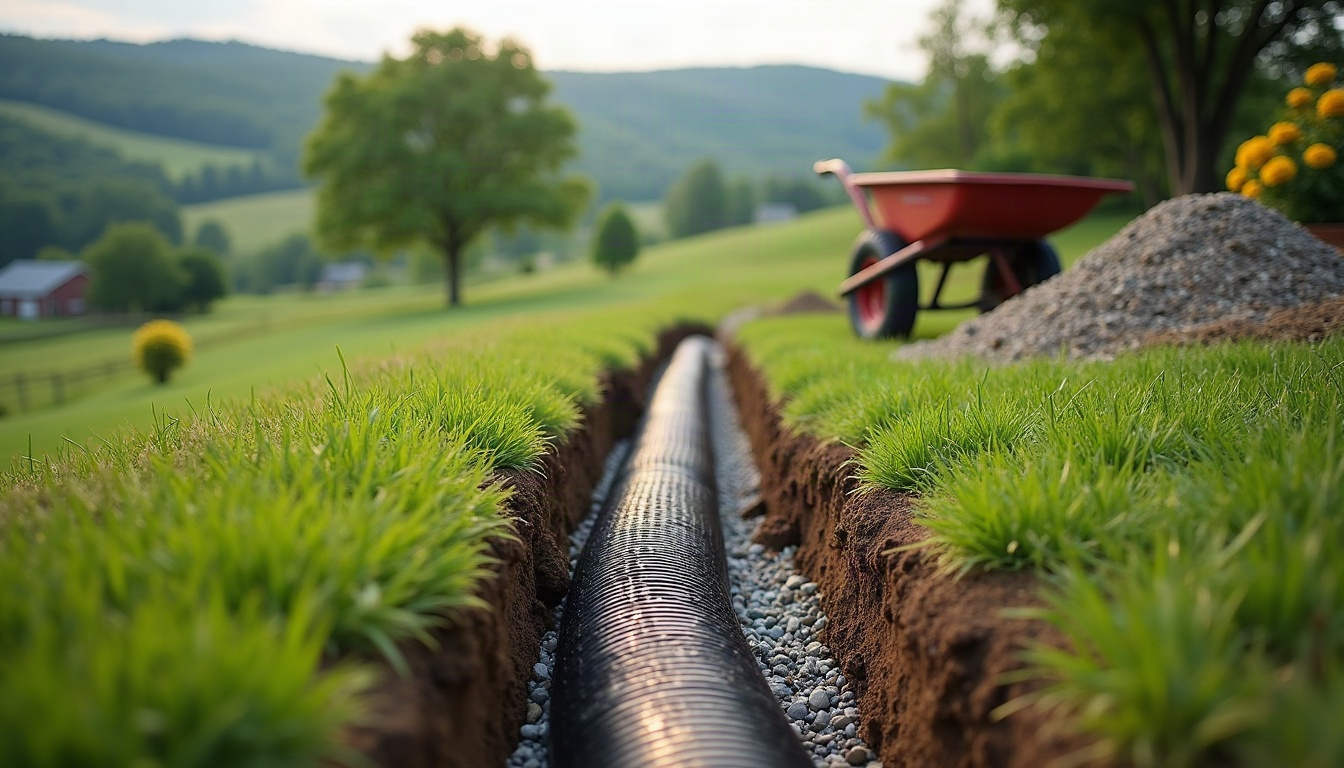
Quick answer: The best gravel for a French drain is clean, washed stone in the 3/8 to 3/4 inch range with no fines. Set perforated pipe on a 2 inch gravel bed, cover it with at least 4 inches of the same stone, and wrap the gravel envelope in non-woven filter fabric when the native soil is silty or clayey. Slope the pipe to a free outlet and use herringbone laterals for wide wet areas.
What a French Drain Actually Does
A French drain is a gravel-filled trench, usually with a perforated pipe in the bottom, that gives groundwater and seepage an easier path than the soil around it. Water always moves toward the route with the least resistance. Clean stone has large, connected voids, so water in the surrounding soil drains sideways into the trench, drops to the pipe and travels downhill to an outlet. The trench lowers the water table along its length and intercepts seepage before it reaches a foundation, a playing surface or a soggy spot in the lawn.
That makes a French drain a subsurface tool. It is the right answer when water is coming up from below or moving laterally through the soil: a hillside seep, a spring line, a basement wall that stays damp, a green that never firms up after rain. It is not the right primary answer for sheets of water running across the surface during a storm. That job belongs to grading, swales and catch basins, which we cover in our guide to surface water drainage and slope. Many good systems use both: shape the surface so storm water leaves quickly, and put French drains where seepage remains.
Across West Tennessee and the wider Mid-South, the clay-heavy and silty soils common in the region hold water for days after a rain. A properly built French drain is one of the most reliable ways to dry out those sites. The difference between one that works for decades and one that clogs in a few seasons comes down to three things: the gravel you choose, how you build the trench, and whether you protect the stone from migrating fines.
Why Clean 3/8 to 3/4 Inch Gravel Is the Right Fill
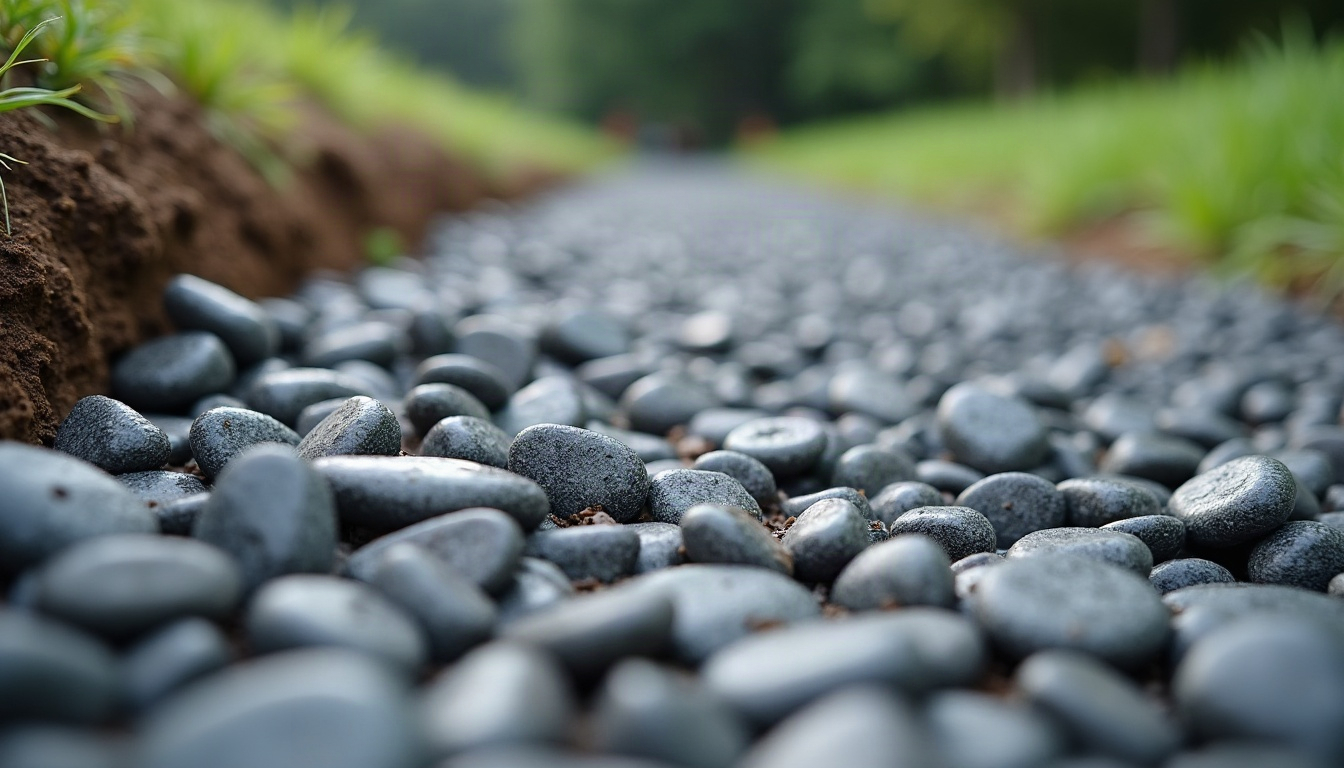
The standard recommendation for French drain fill is clean gravel between 3/8 inch and 3/4 inch. Both halves of that phrase matter.
Size
Stone in the 3/8 to 3/4 inch range is large enough that the pores between pieces are wide and connected, so water flows through quickly. It is also small enough to pack around a pipe without bridging over the perforations or leaving big voids that let soil slump in. Much larger rock (1.5 inch and up) moves water well but is harder to place around small pipe and offers less contact surface for collecting seepage from the trench walls. Much smaller material, such as coarse sand, starts to hold water by capillary action instead of releasing it.
Clean
Clean means the stone has been washed or screened so dust, silt and clay are removed. This is the single most important property. Fines in the gravel fill the voids from day one, and every rain washes more of them down to the pipe, where they settle in the bottom and plug perforations. Dense-graded base material such as crusher run is designed to compact into a hard, low-permeability layer. That is perfect under a driveway and exactly wrong inside a drain.
Uniform
A narrow size range (all pieces roughly similar) keeps the pore space high. A wide range lets small particles nest between large ones, which is how you build strength in road base and how you lose permeability in a drain. When you ask a supplier for drainage stone, ask whether it is washed and what the size range is. A quick look at a handful should show distinct pieces with no gray dust coating your palm.
Comparing Gravel Options for Drainage Work
Not every gravel on the yard is meant for a drain trench. The table below compares common choices, including the materials on our gravels page, by how they behave in drainage work.
| Material | Shape | Fines | Best drainage use | Watch out for |
|---|---|---|---|---|
| Clean washed stone, 3/8 to 3/4 in | Angular or rounded | Very low | Pipe envelope and trench fill | Confirm it is washed, not just screened |
| Pea gravel | Small, rounded | Low when clean | Trench fill, open drain tops, around downspout outlets | Rounded stones roll and shift under foot or tire traffic |
| 33C limestone gravel | Crushed, angular | Ask about current gradation | Stable base, bedding where interlock matters | Crushed limestone fines can cement and slow flow if not washed |
| Red river rock | Rounded, larger | Low | Decorative cap on open drains, splash areas, dry creek beds | Too large to envelope small pipe well |
| Crusher run or dense-grade base | Angular with dust | High by design | None inside a drain; use under paving | Compacts into a near-impermeable layer |
| Sand | Fine particles | Varies | Root zones and filter layers in engineered profiles | Will wash into pipe perforations without proper design |
For most residential and landscape French drains, a clean, rounded pea gravel or a washed angular stone in the 3/8 to 3/4 inch window does the job. Under areas that see vehicle or mower traffic, angular stone locks together better and resists rutting at the surface. Where the drain will be visible, a cap of red river rock over the working gravel gives a finished look without changing the hydraulic performance underneath.
If you are not sure which of our materials fits your trench, call with the trench length, depth and what will sit on top. We will tell you what is on hand and how it is graded.
Building the Trench: 2 Inches Under, 4 Inches Over
The cross section of a good French drain is simple, and the dimensions are well established. Here is the sequence most contractors follow.
- Locate utilities. Call 811 before digging. Irrigation lines and low-voltage cable are common surprises in lawns and on golf courses.
- Mark the route and outlet. The water has to go somewhere lower: a daylight outlet on a slope, a storm structure, a dry well or a ditch. Find the outlet first and work uphill from it.
- Dig the trench. Typical residential trenches are 6 to 12 inches wide and 18 to 24 inches deep, deeper where you are intercepting seepage against a foundation. Keep the bottom smooth and consistently sloped.
- Set the slope. A minimum fall of about 1 percent (roughly 1/8 inch per foot) keeps water and light sediment moving. More fall is better when the site allows it.
- Line with fabric if needed. In silty or clay soils, lay non-woven geotextile in the trench with enough excess on both sides to fold over the top later.
- Place a 2 inch gravel bed. Spread clean stone along the bottom and level it to grade. The bed supports the pipe and lets water reach the perforations from below.
- Lay the perforated pipe. Most installers set perforations facing down or at the 4 and 8 o’clock positions, so water rises into the pipe and sediment is less likely to settle inside. Check slope with a level as you go.
- Cover with at least 4 inches of gravel. Place stone carefully around and over the pipe so you do not crush or shift it. Four inches of cover is the minimum; filling the trench with stone to within a few inches of grade gives more collection capacity.
- Close the fabric and finish the surface. Fold the fabric over the gravel, then top with soil and sod, or leave the stone exposed for an open drain.
The 2 inch bed and 4 inch cover rule is the same principle used in golf course and sports-field drainage, scaled to the job. It keeps the pipe fully surrounded by a permeable envelope so water reaches it from every direction.
Filter Fabric: When to Use It and When to Skip It
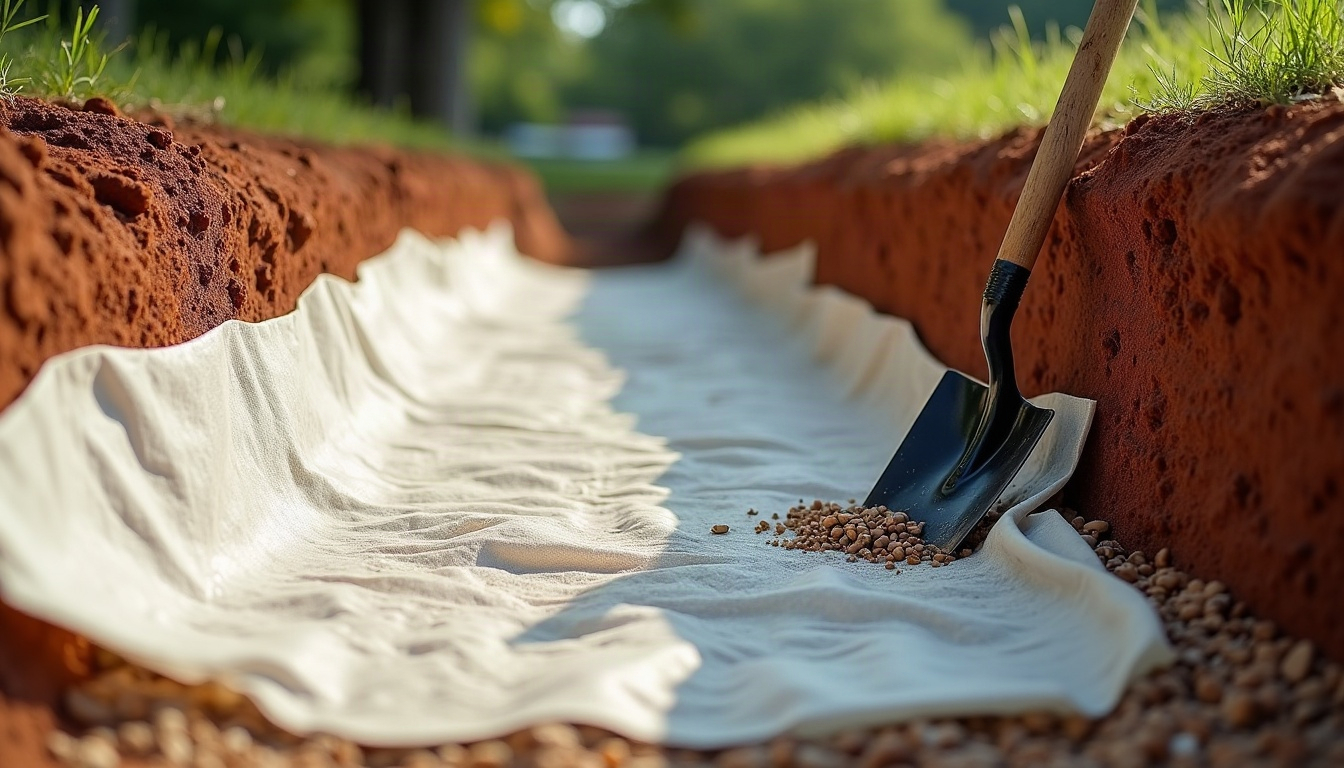
The enemy of every French drain is fine soil migrating into the stone. Fabric is the usual defense, but it is not automatic.
Use fabric when
- The native soil is silty, clayey or fine sand, which describes much of West Tennessee.
- The drain will be covered with topsoil and sod, so there is soil directly above the gravel.
- You cannot easily access or flush the pipe later.
Choose the right type
Use a non-woven geotextile, the felt-like kind. Woven fabric, the type used to stabilize roads, has much lower water flow and can blind off quickly. Wrapping the whole gravel envelope (trench lined, then folded over the top) is better practice than a sock on the pipe alone. A pipe sock sits right where fine particles concentrate and can clog in heavy clay.
When to skip fabric
Engineered turf systems often skip fabric between the gravel and the root zone and instead rely on a properly matched sand above the stone. On a USGA-style putting green, for example, the profile is a 4 inch gravel blanket topped by 12 inches of root-zone mix. The sand is chosen so its particles bridge over the gravel pores without washing through, and fabric in that layer would trap fines and create a perched layer. That kind of system should be designed with lab-tested materials. Our sand specs page shows the particle-size data for the sands we supply into these profiles.
For homeowner and landscape drains, fabric is cheap insurance. For specialty turf construction, follow the design and the lab.
Herringbone Layouts and Other Drain Networks
One trench handles a narrow seep. Wide wet areas need a network. The layout you choose depends on the shape of the area and where the outlet is.
Herringbone
A herringbone layout runs a main collector line down the low axis of the area, with lateral lines joining it at an angle on both sides, like the bones of a fish. Laterals typically meet the main at around 45 to 60 degrees so water merges smoothly. This is the classic pattern for putting greens, tees, sports fields and large lawn areas because it covers ground evenly and follows the natural fall toward one outlet. Lateral spacing depends on soil and use: tight spacing (in the range of 10 to 20 feet) for high-value turf over native soil or engineered profiles, wider spacing where the goal is just to take the edge off a wet yard.
Gridiron
A gridiron pattern uses parallel laterals that tee into a main header running along one side. It suits rectangular areas with a uniform slope, such as a practice field, where the outlet sits along one edge.
Interceptor or curtain drain
A single line run across a slope, perpendicular to the flow, catches seepage moving downhill before it reaches a house, patio or playing surface. This is the most common residential French drain and often the only one needed.
Natural or random layouts
Irregular sites, including many golf course surrounds, use lines that follow the actual wet spots and low swales. Walk the area after a long rain and flag where water stands and where turf stays soft; those flags become your layout.
In every pattern, make each connection with proper fittings, keep laterals sloped toward the main, and consider cleanouts at the upper ends so lines can be flushed. Our seepage drainage page explains the subsurface side of these systems in more detail.
Open vs. Covered French Drains
Once the pipe and gravel are in, you decide what goes on top. The choice affects how much surface water the drain can accept, how it looks and how long it lasts.
| Factor | Open drain (gravel to grade) | Covered drain (soil and sod on top) |
|---|---|---|
| Surface water intake | High; takes runoff directly | Low; mostly collects subsurface water |
| Appearance | Visible stone strip, can be decorative | Hidden in the lawn |
| Mowing and traffic | Stones can be thrown by mowers if loose | Normal turf use |
| Clogging risk | Surface debris, leaves and mulch can wash in | Fines from topsoil can migrate down without fabric |
| Typical use | Along foundations, beds, dry creek beds, low spots that pond | Through lawns, fields and play areas |
An open drain works well along a foundation or a bed edge where you want to catch roof drip and surface runoff as well as seepage. A rounded stone such as pea gravel or red river rock gives a clean finished edge. Keep mulch from spilling onto it, and rake out leaves each fall.
A covered drain is the choice through turf. Leave at least 4 to 6 inches of soil over the fabric so grass roots have room, and use a sandy topsoil rather than heavy clay right over the trench. On sports fields and golf turf, some managers backfill the top of the trench with sand to a narrow slit so surface water can still reach the gravel. That approach, often called slit or sand-band drainage, keeps the surface draining while turf grows over the top.
How Much Gravel Do You Need?
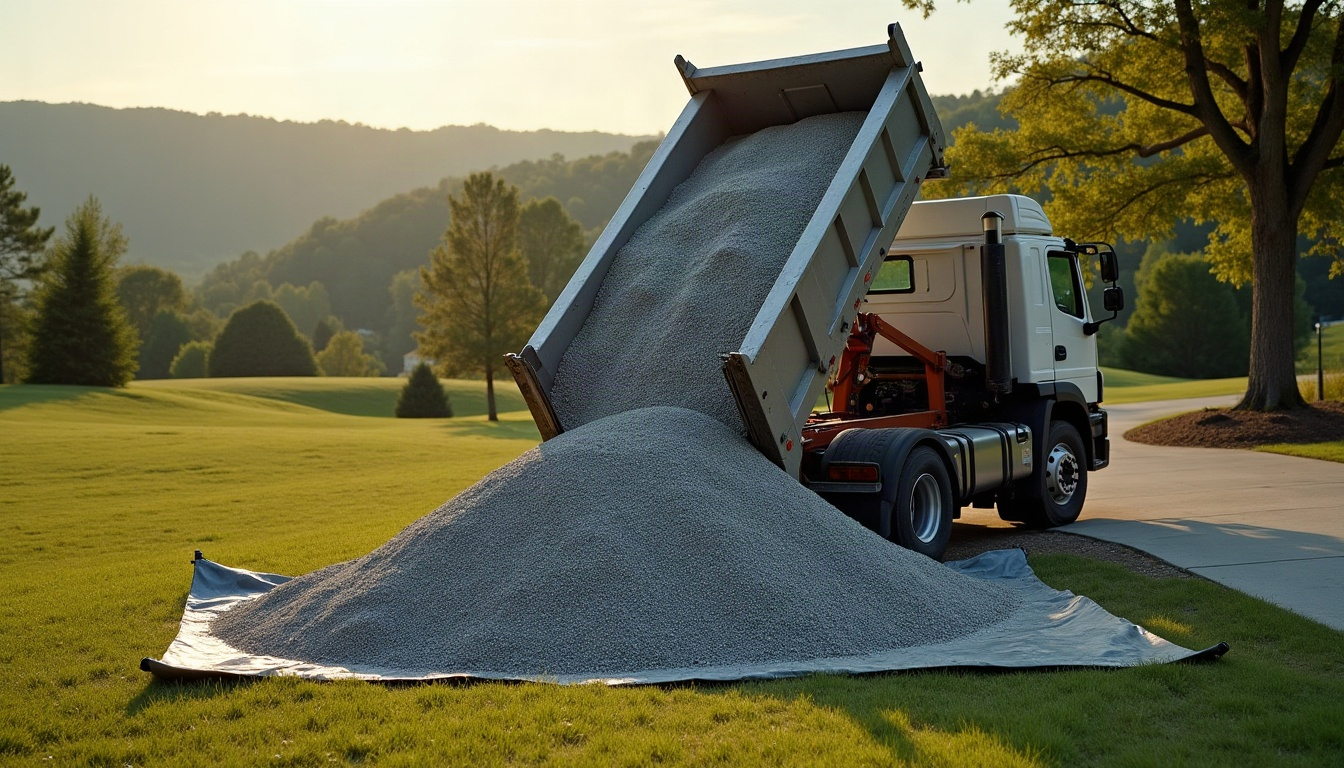
Gravel is ordered by the cubic yard. The math is simple, and it is worth doing before you call so you order once.
Cubic yards = length (ft) x width (ft) x depth (ft) / 27
Example: a 60 foot interceptor drain, 1 foot wide, with gravel filled 1.5 feet deep.
- 60 x 1 x 1.5 = 90 cubic feet
- 90 / 27 = 3.33 cubic yards
The pipe takes up a small share of that volume. A 4 inch pipe occupies about 0.09 cubic feet per foot of length, or roughly 5 cubic feet over 60 feet. That is small enough that most contractors ignore it and treat it as a margin for spillage and settling. Rounding up to the next half yard is sensible.
For a herringbone network, add up the length of the main and every lateral, then run the same calculation. If laterals are narrower or shallower than the main, figure them separately and total the results.
Our free yardage calculator does this math for you. Enter length, width and depth and it returns cubic yards. Have that number ready when you call, along with the type of stone you want and where the load should be dropped. Put a tarp or plywood down at the drop spot if you want to protect the lawn and keep the stone free of soil.
Common French Drain Mistakes
Most failed French drains we hear about fail for one of a handful of reasons.
- Using dirty or dense-graded stone. Base gravel with fines feels like a bargain until the drain stops flowing. Use clean, washed stone.
- No outlet, or an outlet that is too high. A drain without a lower exit is just a buried bathtub. Confirm the outlet elevation before you dig the first foot.
- Flat or bellied pipe. Low spots in the pipe hold sediment and water. Check slope every few feet with a level or laser.
- Too little cover over the pipe. Less than 4 inches of gravel over the pipe reduces the collection zone and lets soil get close to the perforations.
- Wrong fabric or no fabric in clay. Woven fabric clogs; no fabric in silty soil lets fines migrate. Use non-woven geotextile around the envelope.
- Solving a surface problem with a subsurface drain. If water sheets across the lawn in a storm, fix grading and add a swale or catch basin first. A covered French drain cannot absorb a downpour fast enough.
- Connecting downspouts into the French drain. Roof water carries grit and arrives in surges. Run downspouts in solid pipe to their own outlet, not into the perforated line.
- Heavy clay backfill on top. Capping a gravel trench with dense clay seals it off from the surface. Use sandy soil or keep the stone open.
Avoiding these takes no special equipment, just the right material and a little care with grade.
Get the Right Drainage Gravel from Jackson Sand
Jackson Sand supplies gravel and sand to contractors, landscapers, golf courses, sports-field managers and homeowners across Jackson and West Tennessee. Our gravel lineup includes pea gravel, 33C limestone gravel and red river rock, and we can talk through which one fits your trench, what is currently available and how it is graded.
We have been in production since 1996, and we run around 14 trucks of our own, daily from as early as 6 a.m. Because we own those trucks, your gravel does not ride in a bed that just hauled clay fill or someone else’s mixed load. You get the material you ordered, without the fines and debris that shorten a drain’s life. When your project involves turf, such as a green rebuild or a field drainage retrofit, we can also supply the sands and root-zone mixes that go over the gravel.
Have your trench dimensions or yardage ready, and call 731-668-0440 or reach us through our contact page. We will help you size the order and get the right stone to your site.
Inside the Jackson Sand Plant
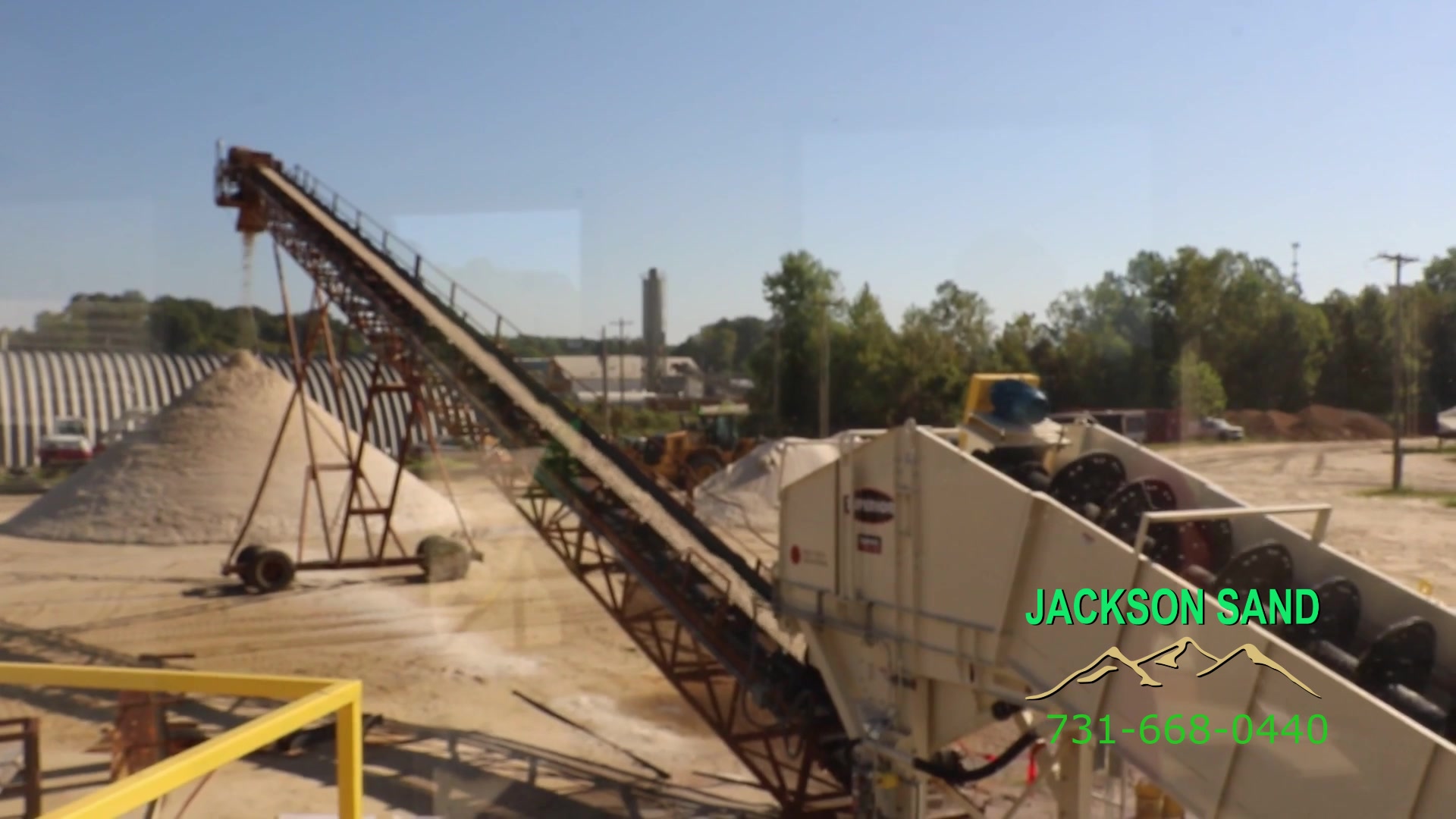
Take a 90-second look at where our sand comes from: the washing plant, screens and conveyors, and the Jackson Sand truck fleet that delivers every load. President Carlton Pope tells the story of how the company grew from one truck in 1996.
Sources and Further Reading
- Penn State technical bulletin on underdrains (PDF) (Penn State Center for Dirt and Gravel Road Studies)
- constructed stone underdrains (PDF) (Penn State Center for Dirt and Gravel Road Studies)
- homeowner's guide to managing stormwater runoff (PDF) (USDA NRCS)
- EPA stormwater BMP: gravel infiltration trench (PDF) (U.S. EPA)
Frequently Asked Questions
What size gravel is best for a French drain?
Clean gravel between 3/8 inch and 3/4 inch is the standard choice. It has large, connected voids for fast water movement, packs well around 4 inch perforated pipe, and does not hold water the way sand or small grit can. The key is that it is washed and free of fines, since dust and clay fill the voids and clog the pipe over time.
Can I use pea gravel in a French drain?
Yes. Clean pea gravel drains very well and is easy to place around pipe. Because the stones are rounded, they can shift under heavy traffic, so for drains under walkways or mower paths some installers prefer angular washed stone near the surface. Pea gravel also works well as the visible top of an open drain.
How much gravel goes under and over the pipe?
Place a bed of about 2 inches of clean gravel under the perforated pipe and cover it with at least 4 inches of gravel above. Many installers fill the trench with stone to within a few inches of the surface for extra collection capacity, then fold filter fabric over the top before adding soil or leaving the stone exposed.
Do I need landscape fabric in a French drain?
In silty or clay soils, which are common in West Tennessee, a non-woven geotextile wrapped around the gravel envelope is strongly recommended. It keeps fine soil from migrating into the stone and pipe. Avoid woven fabric, which passes water poorly. Engineered turf profiles, such as putting greens, rely on matched sand over gravel instead of fabric.
What is a herringbone drain layout?
A herringbone layout uses a central main line running down the low axis of an area, with lateral lines joining it at an angle from both sides. It drains wide areas evenly toward one outlet and is common on putting greens, tees, sports fields and large lawns. Lateral spacing depends on soil type and how dry the surface needs to be.
How do I figure how much gravel to order?
Multiply trench length by width by gravel depth, all in feet, then divide by 27 to get cubic yards. A 60 foot trench, 1 foot wide with 1.5 feet of gravel, needs about 3.3 cubic yards. Jackson Sand's free yardage calculator at jacksonsand.com does the math for you.
Ready to order or have a question about the right material? Call Jackson Sand at 731-668-0440 or send us a message and we will help you pick the right product and quantity.
Leave a Reply