
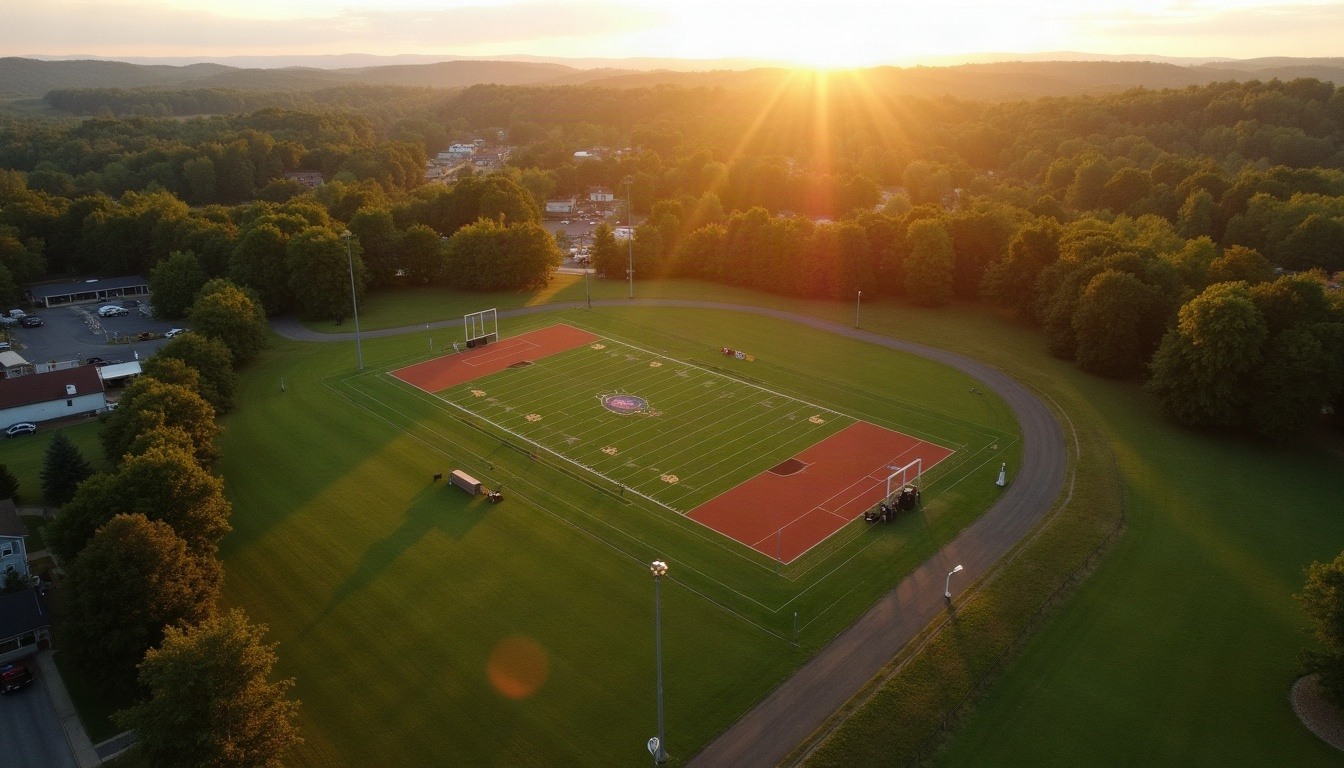
Choosing Sand for Sports Fields: A West Tennessee Field Guide
Quick answer: The best sand for sports fields is a clean, medium-to-coarse top dressing sand with very low silt and clay. Apply about 1/8 inch (0.4 cubic yards per 1,000 sq ft) right after core aeration, at least twice a year during active growth. On native soil fields this slowly builds a sandier, faster-draining surface; on sand-based fields it maintains the profile. Keep straight sand off skinned infields.
Why Sand Choice Matters on a Sports Field
Every athletic field is a balancing act between three things that pull against each other: a surface firm enough for safe footing and true ball bounce, a root zone open enough for turf to breathe, and a profile that moves water off or through the field fast enough to keep games on schedule. Sand sits at the center of all three. Pick the right material and apply it on a steady program, and a field gets firmer, drains faster and recovers from wear sooner. Pick the wrong one, or skip the program, and the same field turns into a slick mud pan in March and a brick in August.
For athletic directors, parks departments and sports-field managers across West Tennessee, the challenge is sharper than in many regions. Our native soils lean heavily toward silt loams and clays. They hold water after a spring thunderstorm, compact under cleats, and crust when they dry. Those soils grow grass well enough on a lawn that sees light traffic, but a varsity football field or a heavily scheduled youth soccer complex asks far more of them.
This guide walks through the decisions that actually move the needle:
- How sand-based fields differ from native soil fields, and why that difference changes your maintenance plan.
- What baseball and softball infields need from sand compared with turfed areas.
- How top dressing works on football and soccer fields, and what rates make sense.
- How drainage and compaction tie together, and where aeration fits.
- What to look for in the sand itself, and how to figure the quantity you need.
Throughout, we will reference the top dressing sand Jackson Sand mixes and hauls out of Jackson, Tennessee, because it is the product most fields in our area use day to day. The principles apply no matter where your sand comes from.
Sand-Based vs. Native Soil Fields
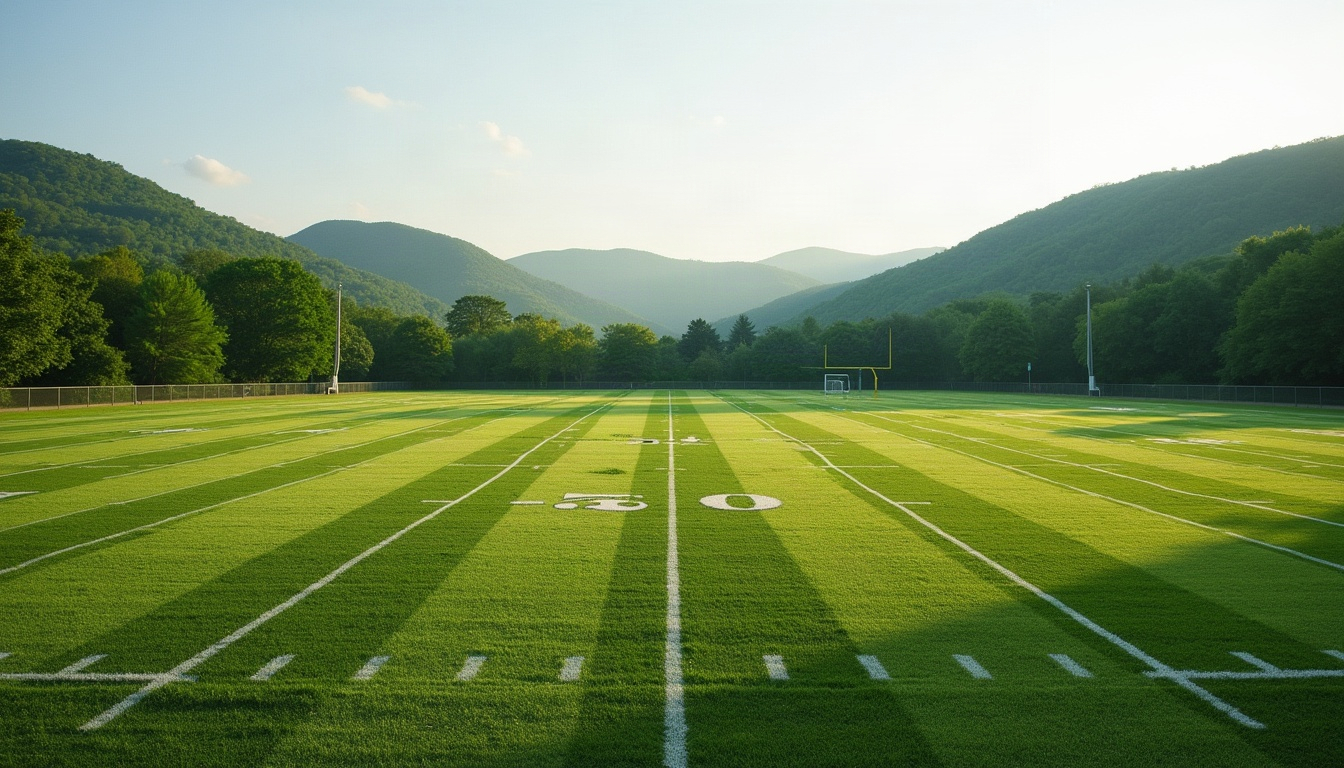
Sports fields generally fall into two camps. A sand-based field is built with an engineered root zone, usually a high-sand mix several inches deep, often placed over a gravel drainage layer and a network of subsurface drain lines. A native soil field is built on whatever soil was on site, perhaps graded and crowned, but without a constructed root zone.
How they behave differently
Sand-based fields drain vertically. Water moves down through large pore spaces between sand grains and exits through the drainage system, so a field can often be played on shortly after heavy rain. The tradeoff is that sand holds fewer nutrients and less water, so these fields need more frequent irrigation and fertilization, and they depend on the sand staying clean and uniform.
Native soil fields rely mostly on surface drainage. A crown sheds water to the sidelines. Fine silt and clay particles pack tightly under traffic, closing off the pore space roots and water need. That is why native fields often look great in October and worn out by the end of a spring season.
| Factor | Sand-based field | Native soil field |
|---|---|---|
| Primary drainage path | Vertical, through the root zone to subsurface drains | Surface runoff off a crown or slope |
| Recovery after rain | Fast, often playable same day | Slow, can be closed a day or more |
| Compaction resistance | High | Low to moderate |
| Water and nutrient holding | Low, needs more frequent inputs | Higher |
| Up-front cost | Higher (construction) | Lower |
| Role of top dressing | Maintain profile, smooth surface, dilute thatch | Gradually build a sandier surface layer, improve infiltration |
Which do you have?
Many high school and municipal fields in the Mid-South are native soil fields that have been improved over time. You do not have to rebuild a native field to get some of the benefits of sand. A consistent aeration and sand top dressing program, kept up year after year, slowly builds a sandier surface layer that drains better and resists compaction. More on that below.
Baseball and Softball Infield Considerations
Baseball and softball fields add a wrinkle: they combine turf (the outfield and infield grass) with skinned areas (base paths, the infield arc, the home plate area and the pitcher’s mound on baseball fields). Those areas have different jobs and need different handling.
Turfed areas
The grass portions of a diamond behave like any other turf field. Aeration and sand top dressing improve drainage, smooth the surface for consistent ground balls, and help bermudagrass knit back after wear. Top dressing also helps fill low spots in the outfield that hold water and create bad hops.
Skinned infields
Skinned infield mixes are a blend of sand, silt and clay, and the proportions matter. Too much sand and the surface turns loose and unstable, so players lose footing and the ball skids unpredictably. Too much clay and the infield sheds water poorly in some spots, sets up hard as concrete in others, and cracks in summer heat. Most groundskeepers aim for a mix firm enough to hold cleats yet loose enough on top to give a little.
A few practical points for skinned areas:
- Do not dump straight sand on a skinned infield to dry it out. It may help for an afternoon, but over time it shifts the mix toward too much sand and creates a loose, shifting surface.
- Watch the lip. Where the infield dirt meets the grass, material builds up from dragging and wind. A lip that grows higher than the turf causes bad bounces and holds water. Regular edging and blowing material back onto the skin keeps it in check.
- Keep the turf edge clean. When top dressing the infield grass, keep sand from piling up along the transition so it does not contribute to the lip.
- Get advice on your mix. Infield mix needs vary with the field’s level of play, budget and climate. If you are not sure what your skinned areas need, talk with a sports-turf professional or call us to talk through options before you order.
For the turf areas around the diamond, the same top dressing sand used on football and soccer fields works well, and keeping one product across the complex simplifies ordering.
Top Dressing Football and Soccer Fields
Football and soccer fields take punishment in concentrated areas: between the hashes, in front of the goals, along the sidelines where players stand. Top dressing is one of the most effective tools for keeping those areas playable.
What top dressing does
- Smooths the surface. Thin layers of sand fill small depressions and ruts, making footing more predictable and ball roll truer.
- Dilutes thatch and organic buildup. On bermudagrass fields especially, a layer of organic material builds up at the surface and holds water. Sand mixed in keeps that layer from turning spongy.
- Improves infiltration over time. On native soil fields, repeated top dressing after aeration builds a sand cap that moves water down faster than the original soil.
- Helps turf recover. A light sand layer protects stolons and crowns and helps bermudagrass spread back into worn spots.
Rates and timing
Light and frequent beats heavy and rare. A heavy layer that buries the grass blades can smother turf and create a distinct layer in the profile, which is the opposite of what you want. A common working rate is about 1/8 inch per application. At that depth, a 1,000 square foot area takes roughly 10.4 cubic feet of sand, or about 0.4 cubic yards.
For a full-size football field of roughly 57,600 square feet including the end zones, a 1/8 inch application works out to about 23 cubic yards. A soccer field varies widely in size, so measure yours and run the numbers with our yardage calculator.
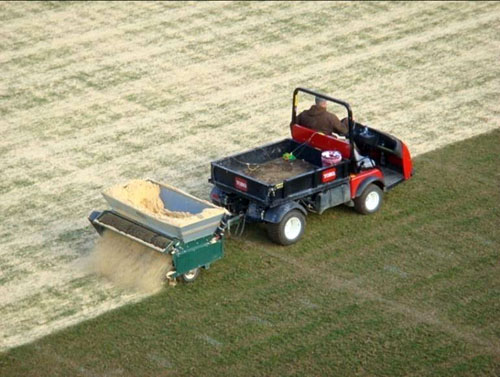
Timing matters as much as rate. Top dress during active growth, when bermudagrass can grow up through the sand quickly. In West Tennessee that typically means late spring through summer. Pairing top dressing with core aeration gets the most from every load, because sand can fill the aeration holes and reach below the surface.
Jackson Sand’s Regular Top Dressing is the product we recommend for athletic fields. It is the same sand golf courses across the region use, and it meets USGA specifications.
Drainage and Compaction: Two Sides of the Same Problem
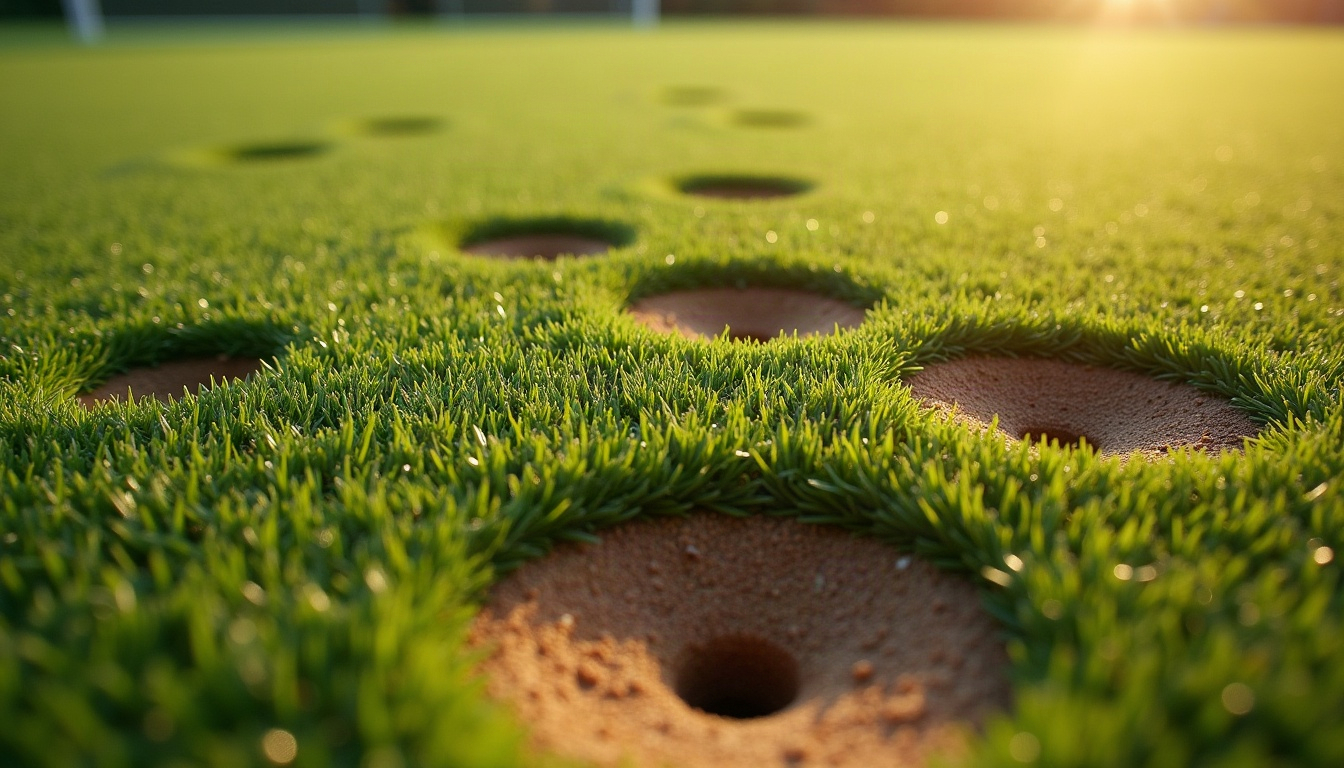
Most field managers think of drainage and compaction as separate issues. In practice they feed each other. A compacted field drains poorly, and a field that stays wet compacts faster when it is played on. Breaking that cycle takes attention to both surface water and what is happening in the top few inches of the profile.
Surface drainage
The first line of defense is grade. Turf areas need a minimum surface slope of about 2 percent to move water, and paved areas need at least 1 percent. Many native soil football fields use a crown that falls toward each sideline. Over years of top dressing, play and settling, low spots develop and the crown flattens, so water stands where it should run. Our guide to surface water drainage and slope covers grade in more detail.
Subsurface drainage
Where grade alone cannot do the job, subsurface drains help. French drains with perforated pipe bedded in clean 3/8 to 3/4 inch gravel, often laid in a herringbone pattern across the field, carry water away from the root zone. A typical installation puts about 2 inches of gravel under the pipe and 4 inches over it. Slit drains backfilled with sand or gravel can connect a compacted surface to those lines. Both approaches pair well with the surface work described here.
Compaction
Compaction squeezes out the large pores that carry air and water. Roots grow shallow, water runs off instead of soaking in, and the surface becomes hard and less forgiving for athletes. Signs include standing water after moderate rain, thinning turf in high-traffic zones, and a surface that rings hard underfoot in summer.
The fix is mechanical. Core aeration opens the profile, and sand top dressing keeps the holes from closing back up. Repeated over seasons, that combination changes the surface layer of a field for the better.
Aeration and Top Dressing as a Program
Aeration and top dressing work best as a pair, done on a schedule rather than in response to a crisis. A sensible baseline for an athletic field in our region looks like this:
- Aerate at least twice a year. Spring and midsummer are the standard windows for warm-season fields, when bermudagrass is actively growing and can heal quickly.
- Make multiple passes. Three passes per aeration event is a good target, with holes spaced about 2 to 3 inches apart.
- Pull real cores. Cores of roughly 3/4 to 1 inch diameter pulled 3 to 4 inches deep remove compacted material and leave room for sand.
- Top dress right after. Spread sand at about 1/8 inch and drag or brush it into the holes. Sand that fills the channels keeps them open and builds better soil structure over time.
- Repeat high-traffic zones. Goal mouths, the middle of the field between the hashes, and bench areas may need extra attention between full-field treatments.
Doing it yourself vs. hiring it out
Many schools and parks departments own a small aerator and spreader. Others lack the equipment or the staff hours to cover a full field properly before the season starts. Jackson Sand offers aeration and top dressing as a service for athletic fields and lawns, so the sand and the labor come from one place. Our athletic fields page explains the service in more detail.
What to expect
One aeration and top dressing cycle will not turn a clay field into a sand-based field. The improvement is gradual. Managers who stick with the program usually notice faster drainage after storms, firmer footing and better turf density over a few seasons. The fields that struggle most are the ones that get attention only when something goes wrong.
What to Look for in Sports Field Sand
Not every sand belongs on a playing surface. Masonry sand, fill sand and concrete sand vary widely in particle size and in how much silt and clay they carry. Spreading the wrong material can create layers that block water movement or add fines that make compaction worse.
Particle size
Good top dressing sand concentrates its particles in the medium to coarse range. Very fine particles fill pore space and slow drainage, while too much gravel-sized material is rough on mowers and players. Jackson Sand’s Regular Top Dressing lab results show 23.1 percent coarse sand and 58.3 percent medium sand, with only 1.5 percent very fine sand and 0.1 percent gravel.
Silt and clay content
Low fines are critical. Silt and clay are the particles that clog pores. Our Regular Top Dressing tests at 98.9 percent sand with 0.5 percent silt and 0.5 percent clay. You can see the full breakdown on our sand specs page.
Compatibility with your root zone
On a sand-based field, the top dressing should closely match the existing root zone so no layer forms. On a native soil field, the goal is different: build a sandier surface, so a clean medium-coarse sand is the right tool.
Consistency and cleanliness
A field that receives sand from a different source each year can develop layers from one material to the next. Sticking with one consistent product avoids that. Cleanliness matters too. Jackson Sand owns its trucks, so loads are not carrying leftover gravel, clay or debris from someone else’s job. You get the sand you ordered.
| Regular Top Dressing (lab) | Percent |
|---|---|
| Total sand | 98.9% |
| Silt | 0.5% |
| Clay | 0.5% |
| Gravel | 0.1% |
| Very coarse | 2.4% |
| Coarse | 23.1% |
| Medium | 58.3% |
| Fine | 13.6% |
| Very fine | 1.5% |
How Much Sand Does Your Field Need?
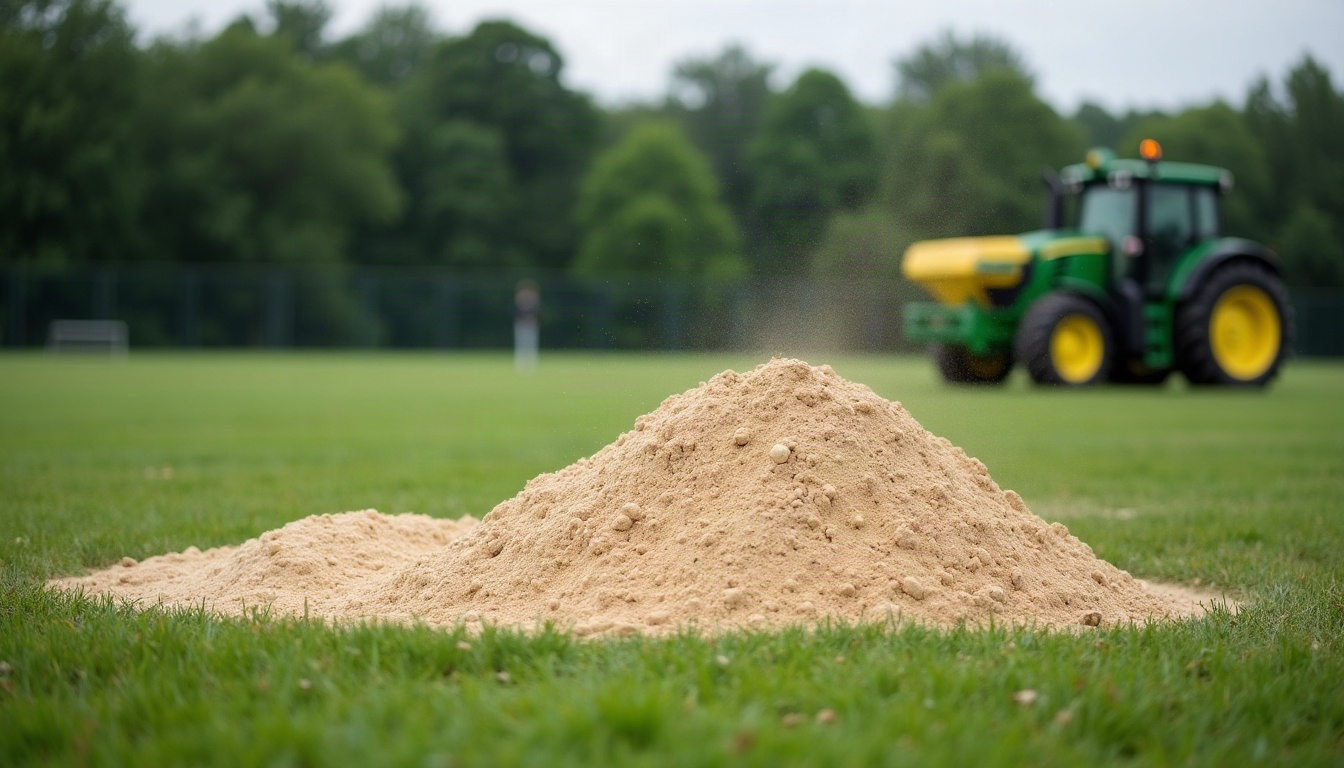
Ordering the right quantity saves money and saves a crew from spreading a half load short at the end of a long day. The math is simple once you have measurements.
The formula
Length (ft) x width (ft) x depth (ft) / 27 = cubic yards. For a 1/8 inch top dressing, depth is 0.0104 feet.
Common field examples at 1/8 inch
| Area | Approx. size (sq ft) | Sand at 1/8 in (cu yd) |
|---|---|---|
| 1,000 sq ft test area | 1,000 | 0.4 |
| Football field with end zones (360 x 160 ft) | 57,600 | about 23 |
| Football field playing area only (300 x 160 ft) | 48,000 | about 19 |
| Youth soccer field (225 x 150 ft) | 33,750 | about 13.5 |
| Full-size soccer field (330 x 210 ft) | 69,300 | about 28 |
These are approximations. Field dimensions vary, and if you are top dressing after aeration, some sand goes into the holes rather than staying on the surface, so you may want a little extra. If you are only treating high-traffic zones, measure those areas separately.
Use the calculator
Our free yardage calculator, linked above, handles the conversion for any length, width and depth. Plug in your numbers, then call us to confirm the order.
Common Mistakes to Avoid
Even well-run programs stumble over a few predictable problems. Avoiding these will save a field a lot of grief.
- Applying too much at once. A heavy layer buries turf, slows recovery and can form a distinct layer in the profile. Stay near 1/8 inch per pass.
- Top dressing without aerating. Sand on top of a compacted native soil sits on the surface and does little to improve drainage below it. Aerate first.
- Switching sands year to year. Different particle sizes stack into layers that interrupt water movement. Choose a consistent product.
- Using the wrong sand. Fill sand or masonry sand may carry too many fines. Ask for lab data.
- Ignoring grade. Top dressing can smooth small dips, but it will not fix a field that has lost its crown or has a low corner. Address grade separately.
- Timing it wrong. Top dressing dormant bermudagrass in winter means the sand sits on the surface for months. Wait for active growth.
- Letting the infield lip grow. On diamonds, keep sand and infield mix from building up at the grass edge.
None of these is complicated to avoid. Most come down to having a plan, sticking with one good material, and doing the work at the right time of year.
Get Top Dressing Sand for Your Field in West Tennessee
Whether you manage a high school football stadium, a city soccer complex, a college baseball diamond or a church league softball field, the right sand and a steady program make a visible difference. Jackson Sand mixes its sand on our own premises in Jackson, Tennessee, and delivers it in our own trucks, so you get a clean, consistent product every time. We also offer aeration and top dressing services for athletic fields and lawns across West Tennessee and the Mid-South.
Jackson Sand has been in production since around 1996 and has made golf-course-grade bunker sands, top dressings and root zone mixes since about 1998, so the sand going on your field comes from the same washing plant that supplies golf courses. Today we run around 14 trucks of our own, hauling from Huntsville, Alabama to Jackson, Mississippi, Little Rock, Owensboro, Kentucky and east to Tullahoma, Tennessee.
If you are not sure how much you need or how to schedule a program around your season, we can help you plan it. Call 731-668-0440 or contact us online to talk through your field and place an order.
Inside the Jackson Sand Plant
Take a 90-second look at where our sand comes from: the washing plant, screens and conveyors, and the Jackson Sand truck fleet that delivers every load. President Carlton Pope tells the story of how the company grew from one truck in 1996.
Sources and Further Reading
- SFMA guide to sports field rootzones (PDF) (Sports Field Management Association)
- baseball field layout and infield mix construction (NC State Extension)
- UF/IFAS baseball field layout and construction (PDF) (University of Florida IFAS)
- Managing Mississippi Sports Fields (PDF) (Mississippi State University Extension)
- building and maintaining soccer fields (AY-31) (Purdue Extension)
Frequently Asked Questions
What kind of sand is best for top dressing an athletic field?
Use a clean sand concentrated in the medium and coarse particle range with very little silt and clay. Fines clog pore space and make compaction worse. Jackson Sand's Regular Top Dressing tests at 98.9 percent sand with 0.5 percent silt and 0.5 percent clay, and it meets USGA specifications, which is why it works well on football, soccer and baseball turf.
How much sand do I need to top dress a football field?
At a 1/8 inch rate, plan on about 0.4 cubic yards per 1,000 square feet. A football field with end zones, about 57,600 square feet, takes roughly 23 cubic yards per application. Add a little extra if you are filling aeration holes, and use the yardage calculator on our site to check your exact dimensions.
Can I put sand on a native clay soil field?
Yes, and it is one of the best ways to improve one. Core aerate first, then top dress with sand so it fills the holes. Repeated over several seasons, this builds a sandier surface layer that drains faster and resists compaction. Spreading sand without aerating mostly leaves a surface layer that does little for drainage below.
Should I add sand to a wet baseball infield?
Avoid dumping straight sand on a skinned infield to dry it out. It may help briefly, but over time it shifts the infield mix toward too much sand, creating a loose surface with poor footing. Skinned areas need a balanced sand, silt and clay blend. Use top dressing sand on the turfed parts of the diamond instead.
How often should sports fields be aerated and top dressed?
Aerate at least twice a year, in spring and midsummer, while warm-season grasses are actively growing. Make about three passes with holes 2 to 3 inches apart, pulling cores 3 to 4 inches deep. Top dress about 1/8 inch right afterward. High-traffic zones such as goal mouths and the middle of the field may need extra treatments.
Does Jackson Sand offer aeration and top dressing services?
Yes. Along with selling and delivering top dressing sand, Jackson Sand offers aeration and top dressing as a service for athletic fields and lawns in West Tennessee and the Mid-South. Call 731-668-0440 to talk through your field, your schedule and how much sand you need.
Ready to order or have a question about the right material? Call Jackson Sand at 731-668-0440 or send us a message and we will help you pick the right product and quantity.
Leave a Reply