
Lab-Tested Sand Specs for Sports Turf Fields: Your 10-Point Guide
Quick answer: Lab-tested sand specifications tell sports turf managers exactly what they're putting under their athletes — particle size distribution, drainage rate, organic matter content, and compaction resistance. For fields in West Tennessee, choosing sand that meets USGA or similar standards means fewer injuries, faster drainage after rain, and turf that stays playable all season. Jackson Sand mixes its own sand on-premises in Jackson, TN, publishes full spec sheets, and delivers in company-owned trucks so every load matches what the lab tested.
1. Why Sand Specifications Matter for Sports Turf
Sports turf is a performance surface, not just a lawn. Whether it’s a high school football field in Madison County, a college soccer pitch, or a municipal baseball diamond, the sand profile underneath the grass determines how the field drains, how firm it plays, and how long the turf stays healthy. Lab-tested sand specifications are the only reliable way to verify that the material you’re ordering will actually perform the way you need it to.
The Cost of Getting It Wrong
A bag of sand from a big-box store and a lab-certified sports turf sand may look identical to the naked eye, but they perform completely differently under cleats, irrigation cycles, and 100°F Tennessee summers. Fields built or top-dressed with unspecified sand compact faster, drain slower, and create uneven playing surfaces that raise injury risk. According to the Sports Turf Managers Association (STMA), surface firmness and traction are two of the top contributing factors in non-contact lower-extremity injuries on natural turf — both of which are directly influenced by the sand profile beneath the grass.
What a Spec Sheet Actually Tells You
A sand specification sheet is a laboratory report that quantifies the physical and chemical properties of a sand sample. At minimum, a credible spec sheet will include:
- Particle size distribution (the percentage of sand in each sieve fraction)
- Saturated hydraulic conductivity (drainage rate in inches per hour)
- Bulk density and total porosity
- Organic matter content
- pH and soluble salts
These numbers let a superintendent or field manager compare products apples-to-apples before a single truckload arrives. Without them, you’re guessing — and on a $200,000 natural turf field, guessing is expensive.
2. Understanding Particle Size Distribution
Particle size distribution is the single most important number on a sand spec sheet. It determines drainage rate, compaction resistance, aeration, and how well grass roots can penetrate the profile. Understanding the sieve fractions — and what the USGA and STMA recommend for each application — is the foundation of smart material selection.
The USGA Sieve Scale Explained
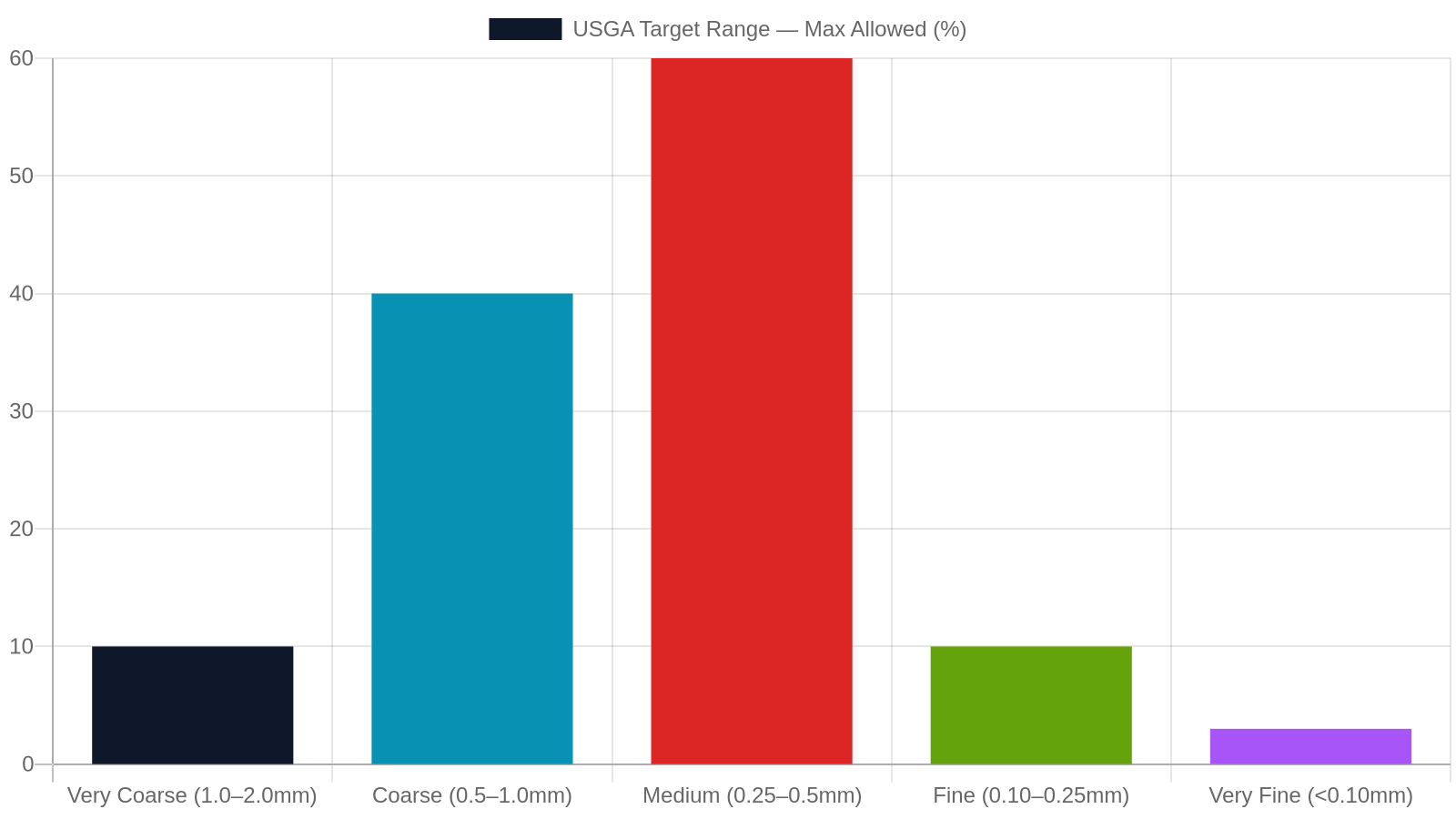
The United States Golf Association (USGA) developed the most widely referenced sand grading system in turf management, and it has been adopted broadly for sports turf as well. Sand is passed through a series of sieves measured in millimeters. The USGA defines particle size categories as follows:
- Very coarse: 1.0–2.0 mm
- Coarse: 0.5–1.0 mm
- Medium: 0.25–0.5 mm
- Fine: 0.10–0.25 mm
- Very fine: 0.05–0.10 mm
For a root zone mix, USGA guidelines recommend that at least 60% of particles fall in the medium-to-coarse range (0.25–1.0 mm), with no more than 10% fines and less than 3% very fine or silt-sized particles.
Why Too Fine or Too Coarse Both Cause Problems
Sand that skews too fine — high in particles below 0.25 mm — compacts readily, reduces pore space, and slows drainage dramatically. On a rainy Friday night in West Tennessee, that means a waterlogged field and a postponed game. Sand that skews too coarse, on the other hand, can create a loose, unstable surface with poor capillary water movement, leaving the root zone dry even when irrigation runs. The sweet spot is a well-graded medium sand with a tight particle size distribution — meaning the bulk of particles cluster in a narrow, consistent range rather than spreading across all fractions.
3. Saturated Hydraulic Conductivity: The Drainage Rate Number
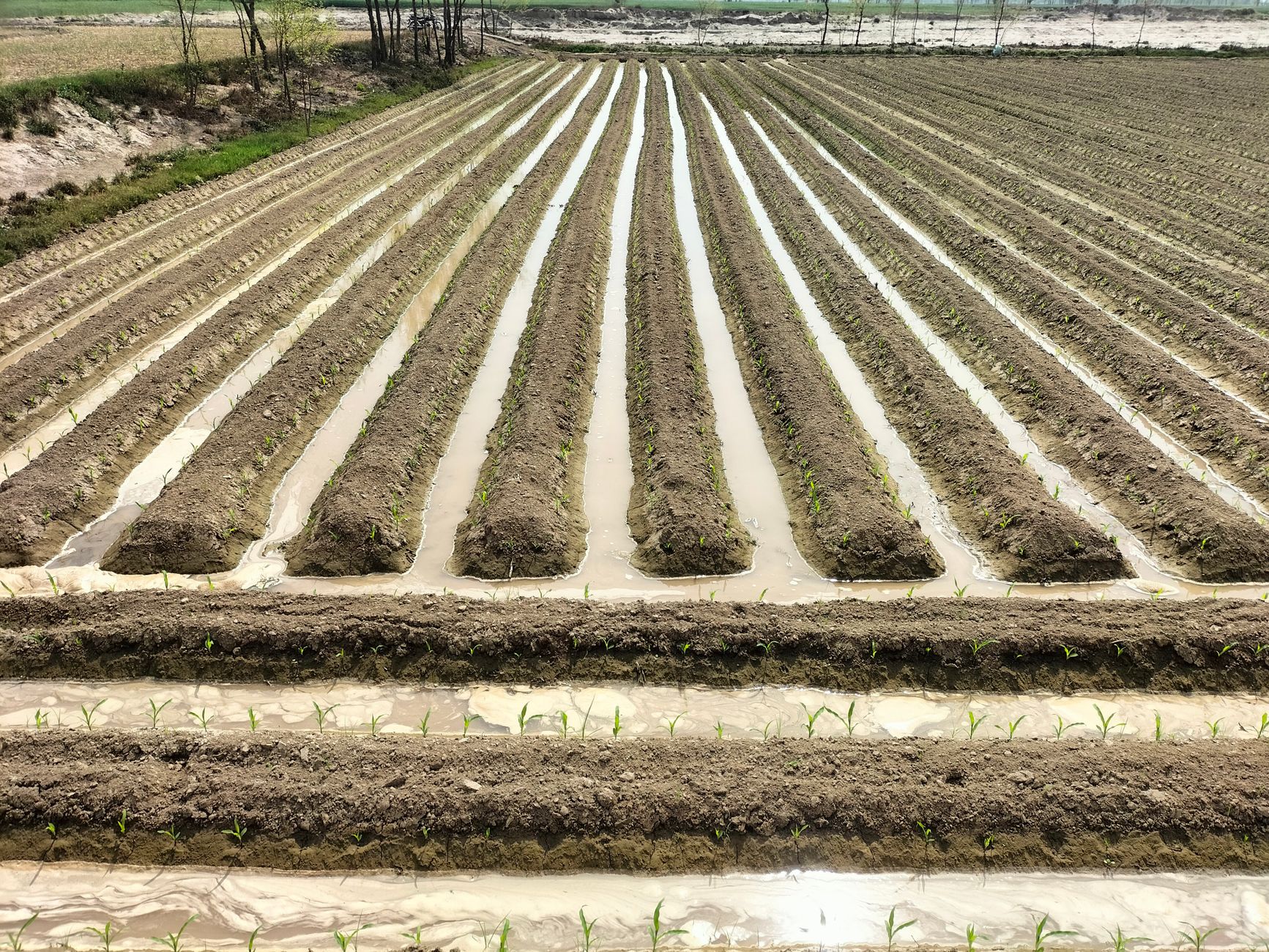
You can have perfect particle size distribution and still end up with a soggy field if the sand’s drainage rate doesn’t match your sub-surface drainage system. Saturated hydraulic conductivity is the lab measurement that bridges particle size and real-world performance — and it’s the number most likely to separate a field that plays on Monday after a Sunday storm from one that doesn’t.
What the Number Means
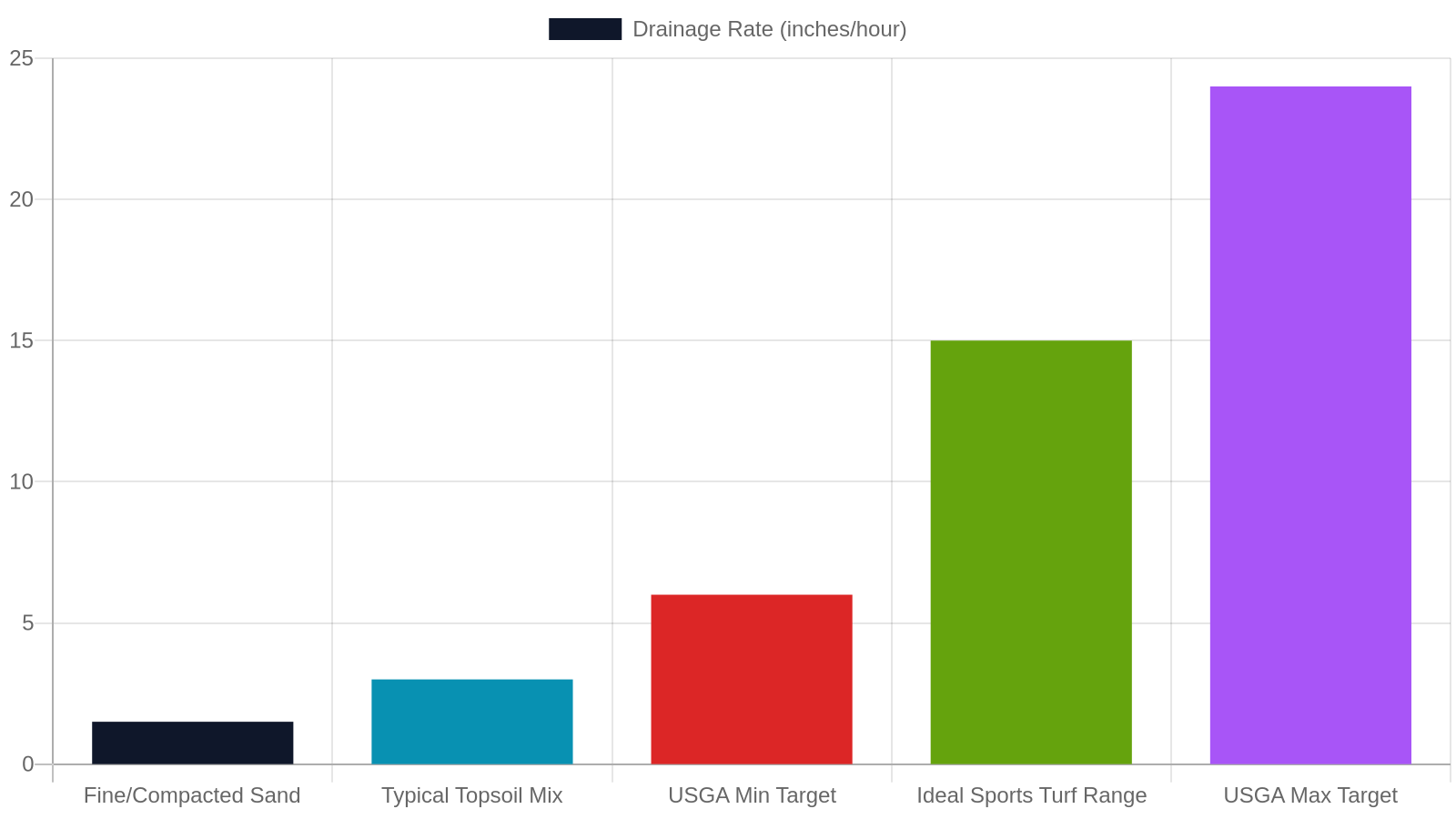
Saturated hydraulic conductivity (Ksat) is the rate at which water moves through a saturated sand profile, expressed in inches per hour (in/hr). The USGA recommends a Ksat of 6–24 inches per hour for putting greens, and many sports turf engineers target a similar range — roughly 10–20 in/hr — for high-use athletic fields. A field draining at 12 in/hr will shed an inch of rainfall in about five minutes under ideal conditions. A field with compacted, fine-heavy sand draining at 1–2 in/hr can stay waterlogged for hours after a moderate rain event.
How Tennessee Weather Makes This Critical
West Tennessee averages roughly 52 inches of rainfall per year, with heavy convective storms common from April through October — exactly when football, soccer, and baseball seasons are in full swing. A field that can’t drain quickly doesn’t just get cancelled games; it suffers turf damage from anaerobic soil conditions, disease pressure, and compaction from foot traffic on saturated ground. Specifying sand with a documented, lab-tested Ksat gives field managers a defensible, data-backed answer when administrators ask why a certain sand was chosen over a cheaper alternative.
4. Organic Matter Content and Why Less Is More
Organic matter is the silent variable that changes over the life of a sports field. At installation, it’s mostly a quality-control issue — you want sand that arrives clean, with low organic content. Over time, it becomes a maintenance metric. Either way, having a lab-documented starting point is essential for managing the long-term health of the root zone.
The Organic Matter Threshold
Organic matter in a sand root zone comes from decomposing thatch, roots, and any soil amendments. A small amount is beneficial — it supports microbial life and holds some nutrients. But USGA guidelines cap organic matter at 3.5% by weight for new root zone construction, and many sports turf agronomists prefer to stay below 2% in the sand itself at the time of installation. Above 3.5%, organic matter begins to fill pore spaces, reducing drainage and increasing compaction potential. It also becomes a substrate for anaerobic bacteria and the production of black layer — a sulfide compound that is toxic to grass roots.
Organic Matter Accumulation Over Time
Even a well-specified sand will accumulate organic matter over years of play. This is why top dressing programs exist — regularly adding thin layers of clean, spec-matched sand dilutes organic matter buildup and maintains the profile’s drainage characteristics. A lab test on your existing field sand every 2–3 years is good practice. If organic matter creeps above 4–5%, it’s time for aggressive core aeration combined with sand backfill, or in severe cases, a partial or full field renovation. Knowing your baseline organic matter percentage — from the original sand spec sheet — makes it much easier to track accumulation over time.
5. Bulk Density, Porosity, and Compaction Resistance
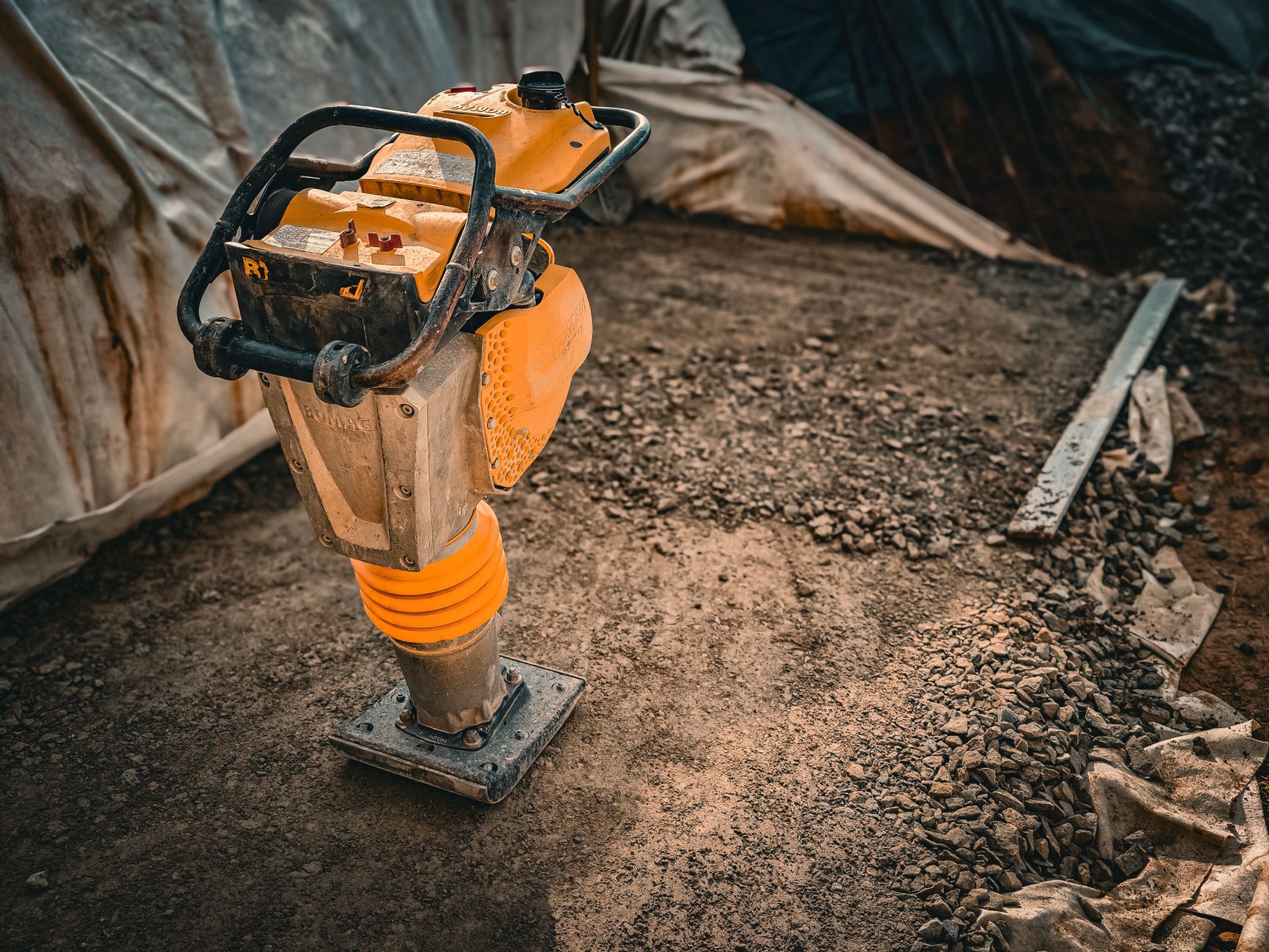
Drainage rate gets most of the attention in sand specs, but bulk density and porosity determine how a field feels underfoot and how long it stays playable under heavy use. A sand that looks good on paper for drainage can still compact into a near-concrete surface if its bulk density is too high or its particle distribution too wide. These numbers belong on every spec sheet you evaluate.
Reading Bulk Density Numbers
Bulk density measures how much a given volume of sand weighs — typically expressed in grams per cubic centimeter (g/cm³). For sports turf root zones, a bulk density of 1.4–1.7 g/cm³ is generally considered acceptable. Sand with a bulk density above 1.8 g/cm³ tends to compact aggressively under repeated traffic, while sand below 1.3 g/cm³ may be too loose for stable footing. Total porosity — the percentage of the soil volume occupied by air and water pores — should ideally fall between 35% and 55%. Within that range, aeration porosity (air-filled pores at field capacity) should be at least 15% to support healthy root respiration.
High-Traffic Zones and Compaction Hot Spots
Not all parts of a field compact equally. Goal mouths, pitcher’s mounds, batter’s boxes, and the center of a football field between the hash marks receive far more concentrated traffic than the sidelines. Sand with a tighter particle size distribution — fewer fines — resists compaction better in these zones. Some field managers use a penetrometer (a simple probe that measures surface firmness in pounds per square inch) to map compaction across the field and identify hot spots that need targeted aeration and sand topdressing. The STMA recommends keeping surface hardness below 200 Gravities (g) on the Clegg Impact Soil Tester scale for most field sports.
6. pH, Salinity, and Chemical Properties

Chemical properties don’t get as much airtime as particle size or drainage rate, but they can quietly undermine a field’s turf quality season after season. A sand that drains perfectly but carries high pH or elevated salinity will fight your fertility program at every turn. These numbers are quick and inexpensive to run in a lab and should be standard on any spec sheet you receive.
The Ideal pH Range for Sports Turf Sand
Most turfgrass species used on athletic fields — bermudagrass, tall fescue, Kentucky bluegrass, perennial ryegrass — perform best in a soil pH between 6.0 and 7.0. Sand itself is relatively chemically inert, but it can carry residual calcium carbonate (limestone) from its geological source, which raises pH. A spec sheet should report the pH of the sand, and anything above 7.5 warrants a closer look. High-pH sand can lock up micronutrients like iron and manganese, leading to chlorosis (yellowing) even when fertilizer is applied. This is especially relevant in West Tennessee, where some local sand sources carry higher carbonate content depending on the deposit.
Soluble Salts and Their Impact
Soluble salt content — measured as electrical conductivity (EC) in millisiemens per centimeter (mS/cm) — should be low in a sports turf sand, ideally below 0.5 mS/cm. High salinity in the root zone draws water out of grass roots through osmosis, causing drought-like stress even when the field is irrigated. Salt problems are more common in recycled or reclaimed sand products than in freshly processed natural sand, but it’s worth confirming on the spec sheet regardless of source. A simple saturated paste extract test in the lab will give you this number.
7. USGA vs. ASTM vs. STMA: Which Standard Applies to Your Field?

When a supplier hands you a spec sheet, the first question to ask is: which testing standard was used? USGA, ASTM, and STMA guidelines overlap significantly but differ in procedure and emphasis. Knowing which standard applies to your project — and confirming your supplier tested to that standard — is the difference between a spec sheet that protects you and one that just looks official.
USGA Standards — Originally for Golf, Now Widely Used
The USGA Method for putting green construction is the most rigorously documented sand specification framework in turf management. It specifies particle size distribution, Ksat, organic matter, bulk density, total porosity, aeration porosity, and capillary porosity — all from a single 1-kg sand sample. While it was designed for golf greens, its testing protocol has become the de facto benchmark for high-performance sports turf as well. Many state high school athletic associations and collegiate programs now require USGA-method lab results for any new field construction or major renovation.
ASTM Standards — The Engineering Perspective
ASTM International publishes a parallel set of standards — particularly ASTM F1632 (particle size analysis of sand) and ASTM F1815 (saturated hydraulic conductivity) — that are often used by civil engineers and contractors working on sports field drainage systems. ASTM methods are slightly different in procedure from USGA methods, which can produce marginally different results on the same sand sample. When reviewing spec sheets, confirm which testing method was used so you’re comparing like to like across suppliers.
STMA Guidance for Athletic Fields
The Sports Turf Managers Association provides field-specific guidance that bridges USGA science with the practical realities of multi-sport, high-traffic athletic facilities. STMA recommends that field managers request lab-certified spec sheets from any sand supplier, verify that the tested sample matches the material being delivered (not just a representative sample from months ago), and keep spec sheets on file for reference during future renovation planning. This documentation also protects field managers when administrators question material choices or when warranty disputes arise with contractors.
Sports Turf Sand Specifications at a Glance
Use this table to quickly compare the key lab-tested parameters for sports turf sand against USGA benchmarks and common out-of-spec scenarios.
8. Top Dressing Sand vs. Root Zone Sand: Different Specs, Different Jobs
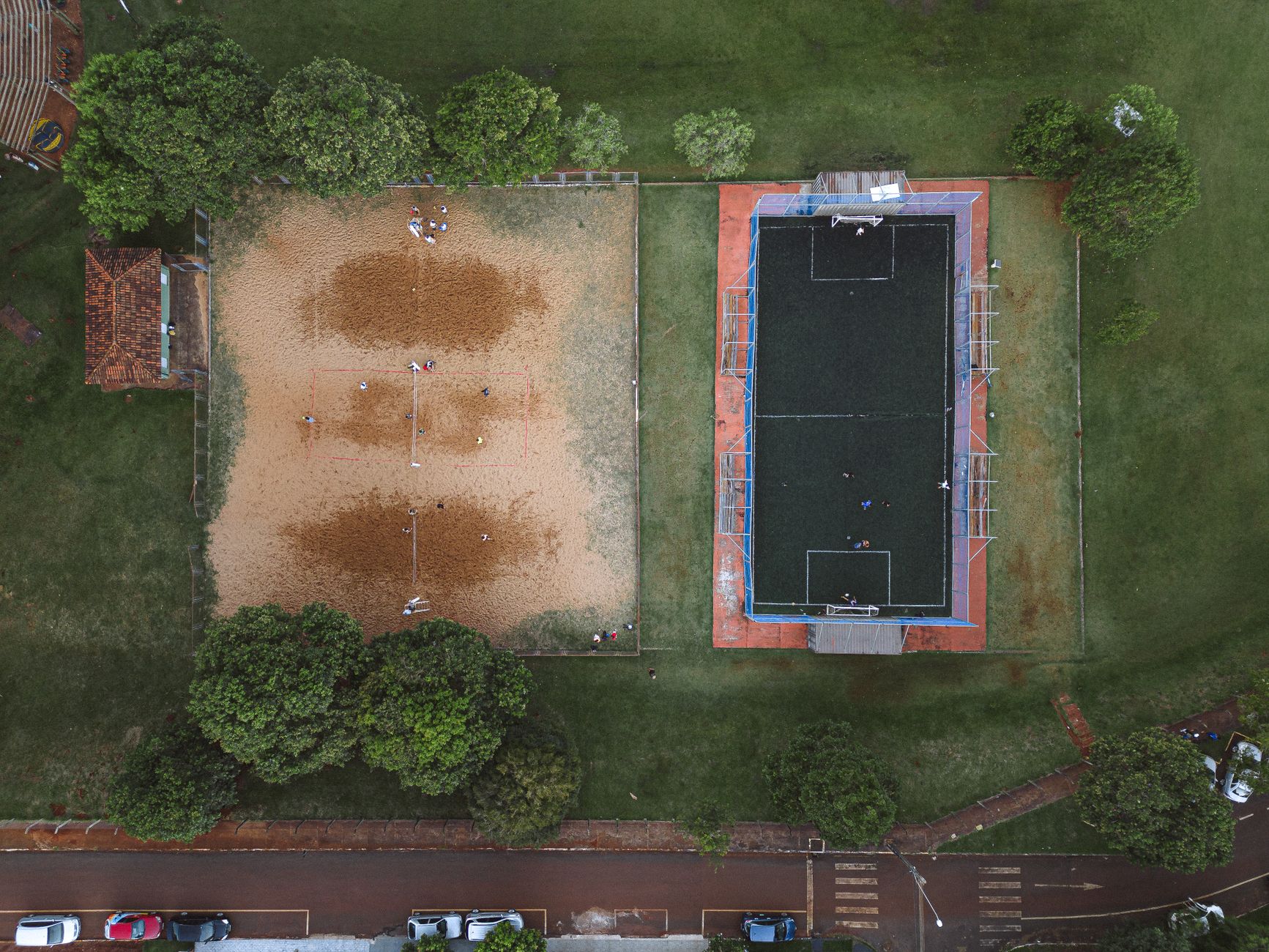
Not all sports turf sand is the same product, even from the same supplier. Root zone sand and top dressing sand serve different functions and are specified differently. Confusing the two — or assuming that any clean sand will work for top dressing — is one of the most common and costly mistakes in athletic field maintenance.
Root Zone Sand — Built for the Long Haul
Root zone sand is the material used to construct or renovate the primary growing medium of an athletic field — typically the top 8–12 inches of the profile. It needs to meet the full suite of lab specifications: particle size, Ksat, bulk density, porosity, organic matter, pH, and salinity. Root zone sand is often blended with a small percentage of organic amendment (peat, compost) at a ratio of roughly 85–90% sand to 10–15% organic by volume, though some modern field designs use 100% sand profiles with nutrient management handled entirely through fertilization and irrigation.
Top Dressing Sand — Precision Matching Required
Top dressing sand is applied in thin layers (typically 1/8 to 1/4 inch) to the surface of an existing field to dilute organic matter, smooth the surface, and maintain drainage. The critical requirement: top dressing sand must closely match the particle size distribution of the existing root zone sand. Adding a finer sand on top of a coarser profile — or vice versa — creates a layering effect that impedes water movement, similar to placing a layer of clay in the middle of a drainage pipe. Always request a spec sheet for top dressing sand and compare it directly to your root zone sand specs before ordering.
9. Drainage Aggregate: What Goes Below the Sand
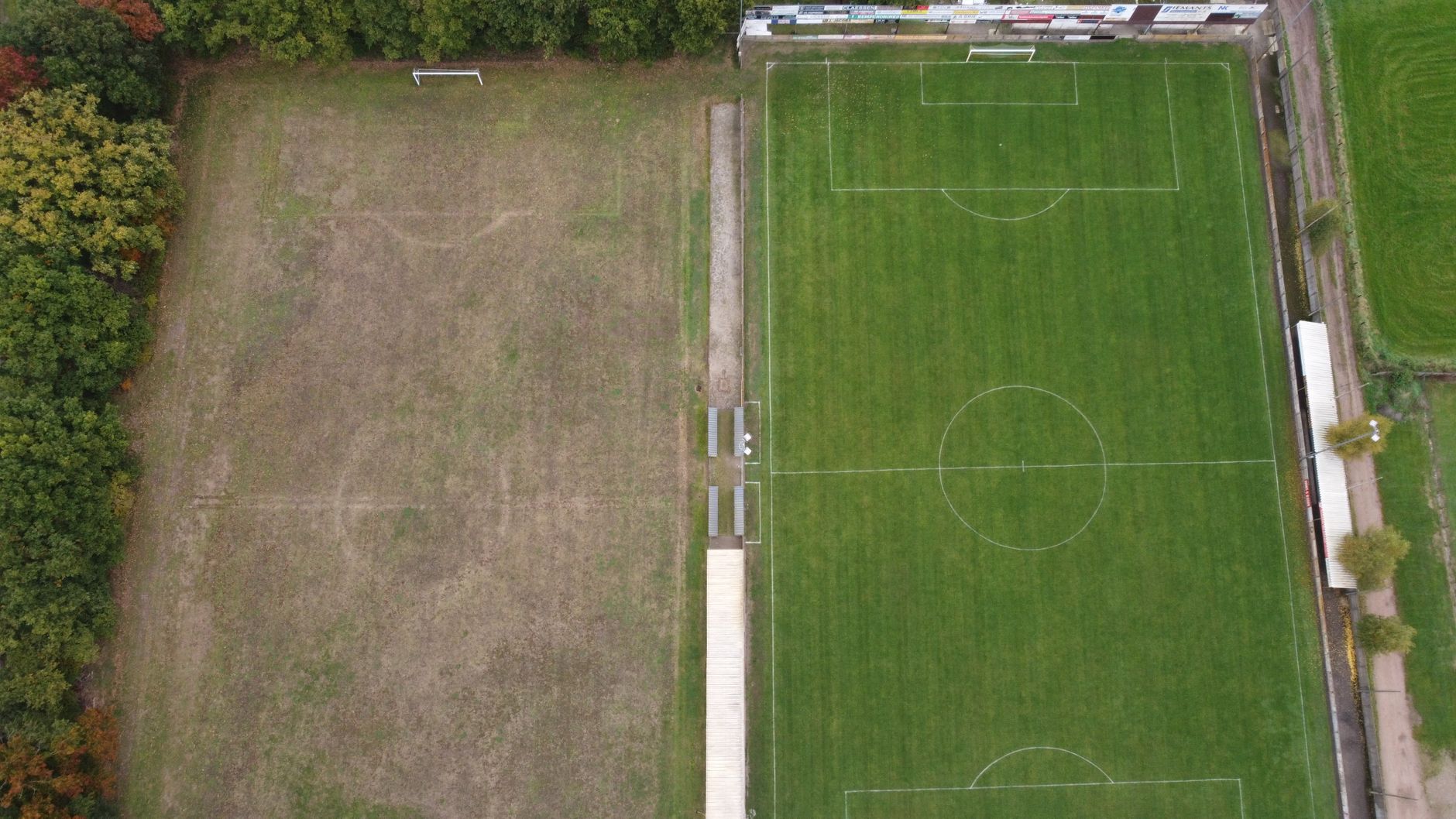
Sand specs don’t exist in isolation — they’re part of a system that includes the gravel drainage layer below and the drain pipe network beneath that. Getting the sand right while ignoring the aggregate spec (or vice versa) is like buying a high-performance engine and putting it in a car with no transmission. The whole system has to be designed and specified together.
The Gravel Blanket Layer
Most USGA-spec and engineered sports field profiles include a 4-inch gravel blanket beneath the sand root zone. This layer serves two purposes: it provides a free-draining reservoir that accepts water from the sand above, and it prevents the sand from migrating down into the drain pipes. The gravel must be sized to create a bridging ratio with the sand above — USGA specifies that the D15 of the gravel (the sieve size at which 15% of particles pass) should be no more than 8 times the D85 of the sand. In plain language: the gravel can’t be so much coarser than the sand that sand particles fall through and clog the drainage layer.
Perforated Pipe and Catch Basin Integration
The gravel blanket feeds water into a network of perforated drain pipes, which carry it to catch basins or daylight outlets at the field perimeter. The spacing of drain lines — typically 15–20 feet apart on center for high-use athletic fields — and the slope of the field (minimum 1% recommended by most turf engineers) determine how quickly the system evacuates surface water. Sand and aggregate specs must be selected in coordination with the drainage system design, not independently. A field with a well-designed pipe network but the wrong gravel gradation will still drain poorly.
10. How to Read a Sand Spec Sheet: A Practical Checklist

Reading a sand spec sheet is a skill, but it doesn’t require a soil science degree. Once you know the six key numbers and the ranges to look for, you can evaluate any supplier’s documentation in under five minutes. The checklist below covers everything a field manager or contractor needs to verify before committing to a material purchase.
You can review Jackson Sand’s published spec sheets to see exactly how these numbers are documented for their sports turf and athletic field sand products — a useful benchmark when comparing suppliers.
The Six Numbers to Check First
When a spec sheet lands in your inbox, here’s the order in which to evaluate it:
- 1. Particle size distribution: Is at least 60% in the medium-to-coarse range (0.25–1.0 mm)? Are fines below 10%?
- 2. Ksat (drainage rate): Is it between 6 and 24 in/hr?
- 3. Organic matter: Is it below 3.5%?
- 4. Bulk density: Is it between 1.4 and 1.7 g/cm³?
- 5. Total porosity: Is it between 35% and 55%?
- 6. pH: Is it between 6.0 and 7.5?
If all six pass, the sand is worth serious consideration. If any fail, ask the supplier whether they can blend or source an alternative that meets spec.
Questions to Ask Your Supplier
A spec sheet is only as good as the sample it represents. Before placing an order, ask:
- When was this sample tested, and from which lot or stockpile?
- Is the material currently in stock, or will it be processed to order?
- Do you mix your own sand on-premises, or are you reselling a third-party product?
- Can you provide a fresh sample from the current stockpile for independent testing?
Jackson Sand mixes its own sand on-premises at 139 United Dr. in Jackson, TN, and delivers in company-owned trucks — which means the material that was tested is the material that arrives on your field, not a substitute sourced from a different pit. That traceability matters when you’re defending a specification to a school board or athletic director.
Ready to Spec Your Field? Start Here
Lab-tested sand specifications aren’t bureaucratic paperwork — they’re the foundation of a field that performs, drains, and stays safe for the athletes who use it. Whether you’re a superintendent, a parks director, a contractor, or a school athletic administrator in Jackson or anywhere across West Tennessee, the process starts the same way: get the spec sheet, check the numbers, and work with a supplier who can back up what’s on paper with what’s in the truck.
Estimate Your Quantities First
Before you call any supplier, know how much material you need. Sand quantities for athletic fields are calculated by area times depth — a 100-yard football field (roughly 57,600 sq ft) filled to 8 inches of root zone depth requires approximately 1,422 cubic yards of sand. Even a top dressing application at 1/4 inch depth across the same field takes about 178 cubic yards. Use the Jackson Sand yardage calculator to get an accurate estimate before you request a quote — it saves time for everyone and helps you budget more accurately from the start.
Serving West Tennessee's Fields
Jackson Sand delivers to athletic fields, school districts, parks and recreation departments, colleges, and contractors throughout West Tennessee and the Mid-South. Delivery is included, and loads arrive in Jackson Sand’s own trucks — the same company that mixed the sand, tested it, and stands behind the spec sheet. Whether you’re building a new field from scratch, renovating a worn-out root zone, or setting up a seasonal top dressing program, the team at Jackson Sand can walk you through the right product for your application.
For more on athletic field sand products and services, visit the Jackson Sand athletic fields page or call 731-668-0440 to talk through your project with someone who knows the material.
Frequently Asked Questions
What sand specs are required for a USGA-spec athletic field?
A USGA-spec field requires sand with at least 60% medium-to-coarse particles (0.25–1.0 mm), less than 3% very fine particles, a saturated hydraulic conductivity of 6–24 inches per hour, organic matter below 3.5%, bulk density of 1.4–1.7 g/cm³, and total porosity of 35–55%. These numbers are verified through laboratory testing of a representative sand sample.
How often should I test the sand on my athletic field?
Most turf agronomists recommend a full lab analysis of your field's root zone every 2–3 years, with particular attention to organic matter accumulation and bulk density. High-traffic fields used year-round may benefit from annual testing. Keep your original spec sheet on file so you can track changes over time.
Can I use the same sand for top dressing that I used to build the root zone?
Yes — in fact, that's the ideal scenario. Top dressing sand should closely match the particle size distribution of the existing root zone sand to avoid creating layering that impedes drainage. Always compare spec sheets side by side before ordering top dressing material, even from the same supplier.
What is the difference between USGA and ASTM sand testing methods?
Both USGA and ASTM methods measure similar properties — particle size, drainage rate, porosity — but use slightly different laboratory procedures that can produce marginally different results on the same sample. USGA methods are most common in golf and high-end sports turf; ASTM methods are more common in civil engineering and contractor specifications. Always confirm which standard your supplier used so you can compare results accurately.
Does Jackson Sand deliver to athletic fields outside of Jackson, TN?
Jackson Sand serves West Tennessee and the surrounding Mid-South region. They deliver in their own trucks, which keeps loads clean and accurate. Contact them at 731-668-0440 to confirm delivery availability for your specific location and project size.
How do I calculate how much sand I need for a sports field renovation?
Multiply the field area (in square feet) by the depth of sand needed (in feet), then divide by 27 to convert to cubic yards. For example, a 57,600 sq ft football field at 8 inches (0.667 ft) of root zone depth needs approximately 1,422 cubic yards. Use the Jackson Sand yardage calculator at jacksonsand.com/yardage-calculator/ for a quick, accurate estimate.