
Proper Slope for Drainage on Sports Turf Fields: Your 9-Point Guide
Quick answer: Most sports turf fields need a minimum slope of 1% (1 inch of drop per 8 feet) and a maximum of 2% in any direction to shed surface water without creating dangerous or uneven playing conditions. Crown-and-slope designs, perimeter swales, and properly graded drainage aggregate work together to move water off the field fast. The right sand particle size — typically USGA-spec medium sand — keeps the rootzone from compacting while still draining freely. In West Tennessee's heavy-rain climate, getting both the grade and the aggregate right is critical to keeping fields playable year-round.
1. Why Slope Is the First Line of Defense Against Waterlogged Fields
Every playable athletic field — whether it’s a high school football field in Jackson, TN, a recreational soccer pitch, or a collegiate baseball diamond — depends on one fundamental engineering principle: water must move off the surface faster than it falls from the sky. Slope is the mechanism that makes that happen. Before you invest in drainage pipe, sand topdressing, or aeration, the grade of your field has to be right. Get slope wrong and every other improvement you make will underperform.
What Happens When a Field Drains Too Slowly
Standing water on an athletic field is more than an inconvenience. It compacts the rootzone, suffocates turf grass, creates muddy bare spots, and — most importantly — puts athletes at risk of slipping and twisting ankles. A field that holds water for more than 30 minutes after a one-inch rain is almost always a slope or aggregate problem, not just a grass problem.
- Turf damage: Saturated soil for 24+ hours can kill cool-season grasses within days.
- Field closures: Schools and parks departments lose practice time and game revenue every time a field is unplayable.
- Long-term compaction: Heavy foot traffic on wet ground compresses soil pores, making future drainage even worse.
The Role of Surface Slope vs. Subsurface Drainage
Surface slope handles the first and fastest job: moving rain off the playing surface before it has a chance to pond. Subsurface drainage — perforated pipe, drainage aggregate, and engineered rootzones — handles the second job: pulling water down through the soil profile. Both systems must be designed together. A perfectly sloped field with no subsurface outlet will still pond water once the surface is saturated. Conversely, the best subsurface system in the world can’t compensate for a flat or reverse-graded surface that funnels water toward the middle of the field.
2. The Industry-Standard Slope Ranges for Athletic Fields
Slope is measured as a percentage: the vertical drop divided by the horizontal distance, multiplied by 100. A 1% slope drops 1 foot over 100 feet of run. That sounds almost imperceptible — and on a well-maintained field, it is. But it’s enough to move water at roughly 0.3 inches per minute under normal conditions, which is faster than most rain events in West Tennessee deliver precipitation.
Minimum Slope: 1% (the Floor You Can't Go Below)
The Sports Turf Managers Association (STMA) and most state high school athletic associations recommend a minimum surface slope of 1% — that’s a 1-inch drop for every 8.3 feet of horizontal run, or roughly 1 foot of drop per 100 feet. Below 1%, water moves too slowly to clear the surface before the next rain event arrives. In practice, many older fields were built at 0.5% or less, which is why they stay wet for days after a moderate storm.
Maximum Slope: 2% (the Ceiling You Can't Exceed)
The upper limit for most sports surfaces is 2% in any single direction. Beyond 2%, players notice the tilt. Running backs cut uphill, soccer balls roll toward the low side, and infield hops become unpredictable. Some governing bodies allow up to 2.5% on natural turf sideline areas where play is less concentrated, but the primary playing surface should stay at or below 2%. For synthetic turf, many manufacturers specify a tighter range of 0.5%–1% because the impermeable surface relies almost entirely on slope — not infiltration — to shed water.
Sport-Specific Slope Recommendations
Different sports have slightly different tolerances based on ball behavior and player movement patterns:
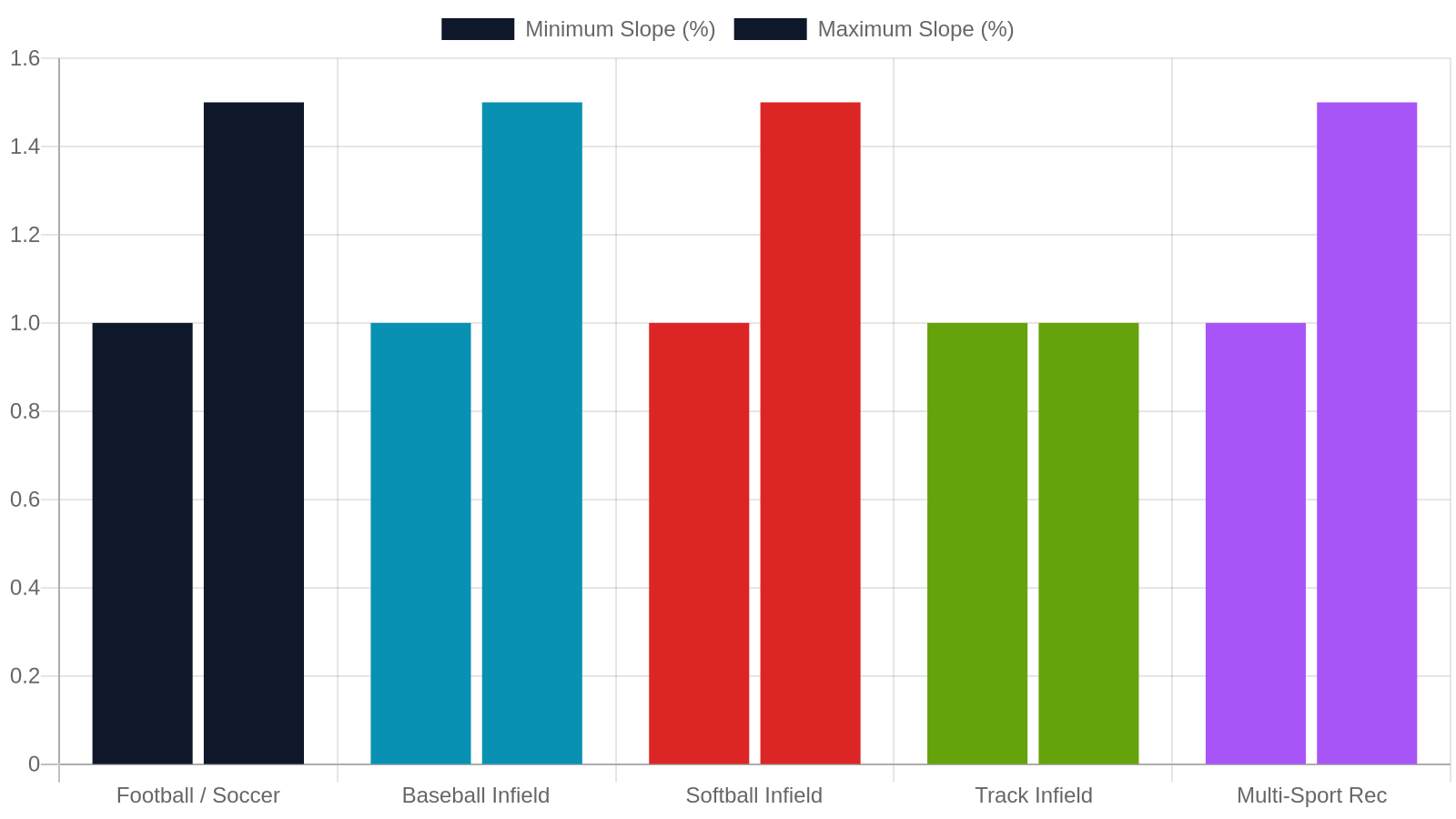
- Football / soccer: 1%–1.5% crown (high center, sloping to both sidelines) is the most common design.
- Baseball / softball infields: 1%–1.5% slope from the pitcher’s mound area toward the outfield grass line; infield skin areas often graded at 1% toward drainage outlets.
- Track and field infields: 1% uniform slope toward interior drainage is typical.
- Multi-sport recreational fields: 1.5% end-to-end or crown design, whichever fits the site geometry.
3. Crown vs. Uniform Slope: Choosing the Right Grade Design
Once you know your target slope percentage, you need to decide which direction the field will drain. There are three primary grade designs used on athletic fields, each with specific advantages depending on field size, sport, and the location of your drainage outlets.
The Crown Design: High Center, Low Edges
A crowned field is highest at the centerline and slopes symmetrically toward both sidelines. This is the most common design for football and soccer fields because it sheds water in two directions simultaneously, cutting the effective drainage distance in half. On a 160-foot-wide football field graded at 1.5%, the center is 1.2 feet higher than each sideline. Players rarely notice this grade during competition, but it moves water off the surface in 10–15 minutes after a typical rain.
The downside: crowns require more precise grading work and more material to build up the center. They also complicate subsurface drainage layout because pipe must be placed along both sidelines rather than one end.
Uniform (End-to-End) Slope: Simpler to Build, Easier to Drain
A uniform slope grades the entire field from one end to the other at a consistent percentage. This is simpler to construct and works well on rectangular fields where a perimeter swale or drainage structure sits at the low end. Baseball and softball fields often use this approach because the geometry of the diamond makes a crown design impractical. The trade-off is that water must travel the full length of the field — up to 360 feet on a football field — before it reaches an outlet, which can slow surface drainage on very large fields.
Compound Slope: The Best of Both Worlds
A compound slope combines a gentle crown (0.5%–1%) with a slight end-to-end pitch (0.5%–1%), so water moves diagonally toward one corner of the field. This is increasingly popular on multi-sport complexes where a single drainage outlet or basin serves multiple fields. It requires careful laser-grading to execute but produces excellent results in high-rainfall regions. If your West Tennessee field sits adjacent to a detention basin or a natural low point, a compound slope design may be the most cost-effective solution.
4. How Sand Particle Size Affects Drainage Rate
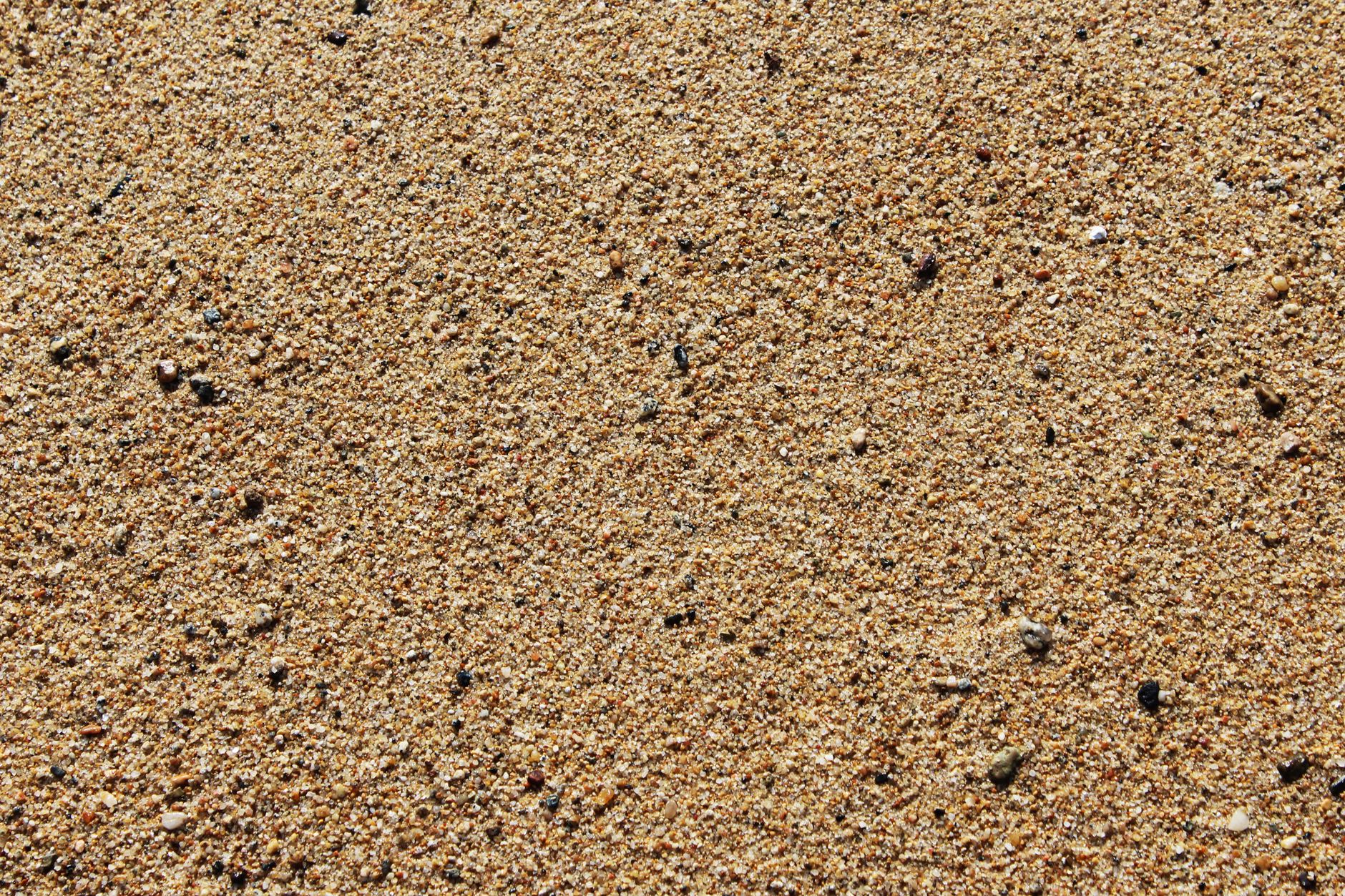
Slope moves water across the surface. Sand moves water through the soil profile. The two systems work in parallel, and the effectiveness of your subsurface drainage depends almost entirely on the particle size distribution of the sand in your rootzone. Use the wrong sand and you can have a perfectly graded field that still stays soggy for 48 hours after a rain.
Why Medium Sand Is the Sweet Spot for Athletic Fields
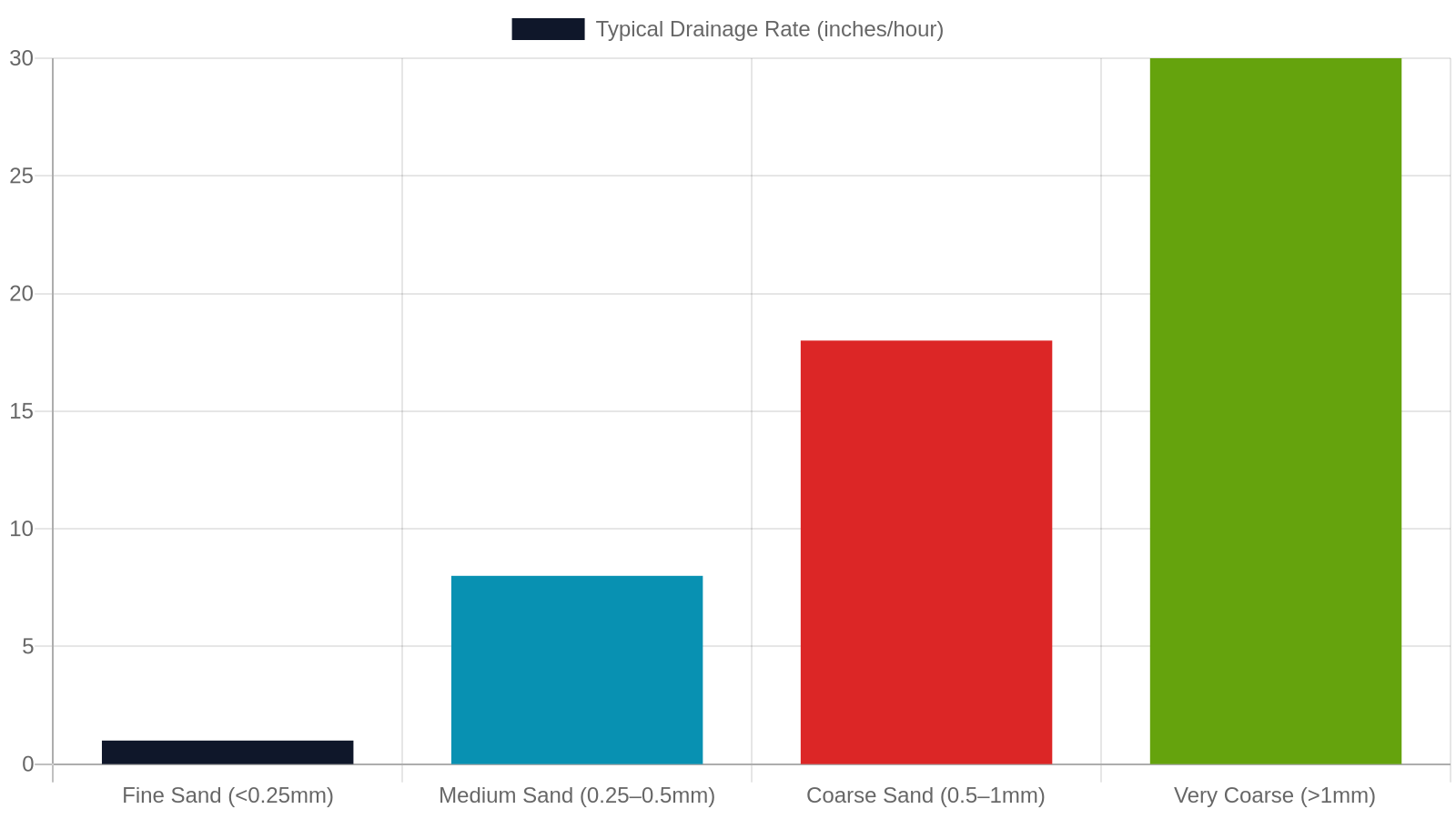
Not all sand drains at the same rate. Fine sand (particles smaller than 0.25 mm) packs tightly and can actually impede drainage. Coarse sand (particles larger than 1 mm) drains fast but provides poor footing and little nutrient-holding capacity. Medium sand — particles between 0.25 mm and 0.5 mm — is the industry standard for athletic field rootzones because it balances drainage speed, compaction resistance, and turf-root anchorage.
The USGA’s rootzone specification for golf greens (which many sports turf managers borrow) calls for 60%–70% medium sand by weight, with drainage rates of 6–12 inches per hour. Athletic fields typically target 4–8 inches per hour, which is achievable with a well-graded medium sand mix.
Lab Testing: Don't Guess at Particle Size
Sand particle size isn’t something you can eyeball reliably. A sieve analysis — run by a certified soils lab — measures the percentage of particles in each size fraction and calculates the overall drainage rate of the mix. At Jackson Sand, published lab-tested sand spec sheets are available so field managers can verify particle size distribution before ordering. This matters because a sand that looks similar to a USGA-spec product may have a much higher fines content that clogs pore spaces over time.
5. Perimeter Swales and Drainage Outlets: Where the Water Goes
Slope and sand get water moving. Swales and drainage outlets give it somewhere to go. Without a properly designed outlet system, surface water will simply pool at the low edge of the field — which is often worse than if the field had no slope at all, because now you’ve concentrated the problem in one spot.
Designing Perimeter Swales That Actually Work
A swale is a shallow, gently sloped channel that runs along the edge of the field and collects surface runoff. For a swale to work, it needs three things: a cross-sectional area large enough to handle peak flow, a longitudinal slope of at least 0.5% toward the outlet, and a stable surface (sod, rip-rap, or concrete) that won’t erode under concentrated flow. On a 100-yard football field receiving 1 inch of rain, the surface runoff volume can exceed 5,000 gallons — a swale that’s too shallow will overflow and undercut the field edge.
Drainage Basins and Catch Basins
Swales must terminate somewhere. Drainage basins — also called catch basins or drop inlets — collect water from swales and perimeter channels and route it into underground pipe or a detention area. Properly sized basins prevent backwater that would otherwise push water back onto the field surface. For most school and park athletic complexes, a basin at each corner of the field (or at the low end of a uniformly sloped field) is the minimum. Larger complexes with multiple fields may need a centralized detention basin. Jackson Sand supplies drainage aggregate and basin materials sized for these applications — see our drainage basins page for available materials.
Outlet Pipe Sizing and Slope
The outlet pipe that carries water away from the basin must be sized for the contributing drainage area. A rough rule of thumb: a 6-inch pipe handles approximately 0.5 acres of contributing area under a 2-inch-per-hour rain intensity; a 12-inch pipe handles roughly 2 acres. Pipe slope should be a minimum of 0.5% to maintain self-cleaning velocity (approximately 2 feet per second). Flatter pipe slopes allow sediment to accumulate and eventually block the outlet, causing the entire drainage system to back up.
6. Subsurface Drainage Systems: Pipe, Aggregate, and Rootzone Layers
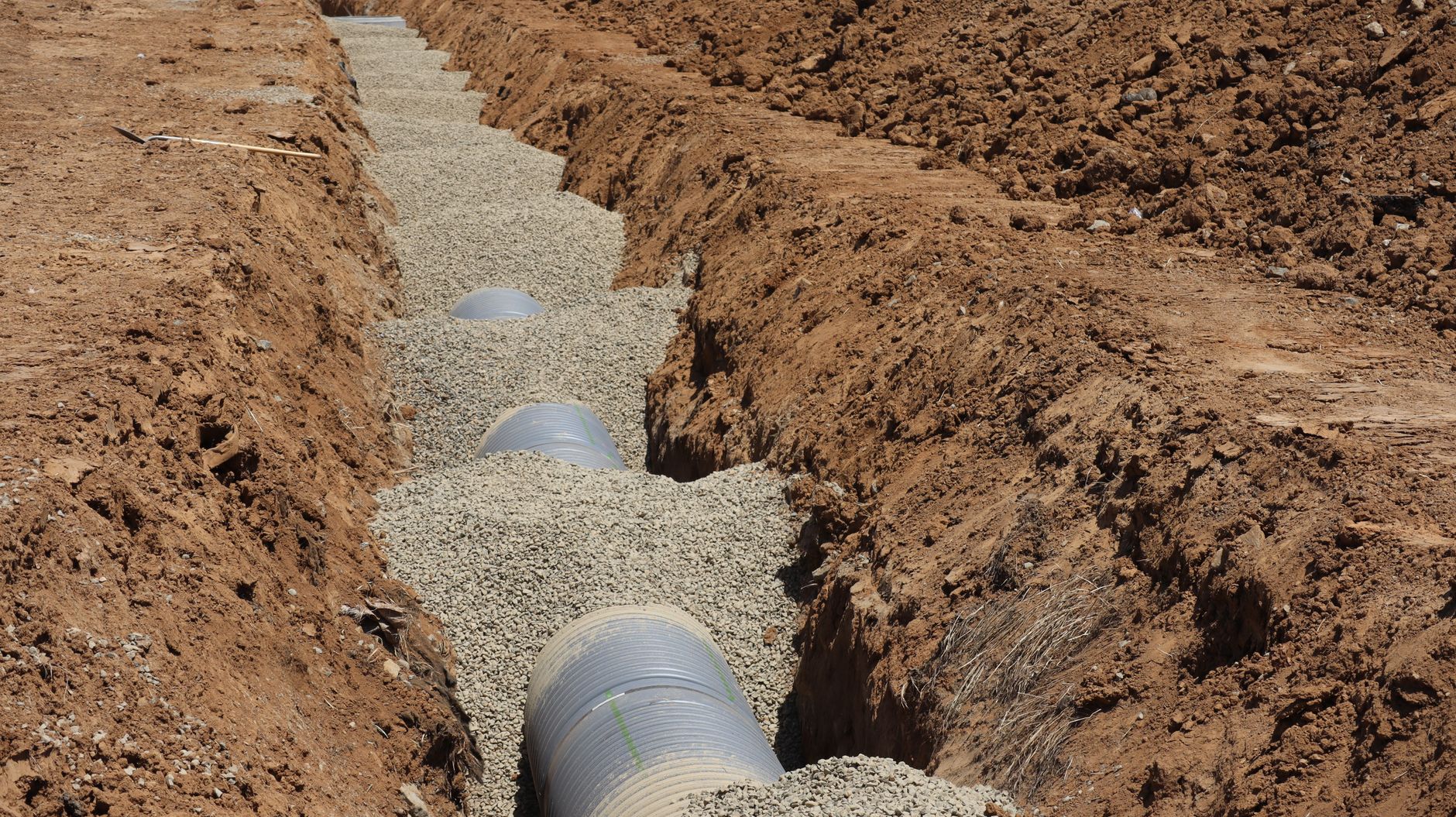
Surface slope handles the water that falls on top of the field. Subsurface drainage handles the water that infiltrates into the soil profile. On a well-designed field, both systems work simultaneously — surface water sheds to the perimeter while infiltrated water moves down through the rootzone and into perforated collection pipe. Understanding the layers of a subsurface system helps field managers specify the right materials and troubleshoot problems when they arise.
The Classic Pipe-and-Gravel System
The most common subsurface drainage system for natural-turf athletic fields uses perforated corrugated pipe laid in trenches filled with clean drainage gravel (typically a 3/8-inch or 1/2-inch washed stone). Pipe is placed at 10–20 foot centers for high-use fields and 20–30 foot centers for lower-use recreational fields. The gravel surrounding the pipe acts as a filter medium, preventing fine soil particles from migrating into and clogging the pipe. Pipe depth is typically 18–24 inches below the finished surface — deep enough to capture water percolating through the rootzone, shallow enough to be cost-effective to install.
The Sand-Cap Rootzone: Building Drainage from the Top Down
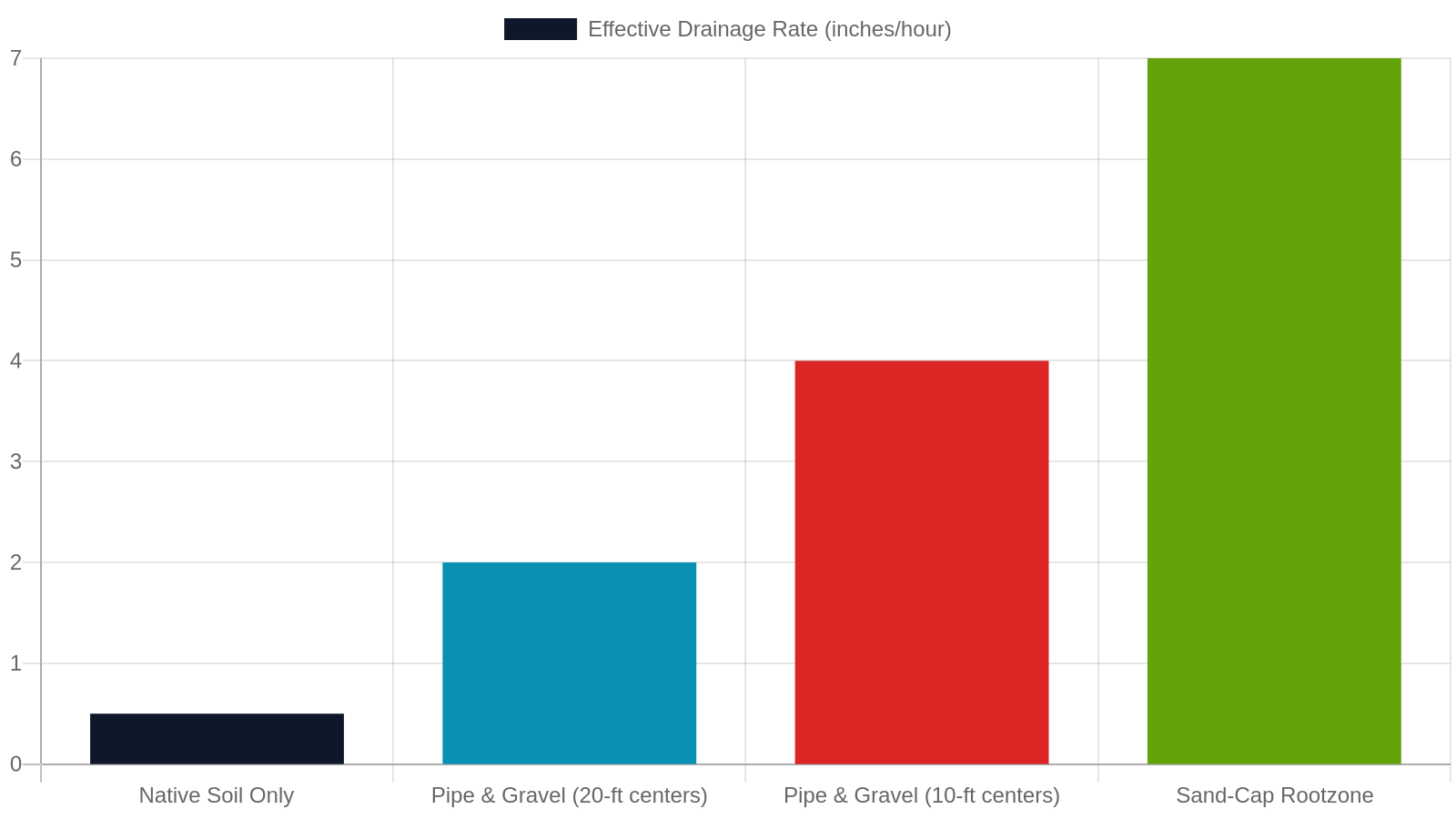
On heavily used fields — high school stadiums, collegiate facilities, or fields that host 300+ events per year — a sand-cap rootzone provides superior drainage performance. A 4–6 inch layer of USGA-spec sand is placed over native soil (or a choker layer of intermediate-size aggregate), creating a highly permeable layer that rapidly moves water down to the pipe system below. Sand-cap fields can drain at 4–8 inches per hour, meaning a 1-inch rain event clears the rootzone in 8–15 minutes. The trade-off is cost: sand-cap construction typically runs $150,000–$400,000 for a full football field, depending on site conditions.
Seepage Drainage for Wet Spots and Low Areas
Some fields have isolated wet spots caused by subsurface water migration rather than surface runoff. These areas stay soggy even when the rest of the field is dry. Seepage drainage — a targeted trench system filled with coarse aggregate and perforated pipe — intercepts this lateral groundwater before it reaches the rootzone. It’s a cost-effective fix for problem areas without rebuilding the entire field. Jackson Sand supplies aggregate for seepage drainage applications; see our seepage drainage materials page for specs.
Athletic Field Drainage Systems: Side-by-Side Comparison
Choosing the right drainage approach depends on your budget, field use intensity, and site conditions. This table compares the most common systems used on natural-turf athletic fields.
7. Aeration: Keeping the Drainage System Open Over Time
Drainage is not a one-time construction problem — it’s an ongoing maintenance challenge. The best-designed field in West Tennessee will develop drainage issues if the rootzone isn’t regularly maintained. Aeration is the primary tool for keeping the pore spaces in your sand rootzone open and functional year after year.
How Compaction Kills Drainage
Even a perfectly built field will lose drainage capacity over time. Foot traffic — especially on wet soil — compresses the pore spaces between sand particles, reducing the infiltration rate from 6 inches per hour down to 1 inch per hour or less within a few seasons. This process is called compaction, and it’s the number-one reason well-built fields start draining poorly after 3–5 years of heavy use. The fix is regular aeration: mechanically removing small cores of soil to reopen pore space and allow water to move freely again.
Core Aeration Schedules for High-Use Fields
Most sports turf managers aerate high-use natural-turf fields 2–4 times per year, typically in spring and fall when turf is actively growing and can recover quickly. Core aerators pull 0.5–0.75 inch diameter plugs at 2–4 inch spacing, removing approximately 15–20% of the surface area per pass. Following aeration with a topdressing of medium sand fills the channels with permeable material, preventing them from simply collapsing back closed. This sand-fill aeration cycle is the single most cost-effective maintenance practice for preserving long-term drainage performance on natural-turf athletic fields.
8. Common Slope and Drainage Mistakes (and How to Avoid Them)
Most drainage failures on athletic fields aren’t caused by unusual weather or bad luck — they’re caused by a handful of predictable design and construction mistakes. Knowing what to watch for can save a school district or parks department tens of thousands of dollars in remediation costs.
Mistake 1: Relying on Topsoil Instead of Sand
Native topsoil in West Tennessee is typically a clay-loam mix with a natural drainage rate of 0.1–0.5 inches per hour — far too slow for an athletic field. Fields built on native soil without a sand amendment will pond water after virtually every rain event. Yet many older school and park fields were built exactly this way, simply because sand was viewed as an unnecessary expense. The long-term cost of field closures, turf replacement, and compaction remediation almost always exceeds the upfront cost of proper sand construction.
Mistake 2: Building a Flat Field 'Because It Looks Level'
A field that looks perfectly flat to the naked eye may actually have a slope of 0.2%–0.5% — not enough to drain effectively. Worse, it may have a slight reverse grade in one area that creates a low spot where water ponds. Laser-guided grading equipment is essential for achieving consistent 1%–2% slopes across a large field. Eyeballing grade with a string line is not accurate enough for athletic field construction. Always verify finished grades with a laser level or GPS-based grade control system before laying sod or seeding.
Mistake 3: Skipping the Perimeter Outlet
We see this frequently: a field is graded correctly, but the water it sheds has nowhere to go. It pools along the sideline, soaks back into the field edge, and creates a perpetually muddy strip that’s worse than the original problem. Every sloped field needs a defined outlet — a swale, a catch basin, a curb cut, or a connection to a storm drain — that carries water completely away from the playing surface. Design the outlet before you grade the field, not after.
9. Specifying and Ordering the Right Drainage Materials
Even the best drainage design fails if the wrong materials are specified or if quantities are miscalculated. This section covers the practical steps for specifying and ordering sand and drainage aggregate for athletic field projects — whether you’re a turf manager at a West Tennessee school district or a contractor bidding a new sports complex.
What to Ask Your Supplier Before You Order
Before ordering sand or drainage aggregate for an athletic field project, get answers to these questions from your supplier:
- What is the particle size distribution? Ask for a sieve analysis showing the percentage of material in each size fraction.
- What is the measured drainage rate? A permeability test (ASTM D2434 or equivalent) gives you a real-world drainage rate in inches per hour.
- Is the material washed? Unwashed sand and gravel contain fines that clog pore spaces. Always specify washed material for drainage applications.
- How is it delivered? Loose material delivered in dedicated trucks stays cleaner and more accurately measured than material hauled in mixed-use equipment.
Estimating How Much Material You Need
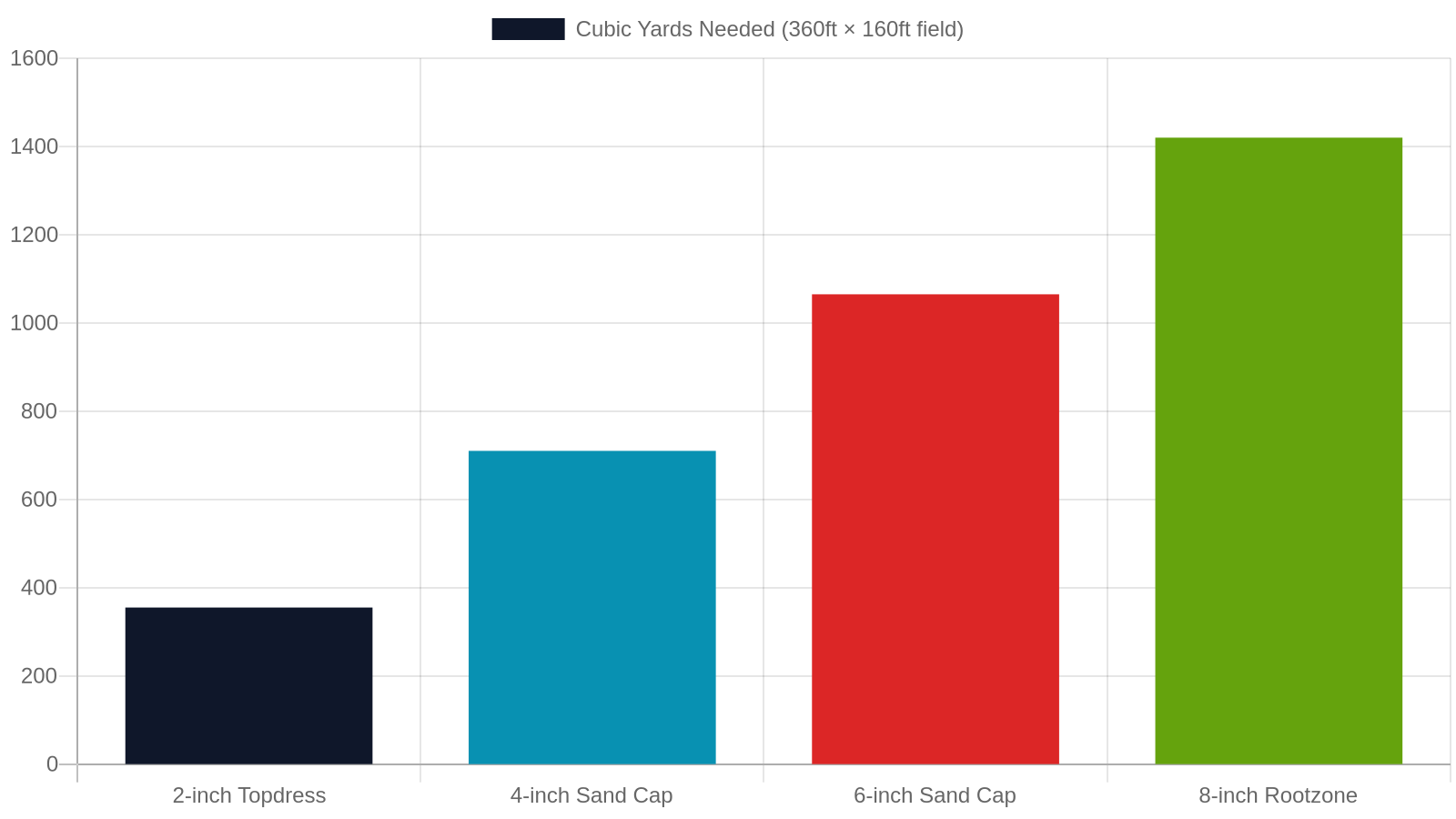
Quantity estimation is straightforward once you know the area and depth of your application. For a 4-inch sand cap on a standard 360-foot × 160-foot football field, you need approximately 710 cubic yards of sand. For a 2-inch topdressing on the same field, you need about 355 cubic yards. Use the Jackson Sand yardage calculator to get an accurate estimate for your specific dimensions and application depth — it takes less than a minute and eliminates the guesswork that leads to costly over- or under-ordering.
Frequently Asked Questions
What is the minimum slope required for a sports field to drain properly?
The minimum recommended surface slope for most athletic fields is 1% — that's a 1-inch drop for every 8.3 feet of horizontal run, or 1 foot per 100 feet. Below 1%, water moves too slowly to clear the surface before the next rain arrives, leading to ponding and compaction.
Can a sports field slope be too steep?
Yes. The maximum recommended slope for most primary playing surfaces is 2%. Beyond that, players notice the tilt, ball behavior becomes unpredictable, and the field may not meet governing body standards. Sideline and non-play areas can sometimes be graded up to 2.5%.
What type of sand is best for athletic field drainage?
Medium sand with particles between 0.25 mm and 0.5 mm is the industry standard for athletic field rootzones. It balances drainage speed (4–8 inches per hour), compaction resistance, and turf-root anchorage. Always request a sieve analysis and drainage rate test before ordering.
How often should an athletic field be aerated to maintain drainage?
High-use natural-turf fields should be core-aerated 2–4 times per year, typically in spring and fall. Following aeration with a medium-sand topdressing fills the channels with permeable material and preserves long-term drainage performance.
What is a drainage basin and does my athletic field need one?
A drainage basin (or catch basin) is an underground structure that collects surface runoff from swales and perimeter channels and routes it into outlet pipe. Most athletic fields need at least one basin at the low end of the field or at each corner to prevent water from backing up onto the playing surface.
How much sand do I need for a 4-inch sand cap on a football field?
A standard 360-foot by 160-foot football field with a 4-inch sand cap requires approximately 710 cubic yards of sand. Use a yardage calculator to get an accurate estimate for your specific field dimensions and application depth.
Next step: Talk to Jackson Sand — we’re here to help with your project.